

Puerto Vallarta Cruise Calls Canceled After Mexico Unrest
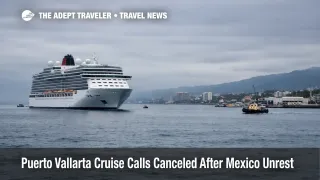
Cruise itinerary changes are now showing up in Mexico, not just flight schedules and road access alerts. After Mexican authorities confirmed cartel leader Nemesio "El Mencho" Oseguera Cervantes was killed during a February 22, 2026, military operation, retaliatory violence and roadblocks spread across multiple states, and cruise lines began skipping Puerto Vallarta port calls this week.
The practical shift for travelers is that this is no longer only a "should I go ashore" question. It is an itinerary integrity problem, dropped ports, swapped calls, extended stays at alternates, and short-notice shore excursion cancellations that can cascade into flight timing risk for anyone planning tight post-cruise connections.
Puerto Vallarta Cruise Reroutes, What Changed For Sailings
So far, the confirmed cruise response is concentrated on Puerto Vallarta. Holland America Line's Zuiderdam and Princess Cruises' Royal Princess skipped Puerto Vallarta on February 23, 2026, and Norwegian Cruise Line's Norwegian Bliss dropped its planned Puerto Vallarta call later in the week.
At least one ship's substitution plan has been publicly described: Royal Princess extended time in Cabo San Lucas and shifted to call Mazatlán instead of Puerto Vallarta. Industry reporting also indicates the main "toolbox" for replacements on Mexican Riviera loops is limited, operators may extend Cabo San Lucas, add La Paz or Ensenada, or substitute an extra sea day depending on berth availability.
Which Cruise Travelers Are Most Exposed Right Now
Travelers on Mexican Riviera itineraries that include Puerto Vallarta in the next 7 to 14 days are the highest-exposure group, because the port call is already being actively canceled or swapped, not merely "under monitoring." If Puerto Vallarta is your marquee day, assume it is at risk until your line confirms otherwise.
A second exposure bucket is anyone who built a stacked itinerary around that port day, private tours, long-distance excursions, or nonrefundable third-party bookings. When a port is dropped, cruise-line shore excursions and onboard packages typically have clearer remediation than third-party tours, which often require the traveler to initiate the refund or reschedule, and may apply stricter terms. The financial pain point tends to be less the missed port, and more the mismatch between what the ship refunds automatically and what outside vendors will not.
Finally, it is worth separating Pacific Mexico from Caribbean Mexico. Reporting as of February 23, 2026, indicates Cozumel and Costa Maya calls have not seen the same wave of cancellations, and cruise traffic there remains much heavier than Puerto Vallarta, which matters because it suggests cruise lines are not treating this as an automatic nationwide Mexico shutdown.
What Cruise Travelers Should Do Now
Start by treating your next decision as time-windowed. If you sail within 72 hours, the only actionable question is what your cruise line has pushed to your booking, app, or cabin notice, because that is where the substituted port and arrival times will appear first. If you sail in the next 7 to 14 days, look at your itinerary and identify whether Puerto Vallarta is the only "must-do" port for your party, if it is, you should consider repricing alternatives now while inventory is still liquid.
Use a simple flight threshold to avoid self-inflicted losses. Do not book same-day flights home with minimal buffer on the assumption the ship returns exactly on schedule, because an extended stay at an alternate port or a late-arriving sea day can tighten disembark timing even when the cruise ends at the same homeport. If you already have tight flights, set a rebook trigger tied to a confirmed itinerary change, not to social media chatter.
For shore excursions, separate "cruise line sold" from "third party sold" immediately. If the excursion was booked through the cruise line, watch for automatic cancellation and refund communication once the port change is posted. If it was booked independently, contact the vendor now and ask what happens if the ship substitutes Cabo San Lucas, Mazatlán, La Paz, Ensenada, or a sea day, because those are the realistic alternates being used or discussed, and they change the feasibility of any reschedule.
Why This Is Happening And How The Disruption Spreads
The core mechanism is not that cruise ships are "under attack" at sea. It is that port calls rely on predictable ground conditions, secure transport corridors, and an excursion ecosystem that can move thousands of people quickly. When authorities report widespread roadblocks and violence after a high-profile cartel leader's death, the risk is that the shore layer becomes unreliable even if the port itself remains physically accessible.
Cruise lines then make a conservative operational tradeoff. Dropping a port protects guests and crew from being routed into a volatile ground environment, and it avoids a secondary failure mode where tours and transport collapse mid-day, trapping passengers away from the pier. The second-order effect is what you are seeing now: substituted ports concentrate demand, berth availability becomes the constraint, and travelers can end up in compensation and refund disputes, especially when multiple vendors are involved.
On the Mexico-wide picture, the best current signal is that the cruise industry is describing this as a Puerto Vallarta-centered disruption rather than a blanket Mexico cruise halt. The Florida-Caribbean Cruise Association said more than 95% of Mexico cruise tourism is operating normally, and noted Puerto Vallarta represents a smaller share of overall Mexico cruise capacity, which aligns with the pattern of cancellations clustering on that port in the first wave.
Sources
- Key events in Mexican operation to capture cartel leader 'El Mencho'
- Surveillance of romantic partner led to El Mencho's deadly capture, Mexican authorities say
- Mexico unrest triggers few cruise changes but lines remain on alert
- Cruise Lines Route Ships Away from Puerto Vallarta
- Violence Strikes Puerto Vallarta; Cruises Canceled
- Will Unrest in Mexico Affect Cozumel Sailings?
- Puerto Vallarta Airport Roadblocks Disrupt Hotel Transfers