

Puerto Vallarta Cruise Calls Skipped, Reroutes Spread
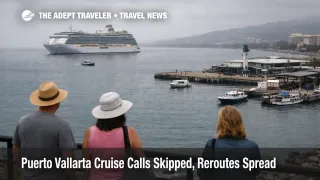
Puerto Vallarta cruise calls are being skipped on select Mexican Riviera itineraries this week, with multiple operators bypassing the port and substituting extended time in Cabo San Lucas, Mexico, Mazatlán, Mexico, or an extra sea day. The immediate traveler impact is not abstract, it is lost port time, canceled shore excursions, and day of changes that can break carefully timed plans built around Puerto Vallarta shopping, beach clubs, and private tours. If you are sailing in the late February 2026 window, treat Puerto Vallarta as a conditional stop, and recheck your line's app and daily program for any port order changes, tender timing shifts in Cabo, and updated all aboard times.
The new development versus earlier disruption coverage is that additional named ships and day specific skips have been reported after the initial phase, which matters because it moves the story from a one off deviation into a short rolling risk window. Reuters and trade reporting described operators monitoring security conditions and adjusting routes, with Princess Cruises' Royal Princess and Holland America Line's Zuiderdam among the ships reported to have bypassed Puerto Vallarta. Coverage also indicates Norwegian Bliss removed a planned call later in the same week pattern, reinforcing that the risk is not evenly distributed across Mexico, it is concentrated around the Puerto Vallarta call decision point.
Puerto Vallarta Cruise Calls Skipped, What Changed This Week
Multiple reports across trade outlets and mainstream coverage indicate that Puerto Vallarta calls were dropped on specific days, rather than a broad shutdown of Mexican Riviera cruising. Travel Weekly reported Zuiderdam and Royal Princess skipping Puerto Vallarta in the February 23, 2026 timeframe, with Royal Princess extending an overnight in Cabo San Lucas and still calling Mazatlán on February 25, 2026. Seatrade Cruise similarly framed the changes as limited in count but focused on Puerto Vallarta, with lines staying on alert and mapping alternatives as conditions evolve.
The practical read for travelers is that your ship may still be operating normally, and your overall cruise may still run as scheduled, but the value center of the trip can shift overnight if Puerto Vallarta is removed. That is especially true on seven day Mexican Riviera loops where Puerto Vallarta is the longest, most excursion dense call for many guests. When the port drops, the replacement is often operationally simple for the ship, but expensive in time and expectations for passengers, because it can turn a planned shore day into a sea day, or compress your substitute port into a more crowded window.
Which Sailings Are Most Exposed Over the Next Two Weeks
The highest exposure group is anyone sailing a Mexican Riviera itinerary that advertises Puerto Vallarta as a marquee call in the final week of February 2026 and the first week of March 2026, especially voyages that also include Cabo San Lucas and Mazatlán as the other main ports. When a line has to replace Puerto Vallarta on short notice, the realistic alternates are limited, because berth space, tender logistics, and port agent capacity constrain what can be added quickly. That is why the most common outcomes reported so far are an extended Cabo stay, a reshuffled port order that preserves Mazatlán, or a sea day substitution.
A second exposure group is travelers who built pre cruise or post cruise plans around the Puerto Vallarta day, even though the ship is not embarking there. This is the quiet failure mode. If you booked a standalone hotel stay in Puerto Vallarta before flying home from a different city, or you planned a domestic hop timed off a private tour, a skipped call can cascade into flight change churn and hotel cancellation decisions. It is not that your cruise ends differently, it is that your personal itinerary tree had a branch labeled Puerto Vallarta, and that branch is now uncertain.
A third exposure group is anyone who booked independent shore tours, private drivers, fishing charters, or nonrefundable experiences that do not automatically sync to the cruise line's cancellation machinery. Cruise line shore excursions tend to unwind cleanly when a port is removed. Third party tours often do not, especially if the vendor's contract defines cancellation windows, weather clauses, or force majeure differently than the cruise ticket contract does.
What Travelers Should Do Now If You Booked Tours
Start by separating purchases into two buckets, cruise line excursions, and everything else. For cruise line sold excursions tied to Puerto Vallarta, the most common outcome is automatic cancellation and refund back to the onboard account or original payment method, but timing varies by line, sailing, and how the excursion was purchased. The immediate action is to open the cruise app, screenshot your excursion list, and then confirm the refund method with Guest Services or the Shore Excursions desk once onboard, because that is where the transaction record lives.
For third party tours, assume nothing is automatic. Email the operator now with your booking number, the sailing date, and the port removal notice once you have it, then ask for a written refund decision. If the vendor offers a credit instead of a refund, push for a refund if the service cannot be delivered, but be realistic about contract language and cutoffs. Your leverage is highest before the vendor has staffed up, dispatched vehicles, or paid guides.
If you have not sailed yet, the decision threshold is simple. Do not stack nonrefundable, independently booked Puerto Vallarta tours as the anchor of your trip until you are within the window where your cruise line has reaffirmed the call and you have current port agent messaging through the app. If you are already onboard and the port drops, shift your focus to the substitute port plan fast, because Cabo San Lucas can become a bottleneck when multiple ships extend time there, and tender logistics can make a long day ashore harder than it looks on paper.
Why The Reroutes Happen, And Where The Ripple Shows Up
Cruise itinerary changes tied to security conditions behave differently than weather disruptions. With weather, the constraint is physical access and sea state, and the decision is often made close in with a clear marine rationale. With security driven volatility, the ship can be perfectly safe offshore, and the port can appear open, but the onshore movement layer can still be unstable. That pushes operators toward conservative decisions, because the risk is not only at the pier, it is on the roads, at staging areas, and along the corridors tours use to move guests.
First order effects hit passengers as lost port time, swapped calls, and canceled excursions, with refunds that are straightforward for ship sponsored products and messy for independent bookings. Second order ripples land in the substitute ports. When Puerto Vallarta drops, demand pressure shifts into Cabo San Lucas and Mazatlán, which can mean longer tender waits in Cabo, tighter beach club and tour inventory, and more congestion around peak tour departure times. It also changes the value equation onboard, because sea days concentrate demand into dining reservations, spa inventory, and paid activities, and that is not always what travelers planned to spend money on.
The main decision advantage for travelers is speed. Once the ship posts a port change, the best tours in the substitute port sell out quickly, and the easiest refund paths close first. Treat the itinerary as a live operational product, not a fixed brochure schedule, until the security driven volatility window clearly passes.