

Israel Taba Exit Costs Raise Cash Risk
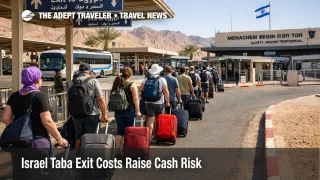
Israel Taba exit costs now sit at the center of Israel land exit planning, not as a small border nuisance but as a real route selection problem. As of April 12, 2026, Canada says land crossings to Jordan and Egypt remain open but can change at short notice, while U.K. advice now tells travelers using Taba to bring at least $170.00 (USD) in cash per person, plus extra cash for added charges, visas, guarantee letters, and vehicles because ATMs at the crossing are often unreliable. That changes the practical question from "Can I leave by land?" to "Which border can I actually fund, document, and finish without getting stranded partway through?"
Israel Taba Exit Costs: What Changed
The new pressure point is not that the land exits disappeared. It is that the Egypt option through Menahem Begin, Taba now comes with a more cash heavy and variable cost structure than many travelers still assume. The U.K. says travelers crossing at Taba should bring at least $170.00 (USD) in cash, and more if they are continuing beyond the immediate border area, using a vehicle, or need extra documents. Its current guidance says a stay limited to Taba requires a $20.00 (USD) border tax, travel farther within Sinai, including Sharm El Sheikh, requires a $120.00 (USD) border tax, and travel beyond Sinai, including onward plans through Cairo or Hurghada, requires that same $120.00 (USD) border tax plus a $30.00 (USD) standard entry visa and a guarantee letter that costs about $20.00 (USD).
Canada's current Israel and Palestine advisory still lists four available land exit paths for those leaving safely by road, Jordan River, Allenby, Yitzhak Rabin toward Aqaba, and Menahem Begin toward Taba. But it also warns that the crossings can be affected at short notice, especially around holiday periods, which means "open" is no longer the same as predictable. The Israel Airports Authority has already shown how fast the operating rules can tighten, with recent restrictions on private vehicle travel to Jordan via the Jordan River and Rabin crossings through April 10 to manage crowding and security.
Which Exit Route Fits Your Border Plan
The Jordan side looks cleaner for travelers whose main goal is to get out of Israel and connect quickly onward from Jordan, especially through Aqaba or Amman, without taking on Egypt-side cash and document friction. But it is not friction free. Canada says its citizens must obtain a Jordan visa online before crossing, and its Jordan advisory warns that border operations can still shift with reduced hours or short notice closures. Allenby is also not a general purpose option for everyone, since Canada notes that Israeli passport holders are not permitted to cross there and that it is the only available exit option for West Bank ID holders.
Taba works best for travelers who already know they can fund the crossing in cash, understand whether they are staying in Taba, moving elsewhere in Sinai, or continuing beyond Sinai, and have built the route around those facts. That distinction is decisive because Egypt's own entry pattern changes by destination. Canada says Canadian passport holders entering via Taba can use a 14 day visa free stamp if they stay within Sinai, but need either an eVisa in advance or a 30 day visa on arrival if they plan to travel outside Sinai. The U.S. State Department adds that U.S. citizens continuing beyond Sinai can obtain a 30 day visa for about $30.00 (USD) in exact cash, but that process also requires a support letter from a travel agency, with fees that vary.
What Travelers Should Do Before Moving
Travelers should decide on the full corridor before leaving their hotel, apartment, or shelter point in Israel. That means choosing not just Jordan versus Egypt, but also the first airport, city, or overnight stop on the far side. A Taba plan aimed at Sharm El Sheikh International Airport (SSH) is a different product from a Taba plan aimed at Cairo International Airport (CAI) or Hurghada International Airport (HRG), because the visa, cash, and transport assumptions are different. A Jordan plan aimed at King Hussein International Airport (AQJ) in Aqaba is also different from one that depends on a longer road move to Amman.
Cash should be treated as route infrastructure, not spending money. At Taba, the U.K. says all payments are required in cash and that ATMs are unreliable, which means a traveler who arrives underfunded can fail at the border even when the crossing is technically open. Anyone using the Egypt route should carry U.S. dollars in hand before reaching Eilat, plus extra buffer for transport, delays, and fees that vary by onward destination. Anyone using Jordan should still verify visa rules by nationality before departure and should not assume a short notice border run will solve missing paperwork.
The decision threshold is simple. Choose Jordan when your priority is the more straightforward onward handoff and you can meet that border's visa rules in advance. Choose Taba when you specifically want Sinai or Egypt onward travel and can fund the crossing in cash with margin. Travelers still comparing both routes should review the exact passport specific rules in Egypt Tourist Entry Requirements For 2026 and Jordan Entry Requirements For Tourists In 2026 before they move.
Why the Taba Route Is Less Forgiving Now
The reason this has become more serious is that land exit planning from Israel is no longer just a border status question. It is a sequence problem. A traveler has to clear the Israeli side, meet the next country's visa and fee rules, find functioning transport on the far side, and still make the next flight, bus, or hotel check in. Once one route becomes cash heavy and variable, the whole chain gets more brittle. A missed assumption at Taba can leave a traveler stuck between Eilat, the border, and Sinai with fewer cards, fewer ATMs, and fewer easy recovery options than they would have at a normal airport departure.
That also helps explain why Jordan remains the cleaner option for some travelers even with its own risks. In an earlier Adept Traveler article, Israel Jordan Land Crossings Tighten Through April 10 the operational problem was crowding and vehicle restrictions. Now the sharper split is between a Jordan corridor that can still change quickly, and an Egypt corridor that may remain open but demands more cash, more route specific planning, and more document discipline. Travelers heading into Jordan should also remember that demonstrations and rolling roadblocks can slow transfers, especially in and around Amman, as noted in Jordan Protests Road Checks Delay Amman Transfers. For travelers still deciding, the next useful test is not whether a border is open, but whether the full route can be funded, documented, and completed that same day.
Sources
- Travel advice and advisories for Israel and Palestine, Government of Canada
- Israel travel advice, GOV.UK
- Land Border Crossing Notifications and Updates, Israel Airports Authority
- Travel advice and advisories for Jordan, Government of Canada
- Travel advice and advisories for Egypt, Government of Canada
- Egypt Travel Advisory, U.S. Department of State
- Israel Jordan Land Crossings Tighten Through April 10, Adept Traveler
- Jordan Protests Road Checks Delay Amman Transfers, Adept Traveler
- Egypt Tourist Entry Requirements For 2026, Adept Traveler
- Jordan Entry Requirements For Tourists In 2026, Adept Traveler