

Gulf Cruise Repatriation: MSC Eyes Charter Flights
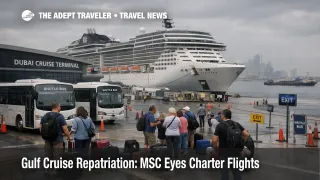
Gulf cruise repatriation flights are turning into the main constraint for passengers whose ships are being held in port as the Middle East conflict continues to disrupt aviation and port operations. MSC Cruises says it is working with airline partners in the region, particularly Emirates and Etihad Airways, to identify and secure return flights for impacted guests, and the line is also exploring charter options from Dubai, United Arab Emirates, Abu Dhabi, United Arab Emirates, and Muscat, Oman, to accelerate returns when regular schedules are still thin. MSC has also said it is staying in contact with local authorities, embassies, and foreign offices, while continuing normal onboard services as guests wait for viable exit paths.
At the same time, the disruption is not limited to one operator. Celestyal has canceled at least two departures and is holding ships alongside, with Celestyal Journey remaining in Doha, Qatar, until March 7, 2026, and Celestyal Discovery alongside in Dubai under instructions that have limited guest movement ashore. This combination, ships held in place plus constrained flight capacity, means the practical traveler problem is no longer "a cruise itinerary change," it is "how to get off the ship and onto a workable flight home without losing control of documents, baggage, and money."
For background on how quickly this expanded from cancellations into extended port holds, see Middle East Cruise Cancellations Trap Ships in Gulf.
Which Travelers Are Most Exposed Right Now
The highest exposure group is passengers whose return plans depend on same day flights out of Dubai International Airport (DXB), Abu Dhabi Zayed International Airport (AUH), or connections through the region while airlines are still prioritizing limited operations and repatriation movement. Even when flights restart, seat access tends to be controlled, uneven by carrier, and vulnerable to renewed airspace restrictions, so a "tomorrow flight" plan can fail again with little warning.
A second exposed group is anyone who stitched together separate bookings, cruise only fares, separately ticketed flights, nonrefundable hotels, and prepaid tours. When disembarkation timing is uncertain, these travelers can end up eating the hotel night they no longer reach, missing a separately ticketed flight that gets treated as a no show, or paying high walk up rates near airports while they wait for a seat home. Travelers who booked flights through the cruise line or a tour operator may have a cleaner rebooking path, but even those travelers still face the same physical constraint, there must be seats and operating corridors available at the moment disembarkation is allowed.
There is also a nationality and documentation exposure that travelers often underestimate. If your passport, visa status, or onward tickets require you to be in a specific country by a specific date, you need written confirmation of what your operator is providing and when, because informal assurances onboard rarely help at a check in counter or with an insurer. Hotel support programs can reduce short term lodging risk for stranded travelers in the Gulf, but they do not create flight seats. For that layer, see UAE, Qatar Cover Hotels for Stranded Airspace Closures.
What Travelers Should Do Now
If you are currently onboard, treat this like an exit logistics problem first, and a comfort problem second. Ask the line for a written status update that covers three things, your disembarkation options, any ship provided transfers, and what the operator is doing to secure flights, including whether you will be contacted directly for a seat assignment. Save screenshots of every notice, airline message, and booking change, because documentation is what determines whether you can escalate effectively with the airline, your credit card issuer, or your travel insurer.
Use a simple decision threshold for timing. If you must be home by a fixed date, for work, school, medical care, or a time locked family obligation, push for the fastest viable routing even if it is less convenient, including options that reposition you to a different departure point such as Muscat International Airport (MCT) if that is where charter capacity or open corridors exist. If you can tolerate delays, waiting can make sense when the cruise line is providing accommodation onboard and is actively coordinating with embassies and airlines, but "waiting" should still include a daily check on whether your passport, visa, and any overstay rules create hidden deadlines.
Over the next 24 to 72 hours, monitor three operational signals rather than social chatter. First, the cruise line's ship specific update cadence, because that is where disembarkation permission and transfer plans usually appear first. Second, airline operational advisories from Emirates and Etihad about what is operating versus what is suspended, because repatriation and charter plans still depend on corridor approvals and crew, and aircraft positioning. Third, airspace and corridor notices, because intermittent closures can invalidate a routing after you have already moved toward an airport.
For a lodging continuity reminder that applies when disruptions force unexpected extensions and rebookings, see What Sonder's Collapse Means for Apartment Hotels.
Why Cruise Disruptions Spread Through the Flight System
Cruise disruption in the Gulf propagates differently than a normal port cancellation because the ship can be safe while passenger movement is constrained by authority permissions and airport operating reality. First order, a ship remains alongside and planned turnarounds fail, which cancels the next sailing cycle and strands future guests before they even depart. Second order, getting passengers home becomes a seat allocation and corridor approval problem, not a normal retail rebooking problem, because the same security situation that halted cruise movement is also reducing flight schedules and rerouting aircraft around closed or risky airspace.
That is why MSC focusing on airline coordination and exploring charters is a meaningful change in the traveler decision set. Charters can bypass the bottleneck of limited commercial inventory, but they still rely on airport processing capacity, operating windows, and clearances that can change quickly. Meanwhile, carriers in the region have been running limited flights largely aimed at clearing stranded banks, which helps explain why many travelers are hearing about "special flights," but not seeing broad availability they can simply buy. In practice, your cruise line, your airline, and local authorities are all parts of the same constraint system, and your best outcome comes from aligning your documentation, your flexibility, and your decision timing with how that system is actually recovering.