

State Dept Depart Now Alert Hits Gulf Hub Connections
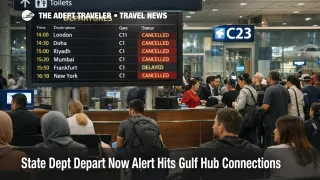
The U.S. State Department escalated its guidance on March 2, 2026, telling Americans in 14 Middle East countries and the West Bank and Gaza to "DEPART NOW" using available commercial transportation, citing "serious safety risks." This matters for travel right now because the same conflict is still breaking the region's aviation backbone, the Gulf hub connection banks that normally move Europe to Asia and Africa traffic through Dubai, Doha, and Abu Dhabi. If you are ticketed through the region in the next 24 to 72 hours, treat your itinerary as unstable even if your flight still shows "on time," because airspace and airport operating status can change faster than airline schedules can refresh.
The Depart Now travel advisory is not a generic reminder, it is a timing signal. The practical window is before you start moving toward an airport or border crossing, when you still have options to reroute, postpone, or secure lodging. For context on how quickly this has been evolving since the initial disruptions, travelers can review Worldwide Caution, Middle East Flights Still Halted and UAE Exceptional Flights Restart From Dubai and Abu Dhabi.
Depart Now Travel Advisory: What Changed For Travelers
The change is the State Department moving from heightened caution messaging to an explicit departure directive across Bahrain, Egypt, Iran, Iraq, Israel, Jordan, Kuwait, Lebanon, Oman, Qatar, Saudi Arabia, Syria, the United Arab Emirates, and Yemen, with the West Bank and Gaza also called out in the same public guidance stream. In parallel, major transit points are operating on exception rules. Dubai Airports has confirmed only a small number of flights are permitted to operate from Dubai International Airport (DXB) and Dubai World Central, Al Maktoum International Airport (DWC), which is a very different operating environment than a normal published schedule. This combination is why travelers can see a flight number in their reservation, but still get stuck in a stalled connection bank, or get moved to a later day simply because the hub is clearing backlog and repositioning aircraft first.
Which Itineraries Are Most Exposed Right Now
The highest risk group is anyone connecting through Gulf hubs on a tight same day plan, especially travelers who need one long haul arrival to feed a short onward segment. When a hub pauses or caps movements, the first order effect is cancellations and missed connections. The second order effect is inventory collapse, seats vanish on alternates, crews and aircraft end up out of position, and "tomorrow" availability becomes the constraint even after airports partially reopen.
Travelers who are not headed to the Middle East can still be impacted if their routing normally overflies constrained airspace, or if their trip relies on Dubai, Doha, or Abu Dhabi as the connection machine between continents. If your trip is built around a cruise embarkation, a tour start, a wedding, or a timed event, assume a larger buffer than usual, because a single broken connection can force an overnight with limited reaccommodation options.
What Travelers Should Do Now
If you are in one of the listed countries or territories and you are a U.S. citizen, the immediate move is to shift from monitoring to execution: enroll in STEP, watch for embassy security alerts, and look for the fastest commercial path out that does not rely on a single hub connection. If flights are not operating from your airport, land departures may be the only option in the near term, but do not improvise border crossings without checking current embassy guidance, entry rules, and local safety conditions first.
If you are ticketed to transit the region, decide based on connection fragility. Rebook now if your itinerary depends on a short connection through DXB, Doha, or Abu Dhabi, or if you have a same day obligation at your destination. Wait only if you can absorb a multi day slip and you have multiple viable alternate routings. Do not go to DXB, DWC, or Zayed International Airport (AUH) unless your airline has confirmed you are on an operating flight under the current capped conditions.
Over the next 24 to 72 hours, monitor three things: official airspace and airport status updates, airline waiver behavior, and whether hubs announce a return to normal scheduled banks rather than "limited" or "exceptional" operations. The next decision point is when your carrier starts publishing stable schedules again, that is the moment when rebooking stops being a blind scramble and becomes a normal planning choice.
Why The Disruption Spreads Beyond The Region
The mechanism is hub banking plus airspace constraint. Dubai, Doha, and Abu Dhabi normally work because dozens of flights arrive in coordinated waves, and dozens more depart shortly after, which compresses long haul travel into short connections. When airspace closes or airports cap operations, those banks break. Aircraft and crews cannot flow into the next wave, inbound flights divert or cancel, and the travelers who miss one bank get pushed into the next day because there is no spare capacity to absorb the backlog.
Even partial reopening can feel worse before it feels better, because airlines prioritize repatriation, clearing stranded passengers, and repositioning aircraft before they rebuild the published network. That sequencing is why you can see "some flights resumed" headlines, but still experience long holds, rebooked routings, and crowded hotels far from the front lines.
Sources
- Worldwide Caution, February 28, 2026, U.S. Department of State
- STEP, Smart Traveler Enrollment Program, Travel.State.Gov
- U.S. urges citizens to immediately depart over a dozen Middle Eastern countries, Reuters, March 2, 2026
- Stranded travelers scramble as war shuts much of Middle East to air travel, AP News
- Dubai Airports announces limited flight resumption, WAM, March 2, 2026
- Middle East flights, Hamad movements suspended and transit passengers stranded, Euronews, March 3, 2026