

UAE Flights Restart Slowly as Dubai Cancellations Top 12,300
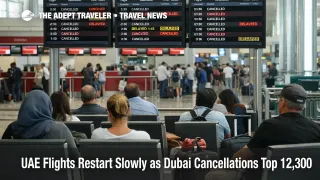
A limited restart is taking shape out of the United Arab Emirates, but it is not a normal schedule return. Virgin Atlantic has resumed services from Dubai International Airport (DXB) to London Heathrow Airport (LHR) and from King Khalid International Airport (RUH) after the region's airspace closures, while Emirates and Etihad continue to hold most scheduled flying and prioritize repatriation moves for stranded passengers. At the same time, Qatar's situation remains structurally different because all aircraft movements at Hamad International Airport (DOH) are still suspended while Qatari airspace is closed, which keeps Doha non viable as a standard connection point until an aviation authority reopening notice arrives.
The practical traveler takeaway is that a flight operating today does not mean the hub is stable. The cancellation count remains enormous, with flight tracking summaries showing cancellations across major Gulf airports exceeding 12,300 flights from February 28, 2026, through March 3, 2026. That scale matters because recovery is constrained by aircraft and crew displacement, capped airport movements, and airlines triaging who gets moved first.
Which Travelers Are Most Exposed Right Now
The highest risk group is anyone connecting through Gulf hubs on a tight same day plan, especially travelers whose itinerary depends on timed connection banks through Dubai, Abu Dhabi, or Doha. When only a subset of flights operate, missed connections become the default failure mode, not the exception, because the next onward option may not exist that day, or it may be restricted to specific passenger groups. Travelers on separate tickets are still the most exposed financially, because protections can break when the first segment is delayed or canceled and the onward segment is treated as a separate contract.
If you are currently stranded in the UAE, the priority order being used by airlines and authorities matters more than published timetables. UAE aviation authorities have described an emergency departure flow, including 60 flights transporting 17,498 passengers so far, and an objective to scale scheduled flying up to 80 flights per day with capacity around 27,000 passengers. That sounds large until you compare it to the size of the backlog created by multiple days of near systemwide disruption. It helps, but it does not instantly normalize the network.
If you are trying to get home from a third country by routing through the Gulf, treat Dubai and Abu Dhabi as partially functioning exit points, and treat Doha as closed until you see a formal airspace reopening. If your trip was built around Doha as the connecting hub, the realistic path is rerouting away from Qatar, even if it adds time and costs, because waiting for a reopening can strand you mid journey with limited rebooking inventory.
What Travelers Should Do Now
First, follow the "do not travel to the airport unless contacted" guidance when your airline is running repatriation or manifest controlled flights. On these days, airport processing, check in capacity, and even terminal access can be tuned to specific flight lists, and showing up without confirmation often just adds time and stress without improving your odds.
Second, use a clean decision threshold for rebooking versus waiting. Rebook now if you have a hard constraint such as a cruise embarkation, a medical appointment, a one night hotel plan that collapses if you arrive late, or if you are holding separate tickets that will not protect you automatically. Waiting can be rational if you are on a single ticket, your carrier is explicitly contacting eligible passengers for specific flights, and you can tolerate a rolling 24 to 72 hour slip without breaking the purpose of the trip.
Third, plan around the restart window dates that airlines have published, but assume those dates can move again. Emirates has said scheduled flights remain suspended until late March 7, 2026, local time, and Etihad has extended its suspension into March 6, 2026, local time, while both carriers run limited repatriation flying. Qatar Airways has said it will resume operations only after the Qatar Civil Aviation Authority announces safe reopening, with a further update window communicated by the airline. Build your plan so it still works if a restart date slips by another day.
If you need a baseline on what support exists while you wait, start with UAE, Qatar Cover Hotels for Stranded Airspace Closures, then use Middle East Airspace Closures Ground Gulf Hubs as the operating model for why "partially open" still behaves like irregular operations for connections. For broader context on why this disruption propagates far beyond the Gulf, Geopolitics is the evergreen hub that ties together the recurring travel system risks.
Why the Restart Is Uneven, and How Disruption Spreads
This is not just about individual airports reopening, it is about how the network restarts. When airspace closes, aircraft divert or get stuck out of position, crews time out, and airlines lose the ability to run the next set of planned rotations. Even when an airport can handle a limited number of departures, that does not restore the downstream pieces that make connections work, including inbound aircraft arrival sequences, gate availability, crew legality, and baggage flows.
First order, travelers see cancellations, diversions, and long customer service queues. Second order, they see missed onward connections in Europe, Africa, and Asia because the Gulf hubs normally act as high frequency bridges between banks, and when those banks break, the remaining seats get chased by everyone at once. Third order, airlines pad schedules, reduce frequencies, and prioritize repositioning and repatriation over open sale flying, which is why you can see a few flights resume while the overall system still feels closed.
The key mechanism to watch is whether constraints are easing at the airspace level, not just the airport level. As long as multiple countries maintain closures or partial restrictions across the corridor, flights reroute north or south, flight times stretch, and misconnect risk rises across long haul networks. That is why your itinerary can fail even if your origin airport looks fine, because the constraint is sitting in the middle of the route structure, not at the endpoints.