

Flight Delays and Airport Impacts: March 5
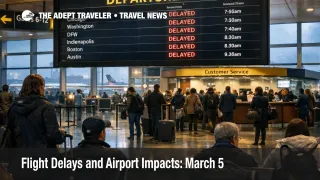
U.S. flight delays March 5 are set up as a multi region constraint day that is more likely to break connection reliability than trigger an all day shutdown. The FAA's daily outlook flags morning low clouds, reduced visibility, and light rain that may slow traffic in the New York area and the Washington, D.C., area, while thunderstorms could disrupt flights in parts of the Midwest and Texas, including the Dallas area and Austin. Low clouds are also forecast in Chicago and Seattle, and wind is in the picture for San Francisco, which matters because crosswinds and arrival spacing can quietly pull down arrival rates even when the airport looks "open."
If this feels familiar, it is the same operational theme as March 4, but with the highest early pressure concentrating more clearly around the Northeast corridor and Washington area airports, then shifting to convective risk later for central U.S. hubs. For travelers, the practical decision is whether to buy extra time before the first flow programs spin up, because once delays propagate, the same day rebooking menu shrinks fast.
U.S. Flight Delays March 5: What Changed
The key change for March 5 is the FAA's explicit emphasis on morning ceiling and visibility constraints in the New York area and Washington, D.C., area, paired with a separate thunderstorm risk that can hit afternoon and evening banks in the central United States. Low clouds and light rain do not usually "close" a major airport, but they reduce arrival rates and increase spacing, which is how you end up with ground delay programs that look modest on paper and still destroy tight connections in practice.
At the same time, thunderstorms in the Louisville, Indianapolis, Dallas Fort Worth, Dallas Love Field, and Austin corridors are a different failure mode. They can force reroutes, compress runway acceptance rates, and trigger tactical holds that spread outward, especially when they sit near or on top of a hub bank. The net is a day where flights may operate, but itineraries that rely on precise timing are fragile.
Which Travelers Face The Most Disruption
Travelers departing early, or connecting in the morning, face the highest risk if their trip touches John F. Kennedy International Airport (JFK), LaGuardia Airport (LGA), Newark Liberty International Airport (EWR), Ronald Reagan Washington National Airport (DCA), Baltimore Washington International Thurgood Marshall Airport (BWI), or Washington Dulles International Airport (IAD). The exposure is not just "delays at those airports," it is the knock on effect when inbound aircraft arrive late and the entire rotation behind them slides.
A second group is anyone flying later today through storm sensitive banks, especially itineraries touching Louisville Muhammad Ali International Airport (SDF), Indianapolis International Airport (IND), Dallas Fort Worth International Airport (DFW), Dallas Love Field (DAL), or Austin Bergstrom International Airport (AUS). If storms build near the hubs, the most common traveler outcome is missed connections and fewer same day reaccommodation options, not necessarily mass cancellations at the first sign of lightning.
A third group is travelers whose plans depend on smooth "background" hubs that can quietly degrade under low ceilings and wind, including Chicago O'Hare International Airport (ORD), Chicago Midway International Airport (MDW), Seattle Tacoma International Airport (SEA), and San Francisco International Airport (SFO). These are the days where a short delay at multiple nodes turns into a long delay somewhere else, because the system runs out of slack.
What Travelers Should Do Now
Buy margin early if your itinerary depends on a connection you cannot miss. If you are connecting through the New York or Washington, D.C., area this morning, treat sub 90 minute connections as a risk decision, not a default, and look for an earlier departure or a longer layover while seats still exist. Waiting for the airport to "look fine" is usually the wrong signal on ceiling days, because the metering happens to protect throughput, not because the terminal is visibly chaotic.
Set a threshold for when you will rebook instead of waiting. Rebook now if you have a hard arrival requirement, for example a cruise embarkation, a last train, a paid tour, or a same day international departure, and your first leg is already trending late or your inbound aircraft is arriving behind schedule. Waiting only makes sense when you have credible later backups that still land inside your true arrival window, not just your preferred arrival time.
Monitor the signals that actually predict your departure. Start with your inbound aircraft and crew status in the airline app, then pair that with FAA planning and advisories for the day as convective weather evolves. If you want yesterday's pattern baseline and how the week has been trending, read Flight Delays and Airport Impacts: March 4, and if your trip intersects the multi day storm window, keep Central US Storms Threaten Flight Banks March 4 to 7 open as your context piece.
Why Delays Spread Beyond One Airport
The mechanism today is throughput protection plus network coupling. Low clouds, low visibility, and light rain reduce the rate at which aircraft can safely land, taxi, and sequence into gates. First order, that creates arrival delays and late inbound aircraft. Second order, traffic management pushes delay back to origin airports through metering so destinations do not saturate, which is why your departure can be held even when your origin weather looks acceptable.
Thunderstorms add route and ramp constraints, not just runway constraints. Convective cells block arrival corridors, force detours, and can pause ramp activity, which slows turn times and creates gate conflicts. When storms sit near banked hub complexes like Dallas or impact connecting spokes like Indianapolis or Louisville, the disruption turns into missed connections and later day equipment, crew, and gate mismatches that are hard to rebuild on the fly.
The tradeoff for travelers is simple. Rebooking early usually costs less itinerary risk, but may cost more money if you move before waivers expand. Waiting may preserve fare rules, but it often narrows your same day options once flow programs begin and seat inventory gets consumed by displaced passengers across multiple hubs. For the deeper structural context behind why these "not catastrophic, but sharp" days can feel harsher, the evergreen explainer is U.S. Air Traffic Control Privatization: Reality Check.