

UAE Oman Border Crossings Offer Overland Exit
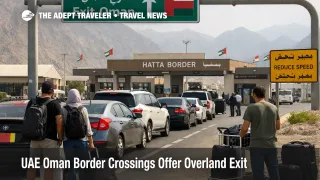
Canada's March 5 update changes the UAE exit story in a useful way. The government now says some commercial flights are scheduled to resume from the United Arab Emirates, but it also explicitly names three land crossings into Oman, Hatta/Al Wajajah, Khatma Malaha, and Khatm Al Shikla at Al Ain, while warning travelers to verify crossing status before moving. That is more actionable than generic "consider Oman" advice because it turns a regional fallback concept into named border infrastructure. For travelers stuck in Dubai, Abu Dhabi, or the eastern emirates, the immediate question is no longer just whether flights are trickling back, but whether an overland move to Oman gives them a faster path to a confirmed seat out.
The new logic only works if the full chain holds together. Canada still says travelers should shelter in place until commercial options resume and should leave when flights are available if it is safe to do so. At the same time, it says border crossings and flights can close without warning, which means overland repositioning is a decision about total trip reliability, not just about getting out of the UAE. A traveler who reaches Oman without valid entry documents, a workable transfer, or a real onward booking may simply move the problem from Dubai or Abu Dhabi to Muscat.
For continuity with prior Adept coverage, this update sharpens the practical choices described in Dubai Airport Limited Departures Resume March 5, 2026 and Muscat Relief Flights Become Qatar Airways Exit Route. It also fits the broader bottleneck logic outlined in U.S. Air Traffic Control Privatization: Reality Check, where limited capacity at one point pushes pressure into every step around it.
UAE Oman Border Crossings: What Changed
What changed is not that Oman suddenly became the only way out. It is that official guidance now treats overland movement from the UAE to Oman as a defined fallback with named crossings. Canada's advisory says some commercial flights are resuming from the UAE as of March 5, 2026, but it also identifies Hatta/Al Wajajah, Khatma Malaha, and Khatm Al Shikla as available land options, and tells travelers to confirm crossing status before travel. That creates a clearer decision tree for people who cannot secure a seat from Dubai or Abu Dhabi, or who judge airport access and same day standby odds to be too weak.
The crossings serve different practical catchments. Hatta/Al Wajajah is the most intuitive option for travelers coming from Dubai because it is the classic Dubai to Oman road corridor. Khatma Malaha sits in Kalba and is a better eastern route for travelers already closer to Sharjah's east coast or Fujairah. Khatm Al Shikla is the Al Ain option, which makes it the cleaner fit for travelers originating in Abu Dhabi's inland corridor or the Al Ain area rather than trying to fight west to east through Dubai first. Sharjah Customs describes Khatmat Malaha as a 24/7 international crossing in Kalba, and Abu Dhabi Customs identifies Khatm Al Shikla as a customs center in Al Ain.
That does not mean the three crossings are interchangeable in practice. Route choice should follow where you already are, where your driver can legally take you, and how quickly you can reach an onward flight. Using the "wrong" crossing can turn a smart reposition into extra hours on the road, a missed check in window, or an unnecessary overnight.
Which Travelers Should Use Oman, and Which Should Wait
The best fit for an Oman move is a traveler who already has a credible next step on the Oman side. That could mean a confirmed commercial seat from Muscat, an airline directed relief move, or a protected itinerary that is clearly more reliable from Oman than from the UAE. It is also a better fit for travelers whose trip has a hard deadline, such as a fixed work commitment, a cruise embarkation, or a long haul international departure where waiting another cycle in Dubai or Abu Dhabi raises the odds of a total itinerary collapse.
The weaker fit is the traveler moving on hope alone. Canada's guidance explicitly says to verify border status before leaving, and Oman's Foreign Ministry says visitors must meet Oman entry rules, including valid travel documents. For many nationalities, Oman's published entry conditions include a passport valid for at least six months, plus a return ticket, confirmed accommodation, health insurance, and sufficient funds. Oman also routes travelers to the Royal Oman Police eVisa system when a visa is required. If you do not know whether you can legally enter Oman, or if your onward flight is not real and ticketed, overland movement can create a second problem instead of solving the first.
Self driving also has hidden failure points. Many UAE rental contracts do not allow cross border driving into Oman, and borrowed or company vehicles can require extra permission and insurance. That matters because the border may be technically open while your car plan is not. In a disruption, private transfer or professionally arranged ground transport is often simpler than discovering at the crossing that your vehicle paperwork does not work. This is an inference based on current entry rules and common cross border vehicle restrictions, not a new rule announced in this advisory.
What Travelers Should Do Before Heading to the Border
Start with the flight question, not the road question. If you can secure a workable commercial departure from the UAE itself, that is often the cleaner choice because it avoids border uncertainty, transfer delays, and an extra country entry. Canada's advisory still says to monitor flight availability and leave when commercial options are available, which means overland repositioning should be a threshold decision, not a default reaction.
Choose Oman when three conditions line up. First, you have checked that the crossing you plan to use is operating. Second, you meet Oman's entry requirements, including visa status where applicable. Third, you have a real onward plan from Muscat or elsewhere in Oman, ideally ticketed, with enough buffer for a same day slip. If one of those pieces is missing, waiting for a confirmed UAE departure may be the less risky move.
Build time and cash buffer into any Oman move. Canada says travel conditions can change quickly and border crossings may close without warning. The U.S. mission in the UAE has also warned that land borders with Oman remain open but there are reports of congestion. In practice, that means travelers should assume slower transfers, slower border processing, and at least the possibility of an overnight in Oman before onward departure. Same day "drive straight to the airport and fly out" plans can work, but they are fragile.
Why This Changes the Exit Math for UAE Travelers
The mechanism here is straightforward. When flights resume only partially, airports stop being all or nothing and start acting like scarce processing points. Some travelers will get out on resumed commercial service, but many will not, and the leftover demand looks for the nearest stable node. Canada's advisory effectively identifies Oman as one of those nodes for UAE based travelers, which is why the border itself now becomes part of the air travel system rather than just a road trip detail.
First order, named UAE Oman border crossings give stranded travelers a defined overland fallback when airport access, inventory, or airline handling from the UAE fails. Second order, those same crossings shift pressure into ground transfers, car hire, private drivers, border staffing, Muscat hotel inventory, and onward ticket supply. That is why this update matters even though it is only a few new lines in a government advisory. It changes where the bottleneck lives.
The practical takeaway is simple. UAE Oman border crossings are now a real part of the decision set, but they only beat waiting in Dubai or Abu Dhabi when the full chain works, legal entry, workable ground transport, and a credible onward seat from Oman. If those pieces are in place, overland repositioning can save the trip. If they are not, the border crossing just relocates the uncertainty.
Sources
- Travel advice and advisories for United Arab Emirates, Government of Canada
- Canada's response to the situation in the Middle East, Global Affairs Canada
- Entry visas, Foreign Ministry of the Sultanate of Oman
- Khatmat Malaha Border, Sharjah Customs
- Canada working to repatriate more than 2,000 citizens from Middle East, Reuters
- Security Alert: U.S. Mission to the UAE, March 3, 2026