

Emirates Dubai Restart: Confirmed Flyers Only March 7
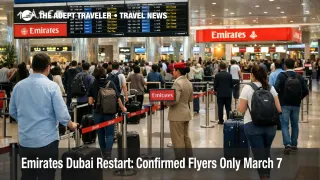
Emirates has reopened Dubai flying on March 7, 2026, but only in a tightly gated way. The carrier says passengers should go to the airport only if they hold a confirmed booking for that afternoon, and transit passengers should move only if their onward segment is also confirmed. That changes the traveler decision from "stay away from Dubai" to "move only if the whole chain is real." For stranded travelers, the practical rule now is simple: do not treat a partial restart as a general airport reopening.
This is an update story, and the important change from prior Adept coverage is that Emirates is no longer in blanket suspension mode. Dubai is acting again as a selective release valve, but not a normal hub, because the airline is flying while still warning unconfirmed passengers to stay away from the airport and keeping all city check in points in Dubai closed until further notice.
Emirates Dubai Restart: What Changed
The confirmed change is operational, not rhetorical. Emirates says it has resumed operations, and its March 7 update states that passengers with confirmed bookings for that afternoon's flights may proceed to the airport. The same notice extends that permission to transit passengers in Dubai only when the onward flight is also confirmed. It also tells customers to check the schedule, review email notifications for changes or cancellations, and avoid heading to the airport without a confirmed booking.
That matters because partial recovery at Dubai International Airport (DXB) is still a scarce capacity event, not a full return to normal. Reuters reported earlier this week that Emirates expected to operate more than 100 flights on March 5 and March 6 under safe air corridors, while broader reporting indicated Dubai traffic was still running well below normal levels. In other words, flying has restarted, but slack has not.
Which Travelers Can Move, and Which Should Wait
The best fit for immediate movement is the traveler who has a confirmed Emirates seat departing Dubai on March 7 and, if transiting, a confirmed onward segment already attached to the trip. That traveler now has a live commercial path out, and waiting too long can create a different failure, missed same day check out windows, expiring ground transfers, or losing place in a reduced operation that can change again. Travelers in that group should still recheck flight status and recent airline messages before leaving for the airport.
The weaker fit is anyone relying on a hopeful standby, an unconfirmed reissue, or a separate onward booking that is not yet protected. Emirates is explicit that transit customers should proceed only when the connecting flight is confirmed. That is the hard line that matters most today, because Dubai's restart can look more open than it really is from the outside. A passenger who reaches DXB without a firm onward segment may simply move from hotel uncertainty into airport uncertainty.
Travelers whose bookings are disrupted still have options short of rushing to the terminal. Emirates says customers booked to travel between February 28 and March 31 can rebook for travel on or before April 30, 2026, or request a refund if they booked direct. For some passengers, especially those without a confirmed onward plan, that may be the cleaner move than trying to force same day recovery through a reduced hub.
What Travelers Should Do Now
Start with documentable confirmation, not with movement. Open the Emirates app or website, confirm the exact flight is active, check for any email or SMS change notice, and confirm that every segment after Dubai is also ticketed and operating. If any leg is missing, especially a transit leg, do not assume airport staff can solve it quickly on arrival. This is the kind of day when partial operations reward travelers with a complete itinerary and punish travelers who arrive hoping to improvise.
The next threshold is whether Dubai is still your best exit point. For travelers in the UAE who still do not have a usable confirmed seat, the fallback logic from UAE Oman Border Crossings Offer Overland Exit still matters. Overland repositioning is not automatically smarter than waiting, but it remains relevant for travelers whose Dubai inventory is not clearing and who can legally enter Oman and reach a credible onward departure.
Over the next 24 to 72 hours, watch three things. First, whether Emirates expands beyond this afternoon's tightly confirmed pool. Second, whether reduced operations at DXB translate into more stable connections or renewed misconnect pressure. Third, whether alternative UAE and nearby exit points continue to absorb spillover demand, especially after Etihad's limited restart from Abu Dhabi and the broader UAE fallback guidance already outlined in Dubai Airport Limited Departures Resume March 5, 2026.
Why the Restart Is Still a Controlled Release, Not Normal Service
The mechanism is straightforward. When a carrier restarts before the hub is fully normalized, the airport stops behaving like an open marketplace and starts behaving like a gated processing point. Emirates is letting confirmed passengers through because the system can handle some movement. It is warning everyone else away because reduced operations still create failure risk at every point, check in, security, connection handling, reissue desks, baggage flow, and onward flight protection.
First order, the Emirates Dubai restart gives stranded passengers a real commercial exit path again. Second order, it pulls demand back toward Dubai International, increases the penalty for broken onward itineraries, and tightens hotel, transfer, and checkout timing around a reduced schedule. That is why the transit confirmation rule matters so much. In a hub built around connections, a flight out of Dubai is not enough if the next flight is still unstable.
The practical takeaway is blunt. Dubai is usable again for some travelers, but only for travelers whose booking is already real from end to end. Everyone else should treat this as a selective reopening, not a green light. That distinction is what keeps a partial recovery from turning into a self inflicted airport problem.