

Saudi Arabia Advisory Hardens Exit Plans
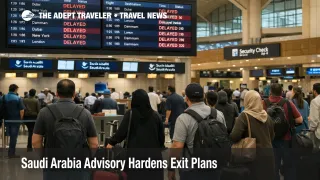
Saudi Arabia's travel picture worsened for Americans on March 8 and March 9, 2026, even though the formal U.S. advisory level did not change. The State Department kept Saudi Arabia at Level 3, Reconsider Travel, but updated the advisory to reflect ordered departures for non emergency U.S. government staff and families, a continuing threat of Iranian drone and missile attacks, major commercial flight disruption, and limited U.S. emergency assistance inside the country. For travelers, that means Saudi Arabia is still commercially reachable, but it is a weaker place to begin, continue, or wait out a Middle East itinerary right now.
The practical shift since earlier coverage is not a full airspace shutdown, it is the combination of open airspace, thinner support, and less predictable recovery. That is a worse operating mix for travelers because flights may still be available out of Riyadh, Saudi Arabia, Jeddah, Saudi Arabia, and Dhahran, Saudi Arabia, but official U.S. guidance is now pushing people to leave if they believe it is safe to do so, and to register through the State Department's Crisis Intake Form if they need help.
Saudi Arabia Travel Advisory: What Changed
The March 8 advisory update did not raise Saudi Arabia above Level 3, but it did add a more serious mission posture. The State Department says non emergency U.S. government employees and eligible family members were ordered to leave Saudi Arabia on March 8, 2026, amending a March 3 authorization for voluntary departure. It also explicitly says the advisory summary was updated to reflect changes to U.S. mission operations.
That matters because advisory level alone can understate operational deterioration. A Level 3 country with normal embassy staffing is one thing. A Level 3 country where official personnel are being pulled out, the embassy says commercial flights face significant cancellations and prolonged delays, and the government warns it has limited ability to provide emergency services is something else. Travelers choosing whether Saudi Arabia still works as a transit point, business destination, or temporary fallback base should treat this as a harder warning than the unchanged label suggests.
The advisory also repeats two location specific cautions that matter for trip design inside the kingdom. The Yemen border remains a Level 4, Do Not Travel zone, and U.S. government personnel face special restrictions near that border and for non official travel to Qatif. For ordinary travelers, that does not just mean "be careful." It means itineraries that push toward the southern border or sensitive eastern areas now carry both higher physical risk and weaker backup if something goes wrong.
Which Travelers Face the Most Disruption
The most exposed group is Americans already in Saudi Arabia who still need a reliable exit. The U.S. Embassy in Riyadh said on March 9 that commercial flights are operating from Riyadh, Jeddah, and Dhahran, but also warned of significant cancellations and prolonged operational delays, while urging Americans to consider departing on those flights if safe. That is usable guidance, but it is not a promise of smooth recovery.
Business travelers and regional connectors are the next most exposed segment. Saudi airports may remain open, but the FAA continues to flag risks to civil aviation operating within or near the Persian Gulf and Gulf of Oman region, including Saudi Arabia. That raises the odds of schedule changes, longer routings, or sudden operational adjustments even when a booking still looks live in the airline system.
The third group is travelers who were using the Gulf as a waiting room for onward departure. That strategy works best when the place is stable, flights are frequent, and consular support is robust. Saudi Arabia now fails at least part of that test. Flights are still moving, but flexibility has narrowed, and the U.S. government is warning that its own emergency assistance is constrained by safety risks.
What Travelers Should Do Now
Americans currently in Saudi Arabia should first decide whether they can leave on a commercially ticketed flight from Riyadh, Jeddah, or Dhahran within the next available window. If they can, and if their local security situation allows safe movement to the airport, that is the cleaner option than waiting for conditions to improve. The embassy's language is clear that commercial departures still exist, but conditions are unstable enough that passengers should expect cancellations, long delays, and weak same day recovery.
Travelers who cannot secure a workable seat should complete the Crisis Intake Form once, not multiple times, so the State Department knows they are seeking help. They should also avoid tight onward connections and avoid assuming a booking confirmation means the flight will operate as scheduled. In this environment, an itinerary with extra ground time and a flexible hotel booking is safer than one built around a narrow transfer window.
For would be visitors, the threshold is stricter. Non essential travel into Saudi Arabia is hard to justify while the State Department is ordering out its own non emergency personnel and warning of drone and missile threats, commercial flight disruption, and limited emergency help. Travelers whose trip can be postponed should postpone it. Travelers whose trip cannot move should keep their routing as simple as possible, avoid border sensitive or security sensitive areas, and monitor both airline updates and U.S. embassy alerts through departure day.
Why the Travel System Is Weaker Even With Flights Operating
The key mechanism here is that open airspace is not the same as normal operations. Saudi airspace remains open, but conflict risk in the wider region, FAA aviation warnings, and the threat of drone or missile attack push airlines and governments into a more defensive posture. That can mean fewer operating flights, longer delays, more cautious routing, and a lower margin for recovery when something breaks.
The second order effect is support compression. When a government orders out non emergency staff and says its emergency response capacity is limited, travelers lose part of the safety net that usually helps during irregular operations. A canceled flight becomes more than a schedule problem. It can turn into an extra hotel night, a harder rebooking fight, a more complicated overland transfer, or a longer wait for official help.
One number here also needs care. Reuters reported on March 5 and March 7 that the United States was facilitating charters from Saudi Arabia and other regional countries, and that thousands of Americans had been evacuated or had returned. Other broadcast reporting has since cited a 27,000 figure for Americans who have safely returned to the United States from the Middle East, but the State Department has not publicly provided a full current estimate of how many Americans remain in the region or in Saudi Arabia specifically. That means travelers should plan around the official facts that are confirmed, not around speculative stranded totals.
Sources
- Saudi Arabia Travel Advisory, U.S. Department of State
- Security Alert: March 9 Update 2, U.S. Embassy and Consulates in Saudi Arabia
- FAA Prohibitions, Restrictions and Notices
- US says it is facilitating Mideast charter flights for Americans amid criticism over Iran, Reuters
- Thousands of Americans evacuated from Middle East on charter flights, State Department says, Reuters
- 27,000 Americans have returned to US from Middle East, ABC 7 Chicago