

Flight Delays and Airport Impacts: March 16
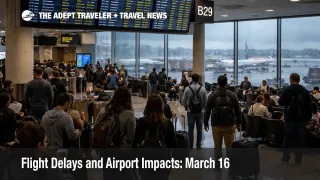
March 16 flight delays are shaping up as a network problem centered on Hartsfield Jackson Atlanta International Airport (ATL), the New York airport cluster, Washington, Chicago O'Hare International Airport (ORD), George Bush Intercontinental Airport (IAH), and later Florida banks. The FAA command center says thunderstorms, rain, wind, low ceilings, and some snow are already driving active or probable ground stops and delay programs across those regions, with Atlanta under an active ground stop earlier in the day and Houston already in a ground delay program. For travelers, the main decision is whether to protect connections before the afternoon and evening squeeze reaches New York, Boston, Philadelphia, Orlando, Tampa, and South Florida.
March 16 flight delays matter because the FAA is not describing one isolated airport problem. It is describing a connected operating day in which Northeast initiatives, Atlanta and Charlotte flow management, Houston delays, Chicago runway limitations, and Florida thunderstorm planning can stack into missed connections and late inbound aircraft by tonight.
March 16 Flight Delays: What Changed
What changed on March 16 is that the FAA's live operations plan moved from a broad weather warning into a specific list of active and probable controls. The FAA said Atlanta had an active ground stop until 1230 UTC and a Delta mainline and Delta Connection ground delay program until 1459 UTC, while Houston had a ground delay program active until 00:59 UTC on March 17. The same advisory flagged possible or probable programs later in the day for ORD, LaGuardia Airport (LGA), Charlotte Douglas International Airport (CLT), Ronald Reagan Washington National Airport (DCA), Orlando International Airport (MCO), John F. Kennedy International Airport (JFK), Boston Logan International Airport (BOS), Newark Liberty International Airport (EWR), Philadelphia International Airport (PHL), and later South Florida airports including Miami International Airport (MIA), Fort Lauderdale Hollywood International Airport (FLL), and Palm Beach International Airport (PBI).
The airport specific picture already shows the stress points starting to separate. FAA airport status pages showed Atlanta under a ground delay averaging 1 hour and 17 minutes early Monday morning because of thunderstorms, LaGuardia with 16 to 30 minute departure delays due to low ceilings, and Houston under a ground delay averaging 34 minutes because of wind. Orlando was still listed on time when checked, which is useful because it shows how a normal looking origin can still sit inside a later risk window once flow controls spread south and east.
Which Travelers Face the Most Disruption
The most exposed travelers are people connecting through Atlanta, New York, Washington, Chicago, Houston, Charlotte, Philadelphia, Boston, or Florida this afternoon and evening. That is especially true for travelers on short domestic connections, final flights of the night, cruise embarkation day moves into Florida, and international departures that depend on a domestic feeder arriving on time. The FAA advisory explicitly ties the day to Northeast initiatives, storms from Boston through Atlanta and Charlotte, Central and South Florida thunderstorms, and en route constraints across the New York, Washington, Southeast, and Florida airspace chain.
Houston and Chicago are the sleeper risk points in the middle of the map. Houston already has a live delay program, and the FAA says ORD may need a ground stop or delay program because the TRACON may fluctuate between two and three arrival runways for the rest of the day. That matters because delays there do not stay there. A late Houston or Chicago arrival often becomes a late evening departure somewhere else.
Travelers already booked on Delta should also treat the broader East Coast waiver as a sign that the airline expects more than a local weather wobble. Delta's March 16 to 17 waiver covers Atlanta, New York, Philadelphia, Boston, Washington, and many feeder airports, which gives some customers room to move before the tightest banks degrade further.
What Travelers Should Do Now
Travelers flying on March 16 should treat short connections as the main failure point. If you are connecting through Atlanta, New York, Washington, Chicago, Houston, or Florida after midday, a later nonstop, a longer layover, or an earlier departure is usually safer than trusting a thin connection to survive multiple FAA programs. That matters even when your origin airport still looks normal, because the FAA is already managing this as a network problem, not a single station event.
Rebook early if your trip depends on a cruise sailing, an international departure, a same day event, or the last flight to your destination. Waiting makes more sense when you have multiple later flight options, an overnight cushion, or a nonstop that avoids the main pressure points. Delta travelers should check whether the March 16 to 17 waiver covers their itinerary before the afternoon push, because proactive rebooking is usually cheaper in time than trying to reaccommodate after hubs go into full delay programs.
Over the next 24 to 72 hours, watch whether the Northeast and Florida evening banks recover cleanly, and whether Washington area operations stay stable after Friday's air traffic control outage story. A day like this can leave aircraft, crews, and passengers out of position even after the heaviest weather passes. Related context is in Flight Delays and Airport Impacts: March 15, Washington ATC Outage Delays DCA, IAD, BWI, RIC, and U.S. Air Traffic Control Privatization: Reality Check.
How the Disruption Spreads Through Travel
The mechanism is straightforward. Storms, low ceilings, wind, and runway constraints reduce how many arrivals an airport can safely accept, so the FAA meters traffic with ground stops, ground delay programs, and routing changes. On March 16, the agency's own plan shows that process already underway in Atlanta and Houston, with probable follow on controls at LaGuardia, Washington National, JFK, Boston, Newark, Philadelphia, Orlando, Tampa, and South Florida later in the day.
The second order effects are what break trips. An aircraft that arrives late into Atlanta or Houston may miss its next departure slot, which can then tighten a connection at New York or Florida, which then leaves fewer seats for reaccommodation by evening. The FAA also flagged route closures and constraint zones across the Northeast, Southeast, and Florida, plus heavy snowbird volume and ski country traffic, which means even travelers not flying into the worst weather can still be delayed by system balancing. That is why March 16 looks less like one airport having a bad day and more like a broad irregular operations day for the eastern half of the network.