

Dubai Airport Resumes, But Hub Risk Deepens
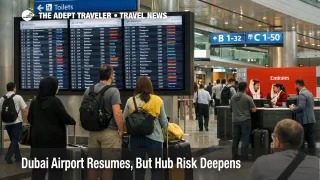
Dubai airport disruptions entered a new phase on March 17, 2026. Dubai Airports said some flights resumed at Dubai International Airport (DXB) after a temporary suspension, and Emirates said it was running a reduced schedule after the partial reopening of regional airspace. What changed since prior coverage is that Dubai is no longer just dealing with a one off airport stoppage. Travelers now face a repeat interruption pattern, with Monday's airport suspension followed by another UAE airspace precaution on Tuesday, while British Airways hardened its own retreat from Dubai and several other Middle East markets. For travelers, that means DXB may be open, but it is still a weak place to trust for same day connections or self built itineraries.
This is the practical shift from earlier "wait and see" advice. A hub can reopen before it becomes reliably useful. Dubai Airports is still telling passengers to check with their airlines, and Emirates is still describing operations as reduced rather than normal. That is the signal travelers should use. The main decision is not whether DXB is technically open, but whether your specific airline, connection bank, and backup options are strong enough to survive another short notice disruption.
Dubai Airport Disruptions: What Changed
The confirmed change is operational, not cosmetic. Dubai Airports says some flights resumed after the suspension, and Emirates says it is operating a reduced schedule as of its March 17 update. Reuters also reported that British Airways extended its temporary flight cuts across the Middle East on March 16, underscoring that major foreign carriers still see the region as unstable enough to keep trimming service rather than rebuilding it.
That matters because Dubai's role in the global system is not only origin and destination traffic. DXB is one of the world's biggest long haul connection machines. When it runs in a reduced or stop start pattern, the problem spreads beyond Dubai holidays. It hits Europe to Asia trips, Africa to North America routings, premium cabin award plans, cruise positioning flights, and business itineraries built around short transfer windows. Adept's earlier Dubai Airport Shutdown Exposes DXB Hub Failure already framed that risk. The new fact is that the system has now shown repeat interruption, not just a single bad day.
British Airways' move sharpens that signal. Reuters reported on March 16 that BA extended cuts across the region, and your update adds that the airline's Dubai suspension now runs until at least June, with Amman, Bahrain, and Israel also pushed to June, and Qatar to April 30. That is not how airlines behave when they expect a clean near term recovery. It is how they behave when they want customers to stop betting on a quick normalization.
Which Travelers Face the Most Risk at DXB
The most exposed travelers are people using Dubai as a same day transfer point rather than ending their trip there. If your itinerary depends on a short onward connection, a separate ticket, an overnight you have not booked, or a carrier change between airlines, your risk remains high even with flights resuming. A reduced schedule can still break the timing that makes a hub useful, especially when aircraft and crews are out of position from earlier suspensions.
The next group is travelers flying on foreign carriers that have not restored a stable Dubai pattern. Even when Emirates and other UAE based operators recover some flow, that does not automatically rebuild the foreign airline side of the airport. Monday's restart and Tuesday's airspace precaution make it harder for non local carriers to trust the schedule, and some are still canceling or reducing service outright.
The least exposed travelers are those with Dubai as a final destination, a single protected ticket on a UAE carrier, and the flexibility to absorb delays or an extra night. Even then, the risk is not gone. Emirates is still running reduced operations, which means passengers should expect some schedule changes, longer recovery times, and tighter seat availability if they need to be rebooked.
What Travelers Should Do Now
For departures or connections in the next 24 to 72 hours, verify directly with the operating airline before going to the airport. Treat any self connect through Dubai as fragile. If your onward segment is on a separate ticket, the safer move is usually to rebuild the itinerary into a longer connection or a different hub rather than assume a resumed operation is a stable one. Travelers already in the region should also keep hotel and transfer plans flexible, because a flight operating on paper can still arrive too late to save the rest of the trip.
Rebook now rather than wait if your trip is time sensitive, your connection at DXB is short, or your airline has already cut regional service deeper into spring. Waiting can preserve fare flexibility if the system improves, but it can also leave you chasing the same limited replacement seats after another disruption wave. That tradeoff is now more obvious because Dubai has shifted from a reopened hub story to a repeat interruption story.
Over the next day or two, watch three things. First, whether Emirates expands beyond a reduced schedule. Second, whether Dubai Airports changes its passenger advisory language toward a clearer normal operations posture. Third, whether more non UAE carriers extend suspensions the way British Airways has. Adept's earlier British Airways Asia Reroutes Reshape Gulf Exits remains relevant here, because once Gulf hubs weaken, airlines often try to push displaced demand through alternate Asia gateways instead.
Why Dubai's Recovery Is Still Fragile
The mechanism is simple. Airports do not fail only when runways close. Hubs fail when the timed wave structure that supports connections stops holding together. A temporary suspension, followed by reduced flying, then another sovereign airspace precaution the next day, breaks aircraft rotations, crew planning, connection banks, baggage flow, and rebooking inventory. That is why a hub can be technically open and still function poorly for travelers.
First order, travelers see delays, cancellations, missed connections, and rolling schedule changes. Second order, the stress spreads into hotel inventory, airport transfer timing, tour starts, cruise embarkation plans, and substitute hubs in Asia and Europe that absorb displaced demand. Financial Times reported that Dubai's Monday suspension lasted about seven hours and that many flights remained delayed or canceled afterward, which fits the pattern of a restart that restores movement before it restores reliability.
That is also why British Airways' longer suspension matters beyond BA customers. Each major carrier that stays out of Dubai removes another slice of normal connection utility from the market. The result is a hub that may still process flights, but with less redundancy, less reaccommodation capacity, and less confidence for travelers building complex itineraries. For now, Dubai remains usable for some trips, but it is still a poor place to gamble on tight same day connections.
Sources
- Passenger Advisory, Dubai Airports
- Travel Updates, Emirates
- British Airways extends flight cuts in Middle East, Reuters
- UAE airspace briefly closed due to missile, drone threat, Reuters
- Dubai flights delayed or cancelled after latest drone and missile attacks, Financial Times
- Dubai Airport Shutdown Exposes DXB Hub Failure
- British Airways Asia Reroutes Reshape Gulf Exits