

Saudi Consular Suspension Cuts Eid Travel Options
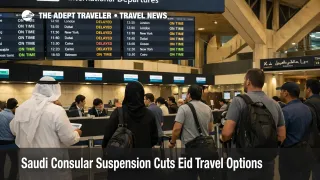
Saudi consular suspension in Saudi Arabia tightened again on March 20, 2026, just as the Eid al Fitr holiday window reduced normal embassy responsiveness. The practical change is not only the security environment, but the loss of routine U.S. consular services while the State Department still says commercial flights are significantly disrupted and missile and drone threats remain active. For travelers, this raises the cost of any passport, visa, detention, or missed flight problem that forces extra days in country. Travelers should move only with current documents, medications, and an exit plan that does not depend on same day embassy help.
Saudi Consular Suspension: What Changed
The new operational fact is sharper than a general Level 3 warning. A March 20 security alert carried by OSAC from the U.S. Mission in Saudi Arabia says the embassy and consulates have suspended all routine consular services, that Mission Saudi Arabia is closed for Eid al Fitr from Thursday, March 19, to Tuesday, March 24, 2026, and that non emergency inquiries will be addressed on March 25. The same alert says Riyadh, Jeddah, and Dammam airports remain open, but travelers should expect possible delays and cancellations and check status directly with their airline.
That matters because Saudi Arabia was already operating inside a harder risk posture before this latest alert. The State Department's March 13 travel advisory kept Saudi Arabia at Level 3, said commercial flights were still operating but had been significantly disrupted, and warned that the U.S. government has limited ability to offer emergency services because of safety risks. It also points to continuing drone and missile threats, the possibility of falling debris, and added exposure around transportation hubs, hotels, and places where foreigners gather.
In an earlier Adept Traveler article, Saudi Arabia Travel Advisory Hardens Risk focused on the broader warning posture. What changed on March 20 is that the consular side tightened again, and that changes the traveler decision chain. A disrupted flight market is one problem. A disrupted flight market plus suspended routine consular access during a holiday window is a more fragile operating environment.
Which Travelers Face the Most Exposure
The most exposed travelers are not only tourists with flexible plans. The higher risk group includes anyone whose passport is expiring, anyone whose passport is already with the embassy, anyone dealing with visa or overstay issues, anyone facing arrest or detention concerns, and anyone trying to leave on a tightly timed itinerary that cannot absorb a canceled or delayed departure. The March 20 alert says passports currently held by the U.S. Embassy in Riyadh are being returned by courier, but Americans without a valid passport may have to wait for security conditions to permit passport services.
Overstay and exit problems deserve more attention than many travelers give them. The March 13 advisory says U.S. citizens have been prevented from leaving Saudi Arabia under exit bans, and explicitly notes that these can be tied to unpaid visa overstay fees, civil or criminal investigations, family disputes, labor disagreements, or other unresolved matters. In plain language, a missed departure is not always just a hotel and rebooking problem. In some cases it can become an immigration, legal, or financial problem that is harder to unwind when routine consular channels are paused.
Travelers depending on prescriptions are also more exposed during this window. The State Department says many prescription medications require prior approval before being brought into or taken out of Saudi Arabia, and that the registration process can take several weeks. That turns a normal packing oversight into a bigger risk if a flight delay, extended stay, or shelter in place period leaves a traveler short on medication while routine consular support is thinned out.
What Travelers Should Do Now
The right move starts with a document audit before any intercity transfer, airport run, or weekend side trip. Travelers should confirm passport validity, keep both digital and paper copies of identity and travel records, verify visa status, save airline booking references offline, and keep enough medication on hand to absorb several extra days in country. The current U.S. guidance also says travelers should have documents up to date and easily accessible, maintain contact with family, and be prepared to shelter in place with food, water, medications, and other essentials.
For travelers whose plans are still movable, the main threshold is simple. Rebook earlier if your itinerary depends on a tight onward connection, a one night airport hotel stay, a passport issue that is not fully resolved, or a same day transfer between cities. Wait only if your documents are clean, your airline is still operating your flight, and you can absorb a delay without creating a visa, prescription, or onward booking problem. This is the same logic Adept Traveler outlined in UAE Border Congestion Complicates Overland Exits, where the problem was not just whether movement was possible, but whether the paperwork and timing were strong enough to survive friction.
What to monitor next is narrower than a generic "watch the news" instruction. Watch for changes to U.S. Mission operating status after March 24, airline notices for Riyadh, Jeddah, and Dammam departures, and any new warnings about shelter in place or threats near hotels and gathering points. If you are already in Saudi Arabia and your problem is urgent, the March 20 alert points travelers to American Citizen Services emails in Riyadh, Jeddah, and Dhahran, and to the State Department emergency numbers for help outside normal channels.
Why the Risk Window Is Still Fragile
The mechanism here is straightforward. Saudi airspace is not fully shut, but it is operating under frequent restrictions tied to continuing missile and drone threats, while the U.S. mission is simultaneously telling Americans to depart by commercial flights if they can do so safely and advising those who stay to be ready to shelter in place. That creates a split system where movement is still possible, but support for problems that emerge during movement is thinner than usual.
The first order effect is thinner consular access during a holiday period. The second order effect is that ordinary travel friction carries more consequence. A canceled departure can mean extra hotel nights near locations the U.S. alert says may be potential targets. A missed connection can push a traveler into overstay, medication, or document problems. A routine passport issue can become a waiting game tied to security conditions, not just office hours. Until the mission restores routine services and flight operations normalize more clearly, Saudi Arabia remains a place where the margin for error is smaller than many travelers expect.