

Spain Airport Strikes Threaten Easter Flight Plans
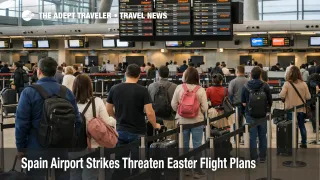
Spain airport strikes are turning into an Easter planning problem, not just a labor headline. Ground handling walkouts tied to Groundforce and Menzies are scheduled to begin as Semana Santa travel builds, starting on March 27, 2026, and hitting some of Spain's busiest gateways during the same period when Aena's network typically handles very high spring passenger volumes. For travelers, the main risk is not an automatic mass grounding of flights, but slower baggage handling, longer check in lines, delayed boarding, and knock on delays that can break tight onward plans. The practical move now is to protect the most time sensitive part of the trip first, especially flights with checked bags, short connections, cruise embarkations, or same day rail and hotel commitments.
Spain Airport Strikes: What Changed
The current action involves two overlapping labor patterns. Groundforce staff are reported set to begin an indefinite partial strike from Friday, March 27, 2026, with stoppages on Mondays, Wednesdays, and Fridays during three daily windows, 500 a.m. to 700 a.m., 1100 a.m. to 500 p.m., and 10:00 p.m. to midnight. Separate 24 hour strikes affecting Menzies handling staff are reported for March 28 to 29 and April 2 to 6, 2026, with warnings that actions could continue later in the year if no deal is reached.
Those time blocks matter because they hit the parts of the day when airports have the least slack. Early morning stoppages can slow first wave departures before the system has room to recover. Midday stoppages can drag out aircraft turnarounds, baggage transfers, and gate operations. Late evening disruption is where stranded bags, missed final flights, and forced overnights become more likely. Spain has dealt with this kind of handling disruption before, and the pattern is usually operational degradation first, full cancellation waves second.
The affected airport list in current reporting includes Adolfo Suárez Madrid-Barajas Airport (MAD), Josep Tarradellas Barcelona-El Prat Airport (BCN), Málaga-Costa del Sol Airport (AGP), Alicante-Elche Miguel Hernández Airport (ALC), Palma de Mallorca Airport (PMI), Gran Canaria Airport (LPA), Tenerife South Airport (TFS), Tenerife North-Ciudad de La Laguna Airport (TFN), César Manrique-Lanzarote Airport (ACE), Fuerteventura Airport (FUE), Valencia Airport (VLC), Ibiza Airport (IBZ), and Bilbao Airport (BIO). That is a broad enough footprint to affect both domestic Spanish flows and the Easter-heavy UK, German, and wider European leisure markets.
Which Travelers Face the Most Disruption
The most exposed travelers are the ones who depend on the airport ground layer working smoothly, even if the flight itself remains on the board. That means passengers checking bags, families moving with strollers or special assistance needs, travelers on separate tickets, and anyone trying to make a short haul connection into a long haul departure. Ground handling is the chain between curb and cabin, check in, bag drop, baggage sort, loading, unloading, gate processing, and aircraft turnaround. When staffing drops inside that chain, the whole airport can slow without formally shutting down.
Leisure islands and coastal gateways are especially vulnerable because Easter traffic tends to be dense, price sensitive, and less forgiving when one part of the itinerary slips. Palma de Mallorca, Málaga, Alicante, the Canaries, and Ibiza are not just endpoints, they are also places where the next transport layer, hotel transfers, ferries, car hires, tours, and resort check in windows, often runs on a tight same day schedule. A one hour bag or boarding delay can turn into a missed final ferry, lost rental pickup, or late hotel arrival fee.
Madrid and Barcelona bring a different kind of risk. These hubs are where disrupted local handling can spill into network timing, because slower turns and slower baggage transfers can affect onward European, transatlantic, and Latin America connections. In an earlier Adept Traveler article, Iberia Adds Madrid Newark Flights From March 2026, Madrid was already becoming more important for long haul connectivity at the end of March. A handling slowdown there does not need a huge cancellation count to create real traveler damage. A few late inbound aircraft and slower transfer processing can be enough to break protected and unprotected onward plans.
What Travelers Should Do Now
The first decision is baggage. For any flight touching one of the affected airports during the strike dates, carry on only is the cleaner play when the trip allows it. Most ground handling labor actions hurt checked baggage before they fully break the schedule, because bags depend on sort, load, unload, and reclaim staffing at multiple points in the chain. If you must check a bag, build more airport time on both ends and use your airline's bag tracking tools before you leave for the airport.
The second decision is connection design. Do not trust a legal minimum connection as a safe connection during Spain airport strikes. Rebook or pad itineraries if the trip includes a cruise embarkation, a nonrefundable event, a final domestic hop, or a long haul departure that is hard to replace. Waiting may be reasonable for a simple point to point trip with flexible dates. It is not the smart play for separate tickets or high consequence departures. For broader strike planning logic, Europe Transport Strike Dates 2026 for Flights and Trains remains the better framework than watching one airport in isolation.
The third decision is rights and recovery. Under EU passenger rights rules, travelers affected by cancellations or long delays may still be entitled to rerouting or reimbursement, and carriers still owe care obligations while passengers wait for alternative transport. Spain's aviation authority, AESA, also points travelers to information, care, and rebooking or reimbursement rights in strike related disruption cases. Keep receipts if the airline fails to provide required care.
Why This Is Happening, And What Happens Next
The labor dispute is being framed in current reporting around pay recovery, working conditions, and pressure for broader labor agreements in Spain's airport handling sector. A January 2026 BOE publication confirms that the sector wide ground handling agreement was updated last year, which shows the labor framework is still active and contested rather than settled background noise. What is not yet clear, at least from the official materials I found, is the exact minimum service order that will govern these specific Easter 2026 walkouts. That means travelers should assume some flights will run, but should not assume normal processing speeds.
The next operational question is whether mediation narrows the strike calendar before March 27, 2026, or whether published minimum services materially blunt the effect. If no deal lands, the likely first order consequence is uneven airport processing during peak banks, not blanket shutdowns. The second order effect is where this becomes expensive, missed onward flights, longer taxi and transfer waits, lost half days on island or resort trips, and weaker same day rebooking options as Easter demand compresses into fewer usable seats. Aena's April 2025 traffic data, when Easter also fell in April, shows how large the passenger base can be, with more than 27.2 million passengers across its Spain network that month. That is why even partial airport friction can become a real trip-planning problem during Holy Week.
Sources
- Easter airport strikes in Spain: what travellers need to know
- Easter strikes at Spanish airports could cause missed connections and slow boarding
- Los aeropuertos del Grupo Aena registran 32,3 millones de pasajeros en abril de 2025
- Los aeropuertos del Grupo Aena registran más de 28,7 millones de pasajeros en marzo de 2025
- Resolución de 7 de enero de 2026, Acuerdo de modificación del V Convenio colectivo general del sector de servicios de asistencia en tierra en aeropuertos
- Air passenger rights, Your Europe
- Air passenger rights, European Commission
- Conoce tus derechos si te afecta la huelga de handling en el aeropuerto Josep Tarradellas