

China Fuel Export Ban Raises Asia Travel Risk
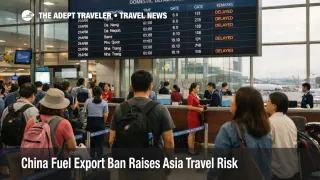
China's refined fuel export halt has turned a string of country level fuel problems into a broader Asia fuel travel risk story. Reuters reports Beijing has banned exports of diesel, gasoline, and jet fuel until at least the end of March 2026, removing a major regional swing supplier just as Middle East disruption has already tightened Asian fuel markets. For travelers, the immediate point is not that Asia is heading into a uniform shutdown. It is that some destinations are now moving from higher prices to thinner transport buffers, and the first visible breakpoints are likely to show up in domestic flights, ferries, regional road transfers, and fuel surcharges before they show up in headline airport closures.
The Asia fuel travel risk now matters because this is no longer only about local mismanagement or one country's supply problem. China's withdrawal tightens the regional backup system itself, which means travelers should watch for whether affected countries are still absorbing the shock through price relief and stock releases, or whether they begin protecting domestic supply through schedule cuts, rationing, and operating restrictions.
Asia Fuel Travel Risk: What Changed
What changed is the center of gravity. Reuters reported on March 17 that China has halted exports of diesel, gasoline, and jet fuel until at least March 31, 2026, tightening an already strained regional market. That matters because China is one of Asia's biggest refined product suppliers, and Reuters described it as the region's swing exporter, the market that can still send volumes when others pull back. With other suppliers in South Korea, Thailand, and India also tightening controls, the loss of Chinese export barrels is not easy to replace quickly.
The first order effect is more expensive and harder to source fuel across Asia. Reuters said Asian jet fuel had already surged to about $163 a barrel, diesel to roughly $150, and gasoline to nearly $140. The second order effect is travel system fragility. Airlines, bus operators, ferries, and tour companies can tolerate price pain for a while, but when importers cannot secure physical supply or enough working capital, published schedules start to lose slack. That is when travelers move from paying more to missing connections.
Which Destinations Look Most Exposed
Vietnam now looks like the clearest traveler facing aviation risk. Reuters reported on March 16 that the Civil Aviation Authority of Vietnam warned airlines to reassess schedules, especially domestic routes, and asked airports to prepare more aircraft parking because importers said they could only guarantee jet fuel through March. Reuters also reported Vietnam previously sourced about 60 percent of its imported jet fuel from China and Thailand, which makes it the cleanest example of the problem jumping from market stress to possible flight cuts. Travelers building multi city Vietnam trips for April should treat domestic sectors as the weakest link. Related coverage already live on Adept is Vietnam Jet Fuel Warning Puts April Flights at Risk.
Australia is exposed differently. It is not at the same immediate threshold for flight cuts, but it is already using government tools to protect supply. Reuters reported Australia released petrol and diesel from emergency reserves on March 13, and Energy Minister Chris Bowen's official statement said up to 762 million litres could be targeted toward localized disruption, especially in regional areas. That makes Australia more of a regional mobility and cost story right now than a national airport shutdown story, but it still matters for long road trips, self drive itineraries, remote touring, and thinner regional air networks that depend on reliable supply chains. Adept's related piece is Australia Fuel Reserve Move Flags Regional Travel Risk.
Bangladesh and the Philippines sit in the middle of the spectrum. Reuters named both as countries especially reliant on Chinese fuel supply. In Bangladesh, the U.K. Foreign, Commonwealth & Development Office warns that fuel sales limits may lead to transport disruption and delays in some areas, which is a strong sign the problem has already touched day to day mobility. In the Philippines, the government is still in price mitigation mode, with Reuters reporting lawmakers moved to give the president temporary power to cut or suspend fuel taxes. That suggests Manila is still trying to contain the shock before it becomes an outright service reliability problem. Travelers should read Bangladesh as already showing ground friction, and the Philippines as a watchlist story where worsening availability would matter more than prices alone. Related Adept coverage includes Bangladesh Fuel Rationing Slows Ground Travel.
What Travelers Should Do Now
For trips inside the next two weeks, the smartest move is to simplify, not just to search for lower fares. Travelers most exposed are those stitching together domestic flights, ferry crossings, long road transfers, or remote touring in countries already showing official stress signals. In practical terms, one gateway city with one reliable onward leg is safer than a chain of self connected segments that depends on normal fuel availability and normal dispatch patterns.
The rebook versus wait threshold is straightforward. Rebook early if your trip depends on Vietnam domestic flying in April, rural or regional Australia road fuel access, or Bangladesh surface transfers with little slack. Wait, but monitor closely, if your exposure is mostly to the Philippines and you still have schedule flexibility, because current public action there is aimed more at cushioning price pressure than rationing travel services. Across all four markets, watch for three signs that the problem is jumping from inflation to cancellation, official advice telling carriers to trim schedules, airport or port operators warning of reduced services, or governments announcing priority allocation for essential transport.
Over the next 24 to 72 hours, the main thing to monitor is whether more countries move from relief measures to preservation measures. Once governments start ring fencing fuel for core services, tourism transport becomes less protected. That is why the Asia fuel travel risk story now intersects directly with already stressed aviation fuel markets. It does not require a full regional shortage to disrupt trips. It only requires enough schedule thinning and transfer unreliability to break the margin travelers normally count on.
Why China's Ban Spreads Beyond Prices
A swing exporter is the supplier that helps balance a regional market when others cannot. China has played that role in Asia because of its large refining system and ability to move refined products into nearby markets. When that supplier steps back, countries that were already leaning on imports have fewer fast substitutes, and replacement cargoes often have to travel farther and cost more. Reuters also reported that companies are already rerouting shipments from farther afield, including the United States to Australia, which lengthens logistics chains and raises the odds of localized mismatch even when supply still exists somewhere in the market.
That is why the disruption spreads unevenly. Major hub airports may continue operating while regional routes, domestic banks, bus networks, ferries, and resort transfers grow less reliable. The system usually breaks first at the edges, where margins are thinner and alternatives are fewer. For travelers, that means the risk is less about a dramatic pan Asia stop, and more about whether your itinerary depends on low buffer segments inside countries now losing access to one of the region's main fuel backstops. That is the real mechanism behind the Asia fuel travel risk story through the end of March.
Sources
- China's fuel export ban to further tighten Asia supply
- China orders immediate ban on March fuel exports, sources say
- Vietnam braces for flight cuts from April after China, Thailand ban jet fuel exports
- Philippines' lower house grants president power to ease fuel taxes
- Australia releases petrol and diesel from emergency reserves
- More fuel for regional Australians
- Bangladesh travel advice
- Vietnam Jet Fuel Warning Puts April Flights at Risk
- Australia Fuel Reserve Move Flags Regional Travel Risk
- Bangladesh Fuel Rationing Slows Ground Travel