

BWI Checkpoint Closures Tighten Departure Risk
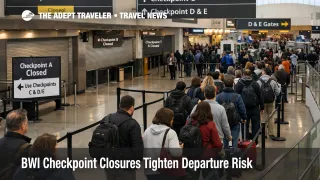
Baltimore area travelers now face a more concrete departure problem than a general TSA staffing warning. At 11:50 a.m. on March 24, 2026, Baltimore/Washington International Thurgood Marshall Airport (BWI) posted that Security Checkpoints A and B were temporarily closed, said wait times were currently minimal but could change through the day, and told passengers to arrive three hours before scheduled departure. The practical consequence is narrower screening access at a busy airport where travelers usually spread across multiple entry points. Anyone flying out of BWI on March 24 should protect the outbound first, arrive earlier than normal, and assume the airport is running in a fragile mode until checkpoints reopen or normal wait time reporting returns.
BWI Checkpoint Closures: What Changed
What changed is not just that BWI warned of long lines. The airport shifted from a variable wait time story into a terminal flow story. Its official alert said both A and B were temporarily closed as of 11:50 a.m., and local reporting said Checkpoint A had been closed all day while B closed around noon, leaving Checkpoint C and the D/E checkpoint carrying the screening load. BWI also pulled or limited public wait time visibility, which removes one of the few tools travelers normally use to judge whether they can still salvage a tight departure window.
BWI's terminal map explains why that matters. The A, B, and C side handles a large share of the airport's domestic flow, especially Southwest Airlines traffic, while the D/E side is also used by American Airlines, Delta Air Lines, United Airlines, Spirit Airlines, Frontier Airlines, jetBlue, Alaska Airlines, Air Canada, and several international carriers. When two checkpoints close on one side of the building, the problem is not only a longer line. It is the loss of routing flexibility for passengers, drop offs, and bag check patterns that were built around multiple nearby screening options.
Which Travelers Are Most Exposed at BWI
The most exposed travelers are passengers in BWI's heavier domestic departure banks, especially Southwest flyers and other travelers who would normally enter through the A, B, or C side. That group now has fewer screening choices, more risk of bunching at the remaining checkpoint, and less room to recover if a parking, shuttle, or bag drop delay hits before security. Short haul business travelers are especially vulnerable because their itineraries often depend on thin airport buffers and limited same day meeting flexibility.
The second order effect starts before the scanner. Earlier arrival advice shifts pressure into parking garages, rental car returns, terminal curbs, and staffed counters. A traveler who reaches BWI on time for a normal day can still fail the trip earlier in the chain if curb congestion or check in friction eats the margin before security. In an earlier Adept Traveler article, U.S. Shutdown Airport Risk Shifts to Continuity, the broader warning was that airport risk could move from long lines into continuity problems when staffing strain starts changing how checkpoints operate. BWI now fits that pattern directly.
What Travelers Should Do Now
For March 24 departures, travelers should treat three hours as the operating baseline at BWI, not as a worst case suggestion. That matters most for anyone who still needs to park, return a rental car, check bags, travel with children, or move through the airport during late afternoon and evening departure banks. If missing the flight would break something expensive or difficult to rebuild, such as a cruise embarkation, international long haul ticket, same day business meeting, or nonrefundable event, the right move is to protect the departure and absorb the extra airport time.
The decision threshold is simple. Rework the airport timeline now if your plan assumes a normal checkpoint choice, a quick bag drop, or a late arrival to the terminal. Waiting is only defensible for travelers on fully point to point trips with several later flight options and low downstream cost if the first departure is missed. Everyone else should assume that the screening bottleneck can worsen faster than the airport's public messaging updates. Travelers should also monitor airline apps closely, because a missed outbound in the current U.S. shutdown strained system is harder to repair once later seats start disappearing. Related coverage on the wider operating backdrop is in Flight Delays and Airport Impacts: March 24.
Why BWI Became a More Serious Screening Bottleneck
Airport security is a throughput system, which means it can look manageable until one or two intake points disappear. BWI's own alert said wait times were minimal at 11:50 a.m., but that should not be confused with normal operating resilience. When an airport closes two checkpoints and still tells travelers to arrive three hours early, it is signaling that flow is being held together with less slack than usual and that conditions can deteriorate later as passenger banks build.
That is also why BWI matters beyond Baltimore, Maryland. National reporting over the past several days has shown TSA absences and resignations rising during the partial shutdown, while some airports have reduced or shifted checkpoint operations rather than keeping every screening point open. BWI is not a systemwide collapse story by itself, but it is a clear terminal level example of how the risk has changed. The next stabilization signal is straightforward, checkpoint reopening, restored wait time reporting, or the removal of the three hour arrival warning. Until one of those appears, BWI checkpoint closures remain a real same day departure risk rather than a routine inconvenience.