

BWI Checkpoint Closure Raises Same Day Airport Risk
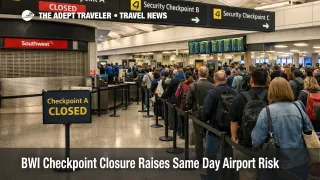
Baltimore area travelers now have a more specific airport problem than the broad U.S. shutdown warning alone. At 8:25 a.m. on March 25, Baltimore/Washington International Thurgood Marshall Airport (BWI) posted that Security Checkpoint A was temporarily closed and told travelers to arrive three hours before scheduled departure. That shifts BWI from a general staffing risk into a real same day screening constraint, especially for passengers who normally use the airport's A, B, or C entry pattern. For travelers flying today, the practical move is to leave earlier than usual, avoid thin check in buffers, and treat security as the part of the trip most likely to break first.
BWI Security Checkpoint Closure: What Changed
What changed is not just that lines may run longer. It is that BWI has lost one of its standard screening entry points while still telling passengers that waits can change through the day. The airport's public alert does not include an end time for the closure, which means travelers cannot plan around a short disruption window with much confidence yet. That uncertainty is the real operational shift. When an airport says one checkpoint is closed and advises a three hour arrival buffer even while waits are currently minimal, it is signaling that flow can deteriorate faster than normal as passenger banks build.
BWI's terminal layout makes that more consequential than it sounds. The airport map shows Southwest Airlines and American Airlines passengers feeding through the A, B, and C checkpoint side of the terminal, while United Airlines, Air Canada, Alaska Airlines, Allegiant Air, Avelo Airlines, Copa Airlines, Delta Air Lines, Frontier Airlines, jetBlue, Spirit Airlines, Sun Country, and several international carriers feed through the D/E side. A closure at Checkpoint A does not shut the airport down, but it removes one normal intake point from the side of the building used by BWI's heaviest domestic bank.
That is why BWI now looks like the next stress point rather than just another airport issuing vague caution. In an earlier Adept Traveler article, U.S. Shutdown Airport Risk Shifts to Continuity, the broader warning was that TSA staffing strain could evolve from long lines into checkpoint continuity problems. BWI now fits that pattern directly. Reuters reported on March 20 that TSA absences were already elevated at major airports and warned that large hubs could start compressing operations by closing checkpoints rather than maintaining normal screening coverage.
Which BWI Travelers Face the Most Disruption
The most exposed travelers are the ones departing in the airport's heavier domestic waves, especially passengers on Southwest, plus some American departures, because those travelers are more naturally drawn toward the A, B, and C checkpoint side that now has less screening flexibility. The problem is not only queue length. It is the loss of choice. A traveler who would normally shift between nearby checkpoints to save time now has fewer workable options, which makes line spikes harder to absorb.
Business travelers on short same day trips are also exposed because their plans usually depend on tight preflight timing. A 30 to 60 minute slip at security can turn a workable day trip into a missed outbound, then a missed meeting, then a full rebook. Leisure travelers are less schedule sensitive in some cases, but they are more likely to travel with checked bags, family groups, and parking or drop off friction, which means the checkpoint problem starts earlier at the curb. First order, screening absorbs more time. Second order, parking decks, departures curbs, and airline counters start carrying the pressure too.
Travelers connecting beyond BWI feel the effect differently. The airport may still operate normally enough to keep flights moving, but a missed first segment becomes harder to repair in the middle of a shutdown strained system. Reuters reported this week that more than 100 airport leaders urged Congress to resolve the TSA funding standoff, warning that the damage to airport operations and passenger experience is already serious and worsening. That means missed flights are landing inside a system with less slack than usual.
What Travelers Should Do Now
For departures today, travelers should treat three hours as the working BWI baseline, not as a worst case suggestion. That matters most for passengers who still need to park, check bags, return rental cars, or move through a family departure routine. Travelers with only carry on bags and flexible schedules may move through faster, but the airport has already signaled that conditions can change through the day, so building a normal buffer is the wrong bet right now.
The decision threshold is simple. If missing the flight would break something expensive or hard to rebuild, such as a business meeting, cruise embarkation, long haul connection, or prepaid same day event, shift earlier and protect the outbound. If the trip is fully point to point, multiple later flights exist, and the downstream consequences are limited, waiting is more defensible. At BWI, the real cost of underestimating the checkpoint problem is not just a longer line. It is losing the day's itinerary before the flight itself becomes the issue.
Travelers should also watch for one clear stabilization signal. The airport needs to either remove the closure alert or stop recommending a three hour arrival buffer. Until one of those changes appears, BWI has not returned to normal screening flow. If additional checkpoints start closing, if the airport stops giving checkpoint specific detail, or if other hubs keep posting the same warnings, that would point to a wider continuity problem rather than a brief local disruption.
Why BWI Became the Next Stress Point
The mechanism is straightforward. Airport security is a bottleneck system, and bottlenecks do not fail gracefully once staffing stays thin long enough. A hub can absorb some absenteeism by stretching lines, redistributing travelers, and using other checkpoints harder. Once one checkpoint is taken out of the normal pattern, though, the airport starts relying on concentration rather than flexibility. That is manageable for a while, but it leaves less room for routine peaks, slower bag drops, weather related departure bunching, or an early rush of spring travelers.
That is also why BWI matters beyond Baltimore. Reuters reported on March 20 that major airports were already facing elevated TSA absences, and the airport industry's March 23 warning said the funding standoff is causing serious, rapidly worsening disruption across U.S. airports. BWI is not the largest airport in that national story, but it is now offering a visible version of what system stress looks like at the terminal level, a specific checkpoint closure, a three hour arrival warning, and no published end time yet. Until the BWI security checkpoint closure clears, travelers should assume the airport remains in a fragile operating mode rather than a normal one.