

Houston TSA Delays Turn IAH Into a Hub Risk
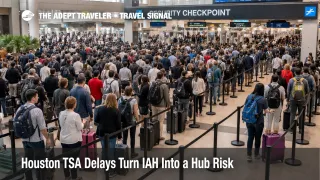
Houston TSA delays at George Bush Intercontinental Airport (IAH) on March 26, 2026, have moved beyond a bad checkpoint day and into a real hub planning problem. Houston Airports said wait times at IAH could reach four hours or longer on Thursday, March 26, and warned that Friday could also run heavy, while Reuters reported that more than 480 TSA officers have quit nationally during the shutdown and that some airports are already seeing waits above four hours. For travelers, the practical shift is simple, departures can still operate, but the screening step is now the part of the trip most likely to fail first. Anyone holding a tight United connection, a same day cruise embarkation, or a fixed resort transfer should treat Houston as an unusually fragile transit point right now.
In an earlier Adept Traveler article, Houston TSA Delays Hit IAH and Hobby on March 23, the issue was already shifting from long lines to checkpoint limits and weaker departure timing. The new change is persistence. Houston is still posting four hour warnings at a major United hub several days later, which makes this less about one ugly rush and more about sustained network fragility.
Houston TSA Delays: What Changed at IAH
The current operating message from Houston Airports is not subtle. Its March 25 update says IAH wait times may reach four hours or longer on Thursday, March 26, that lines may extend outside, and that early morning and peak departure periods are most likely to run longer. The airport system also says conditions can change from one shift to the next because staffing and passenger volumes are moving targets during the shutdown.
That matters more at IAH than at many secondary airports because this is a large hub, not a marginal station. AP reported that Bush handled more than 48 million travelers in 2024, and it is a major United connecting point for domestic traffic, Mexico, the Caribbean, and Latin America. When a hub checkpoint becomes unreliable, the first order effect is missed departures. The second order effect is weaker recovery, fewer seats on later banks, forced overnight stays, and broken onward plans well beyond Houston itself.
Which Travelers and Flights Are Most Exposed
The highest risk sits with travelers whose itineraries depend on timing more than distance. Early departures, short domestic connections, international trips with checked bags, and same day handoffs to cruises, resort shuttles, or nonrefundable ground transfers are the weakest setups. Houston Airports is explicitly telling passengers to plan for waits that can exceed four hours, and Reuters reported that some travelers have already started sleeping at the airport or abandoning the normal hub playbook by switching to Hobby or even driving to Austin, Dallas, or San Antonio for flights.
United customers are especially exposed because IAH is a core United hub, but they should not assume waiver coverage will save them. Local reporting on March 25 said United had offered no fee rebooking for certain IAH departures earlier in the week, with the reported flexibility window tied to original travel through March 25 and rebooked travel through March 27. Other major airlines had not announced matching Houston flexibility at that point. That means a March 26 or March 27 traveler should verify the exact fare rules and any active alerts before relying on Houston as a routine same day connection point.
What Travelers Should Do Now
For departures from IAH, the sensible move is to treat airport arrival time as a risk buffer, not a formality. The airport's own guidance says lines could exceed four hours, so travelers with checked bags or international flights should build for that full window rather than for a normal two or three hour airport routine. Anyone with a very early flight should also think about whether an airport hotel or an earlier trip to the terminal protects the itinerary better than a normal morning drive.
For connections, the tradeoff is between convenience and survivability. Staying on Houston may still work for long layovers and flexible trips. It is a bad bet for short legal connects, same day cruise departures, weddings, tours, or any itinerary where a misconnect triggers a cascade of losses. Travelers who have a realistic option to reroute over a less stressed hub, or to originate at William P. Hobby Airport (HOU) instead of IAH, should compare that cost against the much larger downside of missing the first flight even when the aircraft leaves on time. Houston Airports said National Deployment Officers have had a positive impact at Hobby, and recent reporting has shown Hobby lines can be materially shorter than Bush.
The next decision point is not abstract politics in Washington. It is whether Houston keeps posting four hour warnings into Friday and the weekend, and whether the published checkpoint situation remains volatile. If the airport is still warning of extreme waits on the day before travel, travelers with tight timing should rebook around Houston earlier rather than waiting for the airport to recover in real time.
Why Houston Has Become a Wider Network Problem
Houston has become the shutdown's clearest hub failure because it concentrates several risks in one place, a major United bank structure, spring demand, high TSA absenteeism, and a screening workforce that is still thinning nationally. Reuters reported this week that TSA travel volume is running about 5 percent above last year during spring break, while national absences have climbed above 10 percent and hundreds of immigration and other DHS officers have been deployed to assist at 14 airports. Those support roles may help with line management, but they do not replace trained screening throughput at the checkpoint itself.
That is why Houston matters beyond Houston. A fragile checkpoint at a hub breaks not only local departures, but also the downstream math of the network. Missed morning banks reduce same day reaccommodation, later departures fill faster, and passengers heading to beach destinations, cruise embarkations, and resort transfers lose the slack that normally lets a hub absorb trouble. Travelers making repeated Houston decisions over the next few days should monitor the airport's official wait time page, United alerts, and the Adept Traveler airport page for George Bush Intercontinental Airport (IAH) before locking in short connection strategies.
Sources
- Houston Airports, Government shutdown impacts TSA, passengers
- Reuters, Long lines reported at major U.S. airports as more TSA officers quit
- Reuters, TSA says 460 airport officers quit as standoff poses major security risks
- Associated Press, Houston airport has become a symbol for the shutdown's impacts on air travel
- Houston TSA Delays Hit IAH and Hobby on March 23
- George Bush Intercontinental Airport (IAH)