

Houston TSA Delays Hit IAH and Hobby on March 23
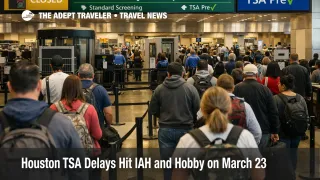
Houston TSA delays worsened on March 23, 2026, as George Bush Intercontinental Airport (IAH) and William P. Hobby Airport (HOU) remained under severe shutdown driven screening pressure. The operating problem is no longer just long lines. It now includes checkpoint consolidation, reduced premium screening options, and more fragile departure timing during a busy spring break window. Travelers departing Houston should build extra time, avoid tight check in and connection plans, and treat airport screening as the part of the trip most likely to fail first.
Houston TSA Delays: What Changed
What changed on Monday is that the Houston disruption became more specific and more restrictive at the airport level. Houston Airports said the federal shutdown that began on February 14 continues to reduce TSA staffing, and Bush posted an updated operating plan for March 23. CLEAR was not operating, TSA could not sustain PreCheck in Terminal A, PreCheck was available only in Terminal C, those lanes were set to close for the day at 10:30 a.m., standard screening was limited to Terminals A, C, and E, and the Terminal D checkpoint was closed. That is a tighter setup than the broader A and C PreCheck wording circulating in some local reporting and social posts.
The staffing numbers behind that change are unusually severe. KHOU reported that DHS data for Friday, March 21 showed a national TSA callout rate above 11.5 percent, while Houston's rates were far worse, 42.4 percent at Bush and 47.4 percent at Hobby. Reuters had already reported Houston Bush at 38 percent on March 19, which shows the problem was already acute before the March 21 spike.
Which Houston Travelers Face the Most Disruption
Bush travelers are the most exposed, especially anyone departing from Terminal D, anyone relying on PreCheck outside Terminal C, and anyone who built their airport timing around CLEAR. The Terminal D closure means some international passengers must check bags in D and then move to Terminal E for screening, which adds a second movement step before reaching the gate. That extra handoff is manageable on a normal day, but it becomes a real weak point when staffing is thin and screening lanes are concentrated.
Hobby remains under pressure too, even if conditions there have at times looked less visibly chaotic than Bush. Houston Airports said National Deployment Officers were sent to Hobby earlier in March after excessive waits, and those officers were still helping as of the March 23 update. That support can improve throughput, but it does not remove the core risk, which is that unpaid TSA staffing remains unstable from shift to shift.
What Travelers Should Do Now
For March 23 departures, the practical move is to arrive at least three hours early for domestic flights and four hours early for international flights, which matches Houston Airports' current recommendation. Travelers flying from Terminal D at Bush should assume a longer pre security process because screening is being rerouted through Terminal E. Anyone who normally depends on CLEAR or on a specific PreCheck checkpoint should recheck the live airport guidance before leaving for the airport, not just once at booking or the night before.
The rebooking threshold is also changing. If you are still at home and your itinerary depends on a short same day connection, a fixed time event, or a nonrefundable tour or cruise handoff later today, paying for a later flight can now be more rational than gambling on a checkpoint that is already running with reduced options. If you are already inside the airport and checked in, the smarter move is usually to stay in the queue and keep the airline app open for backup flights. Houston's main problem is screening access, not a published airport closure.
Why Houston Is Tight, and What Happens Next
The mechanism is straightforward. TSA officers are working without pay during the Department of Homeland Security shutdown, absenteeism has climbed well above normal, and airports respond by closing or consolidating checkpoints so the officers who do report can be concentrated where demand is highest. That protects a minimum operating level, but it also makes the system less resilient. Once one checkpoint closes or one premium lane disappears, queues spill into check in halls, terminal transfers take longer, and missed flights rise faster than the raw staffing percentage alone suggests.
The next variable is whether the new ICE deployment changes anything meaningful for travelers in Houston. Reuters reported on March 23 that DHS sent hundreds of ICE and Homeland Security Investigations officers to 14 airports, while Reuters and AP both reported that the role is tied to assistance and line management rather than replacing TSA behind the checkpoint. That means the deployment may help with crowd flow and visible staffing pressure, but it does not solve the core screening certification problem at airports where TSA officer shortages are driving the bottleneck. Travelers should watch for airport specific updates first, because Houston Airports has not said that ICE support materially changes Bush or Hobby screening availability today. In an earlier Adept Traveler article, U.S. Shutdown Airport Risk Shifts to Continuity the broader U.S. network risk had already moved beyond long lines. In another, U.S. Airports ICE Plan Raises New Travel Risks the main question was whether new federal personnel could ease pressure at the actual bottleneck. Houston now shows that the checkpoint math is still the real problem.
Sources
- Houston Airports, Government shutdown impacts TSA, passengers
- KHOU, Houston airports see highest TSA callout rates in the nation
- Reuters, ICE agents begin deploying at some US airports
- Reuters, Staff absences soar at some US airports as ICE agents prepare to screen travelers
- Reuters, US says TSA absences rose slightly to 10.2% Wednesday
- Reuters, Some small US airports may have to shut due to TSA absences, official says
- AP News, ICE officers will begin assisting TSA as shutdown frustrates travelers and screeners
- AP News, Federal immigration agents seen at Atlanta airport after Trump order amid partial shutdown