

Spain Easter Airport Strikes Meet EES Border Delays
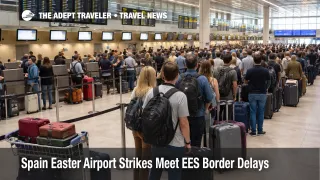
Spain Easter airport strikes are shifting from a planning risk to a live Easter travel problem because ground handling walkouts begin on March 27, 2026, at some of the country's busiest airports, just as the EU's Entry Exit System, or EES, continues its phased airport rollout before full implementation on April 10, 2026. For travelers, the overlap matters most where airport processing is already tight, baggage, check in, boarding, aircraft turnaround, and non EU border control. The practical move now is to protect the most time sensitive parts of the trip, especially checked baggage, short connections, island arrivals, cruise embarkations, and late night arrivals tied to fixed transfers or hotel check in windows.
Spain Easter Airport Strikes: What Changed
What changed is timing. Groundforce staff are set for an indefinite partial strike from Friday, March 27, 2026, with stoppages on Mondays, Wednesdays, and Fridays from 500 a.m. to 700 a.m., 1100 a.m. to 500 p.m., and 10:00 p.m. to midnight. Separate Menzies walkouts are scheduled for March 28 to 29 and April 2 to 6. Current reporting says the affected airport footprint includes Adolfo Suárez Madrid-Barajas Airport (MAD), Josep Tarradellas Barcelona-El Prat Airport (BCN), Palma de Mallorca Airport (PMI), Málaga-Costa del Sol Airport (AGP), Alicante-Elche Miguel Hernández Airport (ALC), Gran Canaria Airport (LPA), Tenerife South Airport (TFS), Tenerife North-Ciudad de La Laguna Airport (TFN), César Manrique-Lanzarote Airport (ACE), Fuerteventura Airport (FUE), Valencia Airport (VLC), Ibiza Airport (IBZ), and Bilbao Airport (BIO). Minimum service rules should keep flights operating, but that does not remove the main risk, slower airport processing and more uneven recovery across the day.
The operational consequence is more specific than a generic strike headline. First order, baggage loading and unloading slows, check in and bag drop lines lengthen, and boarding and deplaning can drag. Second order, those delays bleed into later flights because aircraft turnarounds and baggage transfers lose slack. That makes same day onward plans more fragile, especially for travelers arriving into islands such as Mallorca, Ibiza, Tenerife, and Lanzarote, where hotel transfers, rental pickups, ferries, and tours often depend on narrow arrival windows. In an earlier Adept Traveler article, Spain Easter Airport Strikes Sharpen Flight Risk, the pressure point was the strike calendar. Now the pressure point is the strike calendar colliding with holiday volume and border processing friction.
Which Travelers Face the Most Disruption
The most exposed travelers are not necessarily the ones on the longest flights. They are the ones whose itineraries depend on smooth ground handling and predictable queue times. That includes passengers checking bags, families traveling with strollers or mobility gear, travelers on separate tickets, and anyone landing in Spain and then continuing by rail, ferry, domestic flight, cruise transfer, or prebooked road transfer. Madrid and Barcelona matter because disruption there can spill into network connections. Palma, Ibiza, Tenerife, Lanzarote, and Gran Canaria matter because arrival timing is often tied to resort and island logistics that are harder to fix late in the day.
The EES layer falls most heavily on non EU travelers entering Schengen, including many U.S. and UK passport holders, because first time enrollment requires biometric capture in addition to the normal document check. The EU says EES has been introduced progressively since October 12, 2025, and will be fully operational at all external border crossing points on April 10, 2026. Earlier Adept Traveler reporting, based on ACI EUROPE, noted that EES processing had already pushed border processing times up by as much as 70 percent, with peak waits reaching three hours at some airports, although the European Commission has disputed the scale and causation of those impacts. In practice, that means the strike risk and the border risk do not hit every passenger equally, but they can combine for non EU travelers arriving through Spain's major external gateways during holiday peaks. In an earlier Adept Traveler article, Schengen EES Border Delays At Airports Into 2026, the core warning was that a flight can land on time and still leave the traveler with a broken onward plan. That remains the right frame here.
What Travelers Should Do Now
For Spain Easter airport strikes, the first decision is baggage. Travelers who can move to hand luggage only should seriously consider it, because baggage handling is one of the clearest failure points in this type of action. The second decision is airport timing. For simple point to point trips, arriving earlier than normal can absorb check in and boarding friction. For holiday flights with checked bags, family travel, or non EU border formalities, a standard airport arrival buffer is too thin. The safer play is to add time before departure and avoid building the day around an on paper minimum process time.
The next decision is whether to protect the itinerary now or wait. Rebook now if the trip includes a cruise embarkation, a same day wedding or event, a final island hop, a separate ticket, or a tight arrival to pickup chain. Wait if the trip is a flexible nonstop, you are not checking baggage, and a later same day or next day option would still work. Travelers passing through Madrid, Barcelona, Palma, Málaga, Ibiza, Tenerife, or Lanzarote on strike days should monitor airline alerts, airport updates, and whether mediation changes the strike calendar. Non EU travelers should also factor in EES processing, because the border queue can erase whatever time is left after a late inbound or a slow baggage process.
Why the Overlap Raises Risk Into April
The overlap matters because these two systems fail in different places, then stack. Strike action hits the airport ground layer, baggage, stands, boarding, unloading, and aircraft turnaround. EES hits the border layer, especially at external Schengen entry points where biometric enrollment is required. A single delay in either layer might be manageable. Delay in both layers during Semana Santa is different, because holiday banks compress arrivals and departures into the same narrow windows, and recovery room disappears quickly.
What happens next depends on two clocks. The first is labor mediation before and during the initial March 27 to April 6 strike window. The second is the EES rollout clock, which the EU says runs through April 9, with full operation from April 10, 2026. That does not guarantee every Spanish airport will gridlock, and minimum services should prevent a blanket shutdown. But it does mean Easter travelers should treat Spain Easter airport strikes as a real airport processing risk, not just a labor headline, especially if their itinerary depends on checked baggage, fixed arrival commitments, or non EU border processing.
Sources
- Travelling to Spain for Easter? Prepare for flight disruption as airport staff call strikes
- Easter airport strikes in Spain: what travellers need to know
- Spain airport strikes: fears of disruption at Palma and Ibiza airports over next few weeks
- Entry/Exit System (EES), Travel to Europe, European Union
- FAQs about EES
- How the entry/exit system works