

U.S. Airport Lines Stay High After Senate DHS Vote
6 min read
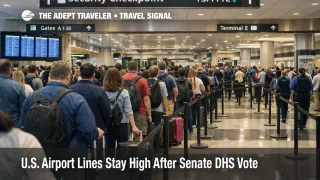
U.S. airport lines remain a same day travel problem on March 27, 2026, even after the Senate passed a bill to restore most Department of Homeland Security funding, including airport security. The operational issue for travelers is that a Senate breakthrough does not instantly rebuild checkpoint throughput, and the House still had to act before the bill could reach the president. Reuters reported that airports in Houston and Atlanta were still warning of waits of up to four hours on Friday. For travelers flying this weekend, the immediate move is still to treat airport security as a live disruption, not a solved political story.## U.S. Airport Lines: What Changed After the Senate Vote What changed on March 27 is political, not operational. The Senate passed legislation early Friday to restore most DHS funding and back pay for airport security screeners, but Reuters reported that the Republican led House still needed to pass the bill, with a vote possible later the same day. That means the travel system is stuck in a transition phase where funding may be moving, but staffing strain and checkpoint congestion are still shaping real departures. The clearest airport level warnings were still coming from Houston and Atlanta. Houston Airports said on March 26 that wait times at George Bush Intercontinental Airport (IAH) on Friday, March 27, could reach four hours or longer, with lines potentially extending outside, while staffing remained below normal and passenger demand stayed elevated. Hartsfield Jackson Atlanta International Airport (ATL) posted a public security wait time advisory telling passengers to plan ahead and allow three hours to clear security during peak travel. Reuters, citing both airports, said passengers should expect waits of up to four hours on Friday. ## Which Travelers Face the Biggest Weekend Risk The biggest exposure sits with same day domestic travelers, families checking bags, passengers departing in early morning banks, and anyone connecting through a strained hub on a short layover. At IAH, the disruption is more than a long queue. Houston Airports said screening was operating only in Terminals A and E, while TSA PreCheck and CLEAR were unavailable, which means some travelers also face extra terminal movement and less process flexibility before they even reach the checkpoint. That combination raises the odds of missed check in cutoffs and missed flights even when an airline is technically operating on schedule. The risk also extends beyond the airport where the line begins. When checkpoint delays force travelers onto later flights, the second order effects can spill into missed onward connections, extra hotel nights, reduced same day rebooking inventory, and more pressure on nearby airports and rental car supply. In an earlier Adept Traveler article, [TSA Quits Push U.S. Airport Lines Higher Before March 27](https://adept.travel/news/2026-03-26-tsa-quits-us-airport-lines-higher-before-march-27), the focus was the immediate pre pay deadline squeeze. That frame still holds, but the March 27 version of the story is that a funding fix does not automatically restore resilience. In an earlier Adept Traveler signal, [Airport Security Delays Could Outlast the Shutdown](https://adept.travel/signals/2026-03-26-post-shutdown-tsa-staffing-could-stay-fragile), the larger warning was that screening capacity recovers more slowly than congressional votes. ## What Travelers Should Do Before Leaving for the Airport Travelers flying out of a major U.S. hub this weekend should act as if airport security remains the weakest part of the itinerary. At airports already posting explicit warnings, arriving based on a normal day buffer is too aggressive. Houston Airports said IAH lines could exceed four hours, and ATL is publicly telling travelers to allow three hours for security during peak periods. Anyone checking bags, traveling with children, or starting from a terminal that requires extra repositioning to screening should build even more time into the trip to the airport itself. The next decision point is whether the trip depends on a tight clock. If missing the flight would break a cruise embarkation, a wedding, a fixed event, or a hard same day connection, the safer move is to overbuffer now rather than assume the Senate vote will calm lines by departure time. If the trip is flexible, monitor the airport's own advisories before leaving, and be ready to switch to a later flight, a nearby airport, or a drive option if screening conditions deteriorate again. That logic fits the broader pattern already visible in another Adept Traveler report, [U.S. Shutdown Boosts Car Rentals as TSA Lines Worsen](https://adept.travel/news/2026-03-26-us-shutdown-car-rentals-tsa-lines-worsen). ## Why Recovery Could Lag the Funding Headlines The main reason recovery may lag is simple. Pay can resume quickly once legislation clears, but checkpoint capacity does not reset at the same speed. Reuters reported that long lines have been driven by officers calling in sick or resigning during the funding lapse. Adept Traveler's March 26 reporting, based on Reuters and other coverage, noted that more than 480 officers had quit and that absences had climbed above 10 percent nationally. Even if money starts flowing again, airports still have to stabilize attendance, rebuild schedules, and absorb the operational damage of a six week disruption. The most useful stabilization signals are not speeches from Capitol Hill. Travelers should watch for airports dropping emergency wait advisories, restoring normal checkpoint footprints, bringing back TSA PreCheck and CLEAR access where those were suspended, and stepping down extraordinary staffing support. Until those signs appear consistently, especially at the biggest hubs, U.S. airport lines should still be treated as a meaningful weekend itinerary risk rather than a problem already on the way out. ## Sources * [US Senate moves to fund most of Homeland Security after shutdown disrupts airports](https://www.reuters.com/world/us/us-senate-agrees-end-shutdown-most-dhs-politico-reports-2026-03-27/) * [Government shutdown impacts TSA, passengers, Houston Airports](https://www.fly2houston.com/airport-business/newsroom/articles/item/frequently-asked-questions-tsa-screening/) * [Hartsfield Jackson Atlanta International Airport security advisory](https://www.atl.com/) * [TSA Quits Push U.S. Airport Lines Higher Before March 27](https://adept.travel/news/2026-03-26-tsa-quits-us-airport-lines-higher-before-march-27) * [Airport Security Delays Could Outlast the Shutdown](https://adept.travel/signals/2026-03-26-post-shutdown-tsa-staffing-could-stay-fragile) * [U.S. Shutdown Boosts Car Rentals as TSA Lines Worsen](https://adept.travel/news/2026-03-26-us-shutdown-car-rentals-tsa-lines-worsen)