

Flight Delays and Airport Impacts: March 30
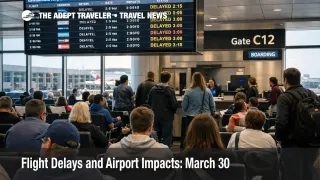
March 30 flight delays are starting with one clear choke point and several secondary risk zones behind it. The FAA says wind could slow Boston Logan International Airport (BOS), the New York airports, Philadelphia International Airport (PHL), and the Washington, D.C. airports, while thunderstorms are forecast for South Florida and Chicago, and low clouds are in play in Southern California. The hardest live problem is LaGuardia Airport (LGA), where the FAA says some arriving flights are being delayed by an average of 3 hours and 27 minutes. Travelers with New York connections, Florida segments later today, or late bank departures should protect time early and watch inbound aircraft, not just the departure board.
March 30 Flight Delays: What Changed
What changed on March 30 is that the FAA is no longer describing a loosely scattered nuisance day. The agency's daily report points to a broad weather footprint, but the live airport data shows a much more concrete problem at LaGuardia, where a traffic management program is delaying some arriving flights by more than three hours on average. By contrast, John F. Kennedy International Airport (JFK), Newark Liberty International Airport (EWR), General Edward Lawrence Logan International Airport (BOS), Miami International Airport (MIA), Chicago O'Hare International Airport (ORD), Chicago Midway Airport (MDW), Washington Dulles International Airport (IAD), and San Francisco International Airport (SFO) were still showing only gate hold, taxi, or airborne delays of 15 minutes or less when checked.
That does not make the rest of the system clean. The FAA's March 30 operations plan says LaGuardia's ground delay program is active, Florida may see thunderstorm related routing changes later in the day, ski country initiatives are possible after 300 p.m. ET, San Francisco is expected to face a ground stop or delay program after 1130 a.m. PDT because runway and taxiway construction starts today, and Chicago route changes are possible overnight into March 31. The plan also says a short stop may be needed for Ronald Reagan Washington National Airport (DCA) because of an Anchorage flyover window, and it notes reduced arrival rates at Dulles because its Airport Surface Detection Equipment is out through April 16, 2026.
Which Travelers Face the Most Disruption
The most exposed travelers are not every passenger in the system. They are people connecting through LaGuardia or the wider New York airspace, travelers flying from the Midwest into Florida, passengers scheduled into South Florida during the afternoon and evening thunderstorm window, and anyone relying on San Francisco to run clean once the construction program starts affecting flows. Travelers using short connections are at higher risk than nonstop passengers because a modest first delay is often enough to break the rest of the itinerary.
Chicago travelers should read the FAA warning carefully. The daily report flags thunderstorms for ORD and MDW, but the current airport status pages were still relatively manageable when checked. That gap matters. A day can begin with only minor airport specific delays, then tighten later when weather reroutes, Florida demand, and aircraft rotation problems start stacking together. The same logic applies in Boston and Washington, where the daily report warns of wind, even though live airport pages were not yet showing severe destination specific delays when checked.
There is also a separate ground process risk that does not appear on the FAA air traffic pages. In an earlier Adept Traveler signal, Airport Security Delays Could Outlast the Shutdown, the warning was that checkpoint recovery would lag any political fix. That still matters on a day like this, because passengers can lose time before the air traffic problem even starts.
What Travelers Should Do Now
Treat March 30 as a protect the itinerary day, not a panic day. If you are flying through LaGuardia, heading into South Florida later today, or depending on San Francisco this afternoon or evening, protecting schedule margin is more valuable than waiting for a larger cancellation headline. A tight connection that looked workable at breakfast can become expensive by late afternoon once one constrained airport starts pushing aircraft and crews out of sequence.
Rebooking early makes the most sense when your trip depends on LaGuardia, when your inbound aircraft is already running late, when you are on the last practical flight of the day, or when missing arrival would disrupt a cruise, tour, or fixed event. Waiting is more defensible if you are flying early, nonstop, and your airport and destination are both still showing only minor delays. The threshold is simple, if a small delay would break the whole trip, do not wait for the board to get ugly.
The next things to monitor are your inbound aircraft, not just your own flight number, plus any FAA shift from "planned" to active programs in Florida, San Francisco, ski country, and later Chicago. Travelers who want broader system context can read U.S. Air Traffic Control Privatization: Reality Check.
How the Disruption Can Spread Through Tonight
The mechanism on March 30 is not one giant nationwide shutdown. It is a layered system problem. Wind reduces throughput in the Northeast corridor. Thunderstorms complicate routing through Florida and can force swaps or longer paths. Construction at San Francisco lowers flexibility at one of the country's most delay sensitive hubs. Snowbird volume means the FAA is already planning for heavy Florida flows, and that matters because the same aircraft and crews often rotate between the Northeast, Midwest, and Florida in the same day. First order, travelers see slower arrivals or departures at the constrained airport. Second order, later flights inherit late inbound aircraft, thinner reaccommodation, and weaker recovery options.
That is why March 30 flight delays are more serious than a calm departure board may suggest at noon. LaGuardia is already posting a hard average destination delay, and the FAA's plan shows several more places where friction can intensify as the day develops. The likely next pattern is not every airport failing at once. It is a widening set of missed connections, late turns, and fewer same day fixes as weather, construction, and route controls combine. In an earlier Adept Traveler article, Flight Delays and Airport Impacts: March 29, the main warning was that delay pressure had become more uneven and more dangerous for travelers caught inside it. March 30 keeps that same structure, but with LaGuardia already deeper in the hole and San Francisco added as a fresh operational risk.
Sources
- FAA Daily Air Traffic Report
- ATCSCC Current Operations Plan Advisory, March 30, 2026
- FAA ATCSCC La Guardia Airport Real-time Status
- FAA ATCSCC John F Kennedy International Airport Real-time Status
- FAA ATCSCC Newark International Airport Real-time Status
- FAA ATCSCC General Edward Lawrence Logan International Airport Real-time Status
- FAA ATCSCC Miami International Airport Real-time Status
- FAA ATCSCC Chicago O'Hare International Airport Real-time Status
- FAA ATCSCC Chicago Midway Airport Real-time Status
- FAA ATCSCC Washington Dulles International Airport Real-time Status
- FAA ATCSCC San Francisco International Airport Real-time Status