

Paris Ring Road Protest Delays Airport Transfers
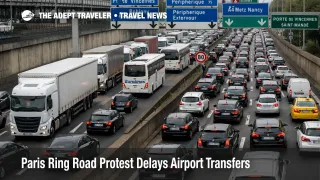
French road transport operators slowed traffic on the Paris ring road on March 30, 2026, turning a political fuel-price dispute into a same-day transfer problem for travelers moving between Paris, France, hotels, stations, and airports. Reuters reported the action on the périphérique as operators protested fuel costs and government support, while Paris police said traffic on the ring road was likely to be heavily slowed between 1000 a.m. and 1200 p.m., with knock-on disruption possible through the day. For travelers, the immediate risk is not an airport shutdown. It is losing the timing cushion that normally makes a Paris departure or cross-city transfer workable.
Paris Ring Road Protest Delays: What Changed
The operational change is straightforward. A slow-roll road protest reduces lane throughput on one of Paris's main circulation arteries, then pushes congestion onto feeder roads, parallel streets, airport approaches, taxi routes, and coach runs. Local coverage reported the action as an "opération escargot," with trucks and coaches assembling near Porte de Vincennes and targeting the ring road during the late morning window. That matters because a partial slowdown on the périphérique spreads faster than many travelers expect, especially when cars, airport coaches, and hired transfers all start hunting for the same alternates.
For air travelers, the main pinch point is ground access, not runway capacity. Paris Aéroport says Paris Charles de Gaulle Airport (CDG) is normally reached by the A1, A3, A104, and N2, while Paris Orly Airport (ORY) is normally reached by the A6, A106, and N7. When the ring road slows, those approaches can still function, but the normal predictability of a car or coach transfer weakens sharply, particularly for trips that start inside Paris or require crossing from one side of the city to the other.
Which Paris Travelers Face the Most Disruption
The highest exposure is for travelers taking taxis, private cars, rideshares, hotel cars, tour coaches, or self-drive rentals to catch a same-day flight or timed train. Airport runs to CDG and Orly become more fragile when they depend on crossing Paris or touching the ring road near peak protest hours. The same goes for departures from Gare du Nord, Gare de Lyon, Montparnasse, and other main stations, where a late road arrival can break an otherwise valid rail plan. Reuters' reporting points to a direct Paris ring road action, and U.S. State Department guidance for France separately notes that demonstrations and strikes in Paris can disrupt transportation services with little warning.
Travelers with the least room for error are those on separate tickets, cruise-to-flight handoffs, last practical departures of the day, airport hotel check-ins tied to evening arrivals, and long-haul flights with early bag-drop or check-in cutoffs. Business travelers are also exposed because a 30 to 45 minute road delay in Paris can cascade into a missed train, then a missed flight, then a much costlier rebooking chain. By contrast, travelers already on rail links or metro-based airport plans are in a better position, provided their route does not also depend on a road segment at the end.
What Travelers Should Do Now
For March 30 departures, the practical move is to add more buffer than usual for any airport or station trip that could touch the périphérique. A reasonable planning threshold is at least 60 extra minutes for airport or mainline rail transfers by road inside greater Paris, and closer to 90 minutes for cross-city hotel-to-airport runs, coach pickups, or itineraries with checked bags and hard cutoffs. That is not because every route will fail. It is because localized road protests in Paris rarely need to block everything to break a timed itinerary.
Where possible, shift away from road dependence. Paris Aéroport says Metro Line 14 reaches Orly from Paris in about 25 minutes, and it advises Metro Line 14 or the RER B plus OrlyVal as the main public transport options to Orly. For CDG, the airport operator also highlights public transport alternatives alongside road access. If your current plan is a taxi to Orly from central Paris during the active disruption window, Metro Line 14 is the stronger same-day option. If you are headed to CDG, a rail-based option can be safer than gambling on a car transfer that gets caught in spreading road congestion.
The decision threshold is simple. If you are traveling on a flexible fare, or can move to an earlier station departure or airport arrival without major cost, do it before the road network worsens further. If you cannot change plans, monitor live traffic and airport access pages before leaving, and do not use your normal Paris transfer time as your benchmark today. Travelers who wait until they are already in a car to improvise are the ones most likely to lose the itinerary.
Why the Disruption Spreads Beyond One Road
A ring road protest in Paris is not just a road story. It is a circulation story. The first-order effect is slower movement on the périphérique itself. The second-order effect is that taxis, coaches, airport transfers, and local drivers all reroute at once, which overloads alternates and makes journey times less reliable even outside the direct protest zone. That is why airport runs, station approaches, and hotel transfers can fail even when the airport, railway, or metro system is still operating normally.
This also fits a broader France pattern that travelers should recognize. In an earlier Adept Traveler article, France Farmer Protests Block Motorways, Port Access showed how localized road actions can create high-impact delays for airport and transfer traffic without requiring a full national transport stoppage. The difference today is geography. Instead of a peripheral motorway or port approach, the friction is hitting Paris's own urban circulation system, which makes the consequences more immediate for visitors trying to connect air, rail, hotels, and ground transport on the same day. Travelers should watch whether the action clears after the late-morning window or reappears elsewhere on Paris approaches later in the day.
Sources
- What G7 countries are doing to cap energy prices, Reuters, March 30, 2026
- French road transport sector protests against fuel prices on the Paris ring road, Reuters Connect, March 30, 2026
- CP opération routiers, Préfecture de Police de Paris, March 30, 2026
- Sytadin traffic alerts, Île-de-France
- To/From Paris-Orly by public transport, Paris Aéroport
- Getting to and from Paris-CDG by car, Paris Aéroport
- Getting to and from Paris-Orly by car, Paris Aéroport
- France Travel Advisory, U.S. Department of State