

Flight Delays and Airport Impacts: March 31
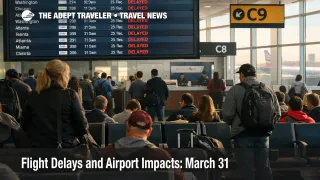
March 31 flight delays are starting as a concentrated New York problem with several secondary risk zones that could tighten later in the day. The Federal Aviation Administration says wind could affect the New York airports, Philadelphia International Airport (PHL), and Harry Reid International Airport (LAS), while thunderstorms may slow Chicago O'Hare International Airport (ORD), Chicago Midway Airport (MDW), and Detroit Metropolitan Wayne County Airport (DTW), and low clouds are in play for Seattle-Tacoma International Airport (SEA), Los Angeles International Airport (LAX), and San Diego International Airport (SAN). The live airport picture is more restrained so far, but LaGuardia Airport (LGA) is already under a traffic management program with some arriving flights delayed by an average of 58 minutes. Travelers connecting through New York or depending on late day Midwest turns should protect margin early.
March 31 Flight Delays: What Changed
What changed on March 31 is that the FAA is flagging a broad northern weather corridor, but the live system has not yet broken evenly across that footprint. The agency's daily report points to wind in New York, Philadelphia, and Las Vegas, thunderstorms in Detroit and Chicago, and low clouds in Seattle and Southern California. The operations plan then adds a more operational warning, weather and en route impacts are expected across ORD, MDW, DTW, Boston Logan International Airport (BOS), and multiple control centers, with New York flow restrictions possible later and ground stop or delay programs possible at San Francisco International Airport (SFO), Detroit, and Chicago as the day develops.
The hard live choke point, at least early, is still LaGuardia. FAA status data shows a traffic management program delaying some inbound traffic to LGA by about 58 minutes on average, while John F. Kennedy International Airport (JFK), Newark Liberty International Airport (EWR), ORD, DTW, SFO, SEA, BOS, and LAS were still showing general delays of 15 minutes or less when checked. That is a different structure from a full network breakdown. It is a day where one active hub constraint can start the cascade, while several other airports sit in watch mode.
Which Travelers Face the Most Disruption
The most exposed travelers are people connecting through LaGuardia or the wider New York airspace, passengers booked on short layovers into or out of Chicago and Detroit later today, and anyone relying on late departures where there is little same day recovery left. The FAA plan also warns that New York swap activity is possible later, ORD and MDW routing changes are possible through the evening, and Detroit could face ground stops or reroutes into the night. That makes late bank travelers more vulnerable than early nonstop passengers, even if the morning departure boards still look manageable.
There is also a separate front end risk at the airport, not just in the air. In an earlier Adept Traveler article, U.S. Airport Security Lines Ease, Recovery Stays Fragile, the warning was that checkpoint recovery was improving but not fully rebuilt. That still matters on a weather meter day. A modest screening delay plus a 45 to 60 minute FAA flow delay is often enough to break a tight itinerary. In an earlier Adept Traveler article, Flight Delays and Airport Impacts: March 30, LaGuardia was already the main pressure point, but on March 31 the broader Midwest and Northern corridor watch is more explicit in the FAA plan.
What Travelers Should Do Now
Treat March 31 as a protect the itinerary day, not a panic day. If you are flying through LaGuardia, connecting across New York, or leaving Chicago or Detroit later this afternoon or evening, the safer move is to build extra time around the trip and watch your inbound aircraft, not just your own departure time. A departure board can stay calm while an inbound aircraft is already being metered, rerouted, or delayed elsewhere in the network.
Rebooking early makes the most sense if your plan depends on a short LaGuardia connection, if your flight is one of the last practical departures of the day, or if a missed arrival would affect a cruise, tour, hotel check in, or business event. Waiting is more defensible if you are traveling early, flying nonstop, and both your departure and arrival airports are still showing only minor delays. The decision threshold is simple, if a one hour slip would break the whole trip, March 31 flight delays are already serious enough to justify a change.
Why Today's Pressure Can Spread Later
The mechanism is the same one travelers have seen on other uneven FAA delay days. Weather, low ceilings, or wind reduce how many aircraft can move safely through a corridor or arrive at a hub in a given period. The FAA responds with traffic management programs, reroutes, and swap activity that meter departures before the aircraft even reaches the destination. First order, the constrained airport slows. Second order, the late inbound aircraft arrives late somewhere else, crews and gates fall out of sequence, and same day reaccommodation thins out.
That is why March 31 looks more dangerous than a simple list of airport names in the morning report. The live data still shows only one clearly hard problem at LaGuardia, but the FAA plan points to later risk in Chicago, Detroit, San Francisco, and the New York flow system. Travelers who want deeper system context can read U.S. Air Traffic Control Privatization: Reality Check. The next signals to watch are whether LaGuardia delay averages worsen, whether ORD or DTW move from possible programs to active ones, and whether New York flow controls broaden as the afternoon develops.
Sources
- FAA Daily Air Traffic Report, March 31, 2026
- ATCSCC Current Operations Plan Advisory, March 31, 2026
- FAA ATCSCC La Guardia Airport Real-time Status
- FAA ATCSCC John F Kennedy International Airport Real-time Status
- FAA ATCSCC Newark International Airport Real-time Status
- FAA ATCSCC Chicago O'Hare International Airport Real-time Status
- FAA ATCSCC Detroit Metropolitan Wayne County Airport Real-time Status
- FAA ATCSCC San Francisco International Airport Real-time Status
- FAA ATCSCC Seattle-Tacoma International Airport Real-time Status
- FAA ATCSCC Harry Reid International Airport Real-time Status