

TSA Staffing Losses Keep U.S. Airport Recovery Fragile
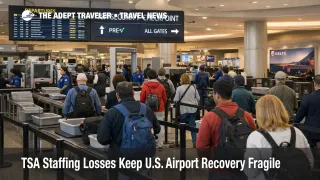
TSA staffing losses are now the main reason travelers should not treat shorter airport lines as a full recovery on March 31, 2026. Security waits improved at major hubs after emergency pay began reaching Transportation Security Administration officers, but more than 500 officers have already quit during the Department of Homeland Security funding lapse, and union officials told the Associated Press some workers still received partial or incorrect pay. That means airports are moving again, but the staffing base behind that recovery is thinner than it was before the crisis.
TSA Staffing Losses: What Changed
The visible change is real. Reuters and the Associated Press both reported on March 30 that security lines dropped sharply after emergency pay reached TSA officers, with conditions improving at airports in Houston, Atlanta, Baltimore, New York, New Orleans, and Dallas after days of multi hour waits. For travelers flying in the next 24 to 72 hours, that lowers the immediate odds of spending hours in a checkpoint queue at the biggest U.S. hubs.
The less visible change is the one that matters next. Reuters reported that more than 500 TSA officers had quit by March 30 after weeks of missed paychecks, after earlier Reuters and AP reporting put the losses in the high 400s only days before. AP also reported that some employees were still dealing with partial or inaccurate pay even after the emergency funding move, which means the return of pay did not instantly repair morale, attendance, or retention.
The shutdown itself is also still unresolved. Reuters and AP both reported that Congress remains deadlocked on full Department of Homeland Security funding, which leaves TSA operations dependent on an emergency fix rather than a settled staffing and pay environment. That is a meaningful distinction for travelers because temporary operational relief is not the same thing as a stable checkpoint system.
Which Airports and Itineraries Stay Most Exposed
The most exposed travelers are still the ones moving through large hub airports where delays cascade quickly once lines start building again. That includes business travelers on tight same day turns, domestic passengers connecting through major banks, and international travelers whose check in, document screening, and bag drop timelines leave less margin for a checkpoint slowdown. TSA has already told Congress that higher callout rates can push waits beyond four and a half hours and create missed or delayed flights, which is the mechanism travelers should keep in mind even as lines look better today.
The biggest risk is not necessarily another headline making collapse. It is weaker shock absorption. A thinner officer base means the system has less spare capacity when thunderstorms bunch departures, when a morning bank runs late, or when a peak holiday pulse hits a hub already operating close to its screening limits. First order, travelers could see lane consolidation or slower checkpoint processing. Second order, that raises misconnect risk, cuts into airline reaccommodation options later in the day, and increases the chance that airport recovery falls behind the flight schedule.
Smaller airports also remain vulnerable for a different reason. Earlier Reuters reporting said TSA warned some smaller facilities could face closure risk if staffing stress kept worsening. Even if that worst case does not materialize now, the fact that TSA raised it publicly shows how little buffer existed during the shutdown and why a partial staffing recovery should not be confused with full resilience.
What Travelers Should Do Before Assuming Normal Operations
Travelers flying this week should still build extra checkpoint time into airport plans, especially at large hubs and especially on mornings, weather days, and heavy bank periods. TSA's traveler guidance continues to point passengers to airport specific checkpoint conditions through the MyTSA app and recommends allowing sufficient time before departure, which matters more when staffing is recovering unevenly rather than fully restored.
For short haul domestic trips, the practical threshold is simple. If an itinerary depends on a tight connection, a last flight of the day, or a nonrefundable onward booking, travelers should treat normal looking headlines as insufficient proof that the day will stay normal. A little extra airport buffer is still cheaper than missing a connection because checkpoint staffing snaps tight again under routine pressure. Travelers with flexible tickets should also watch for morning reports of renewed callouts or long waits before leaving for the airport.
For families, infrequent flyers, and passengers checking bags, the safer move is to remove avoidable checkpoint friction. That means organizing liquids and electronics before reaching the lane, checking airport specific guidance in advance, and not assuming PreCheck or expedited flows will erase all delay risk if staffing pressure returns at a particular terminal or hour. The next decision point is whether Congress resolves the DHS funding lapse cleanly, because that would do more to stabilize staffing than one emergency pay cycle.
Why the Recovery Is Still Fragile
The recovery is fragile because the checkpoint problem was never only about one missed paycheck. It was about attrition, absenteeism, and workforce strain inside a system that screens millions of passengers and has limited slack during surge periods. TSA's own passenger volume data show the agency routinely handles more than 2 million daily checkpoint screenings, so even a modest staffing shortfall can become operationally significant when travel demand stays elevated.
That is what makes this different from a normal bad airport day. Weather disruptions, aircraft delays, and late connection banks can usually be absorbed better when screening staffing is stable. When the officer base is thinner, recovery from those routine shocks gets slower. Reuters reported that Homeland Security personnel had been deployed to assist at airports until operations stabilize, which underscores that the system is still being supported rather than fully normalized.
What happens next depends on two separate tracks. The first is whether checkpoint performance keeps improving as more employees receive correct pay and return to steadier attendance. The second is whether Congress ends the DHS funding fight in a way that stops further TSA staffing losses. Until both happen, TSA staffing losses remain a live travel planning issue, not just a solved headline from the worst days of the shutdown.
Sources
- Major US airports return to normal as TSA workers get paid
- TSA says 460 airport officers quit as standoff poses major security risks
- DHS orders payment of 50,000 US airport workers in emergency action
- Airport bottlenecks ease as TSA workers get paid, but shutdown continues
- TSA worker pay won't eliminate airport woes overnight
- Oversight Hearing - DHS Shutdown Impacts
- TSA checkpoint travel numbers
- MyTSA App