

Flight Delays and Airport Impacts: April 1
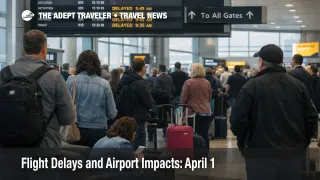
April 1 flight delays are starting with LaGuardia Airport (LGA) as the clearest live choke point, while the Federal Aviation Administration is warning that a much broader set of airports could tighten later in the day. The FAA's April 1 operations plan points to thunderstorms spreading east from the Midwest, rain in the New York and Philadelphia corridor, and low ceilings at Boston Logan International Airport (BOS), Seattle-Tacoma International Airport (SEA), and San Francisco International Airport (SFO). For travelers, the problem is not a full national breakdown yet. It is a day where one active New York delay program can spill into a wider East Coast and hub network problem by afternoon and evening.
April 1 Flight Delays: What Changed
What changed on April 1 is that the FAA planning picture widened even though the live airport map remained relatively contained early in the day. The April 1 current operations plan says LaGuardia already has an active ground delay program, and it warns that ground stop or delay programs are possible later for Boston after 300 p.m. ET, San Francisco after 300 p.m. ET, Newark Liberty International Airport (EWR) after 700 p.m. ET, Houston area airports after 700 p.m. ET, and the Washington, D.C., airports, Hartsfield-Jackson Atlanta International Airport (ATL), and Denver International Airport (DEN) after 8:00 p.m. ET. It also flags route and swap pressure later today around Chicago, New York, Philadelphia, Houston, Atlanta, and Denver.
The live picture is still more selective. LaGuardia was showing a traffic management program delaying some arriving flights by an average of 54 minutes when checked, while John F. Kennedy International Airport (JFK), Newark, Boston, Chicago O'Hare International Airport (ORD), Denver, Miami International Airport (MIA), and San Francisco were all still showing only general gate hold, taxi, or airborne delays of 15 minutes or less. That means the system has not failed broadly yet, but the FAA has already published a road map for how it could deteriorate later.][2])
There is also one odd public-facing wrinkle. The FAA's public Daily Air Traffic Report page was still displaying Tuesday, March 31, 2026, when checked, even though the live status pages and the current operations plan were already reflecting April 1 conditions. That does not erase the traveler value of the page, but for today it makes the operations plan and airport status pages more useful than the summary page alone.
Which Airports and Itineraries Face the Most Risk
The most exposed travelers are people connecting through LaGuardia, passengers booked on late day East Coast flights, and anyone whose itinerary depends on the New York airspace staying orderly into the evening bank. Once the FAA starts metering LaGuardia arrivals, the effect does not stay neatly at one airport. It can distort aircraft turns, gate timing, and crew sequencing across the New York region, then bleed into the next departures at JFK and Newark even if those airports are not yet showing large posted averages.
Boston and San Francisco deserve extra attention because both were listed with low ceilings in the FAA plan, and both were named for possible or probable ground stop or delay programs this afternoon. San Francisco carries a separate structural risk beyond today's weather. In an earlier Adept Traveler article, SFO Landing Restrictions Cut Arrivals Through October 2, the issue was that runway work and new arrival limits are already reducing the airport's margin for recovery. That makes an ordinary FAA weather program more dangerous there than at an unconstrained hub.
Late bank travelers face more danger than early nonstop passengers. If you are flying after midafternoon into Boston, San Francisco, Newark, Washington, Atlanta, Denver, or the Houston airports, you are exposed to a system that may still look manageable on the board while the FAA is already planning reroutes and flow controls around it. That gap between what is posted now and what is likely later is where trips get broken.
What Travelers Should Do Now
Treat April 1 as a protect the itinerary day, not a panic day. If you are connecting through LaGuardia or depending on a late arrival into one of the airports the FAA flagged for possible programs, start by tracking your inbound aircraft and not just your own flight number. A departure can remain technically on time while the aircraft that is supposed to operate it is being held, rerouted, or delayed somewhere else in the network.
Rebooking early makes the most sense if your trip has a hard failure point, for example a short connection, a cruise embarkation, a same day international departure, a timed event, or the last practical flight of the evening. Waiting is more defensible if you are on an early nonstop, have slack at both ends, and your airports are still showing only minor general delays. The threshold is simple, if a 60 to 90 minute slip would unravel the whole trip, today's FAA setup already justifies buying time before the network gets more crowded.
At the airport, keep more buffer than usual even if security conditions look improved from last week's stress points. In an earlier Adept Traveler article, TSA Staffing Losses Keep U.S. Airport Recovery Fragile, the warning was that shorter lines do not mean the front end of the airport has fully regained resilience. On a meter day, a modest checkpoint delay plus an FAA flow delay is enough to break a tight itinerary.
Why Today's Pressure Could Spread Later
The mechanism is straightforward. Thunderstorms, rain, or low ceilings reduce how many flights can safely move through a corridor or arrive at a hub in a given hour. The FAA responds with ground delay programs, possible ground stops, reroutes, and swap activity that hold aircraft before they reach the constrained area. First order, that slows departures and arrivals at the affected airport. Second order, the late aircraft then arrives late somewhere else, crews and gates fall out of sequence, and same day reaccommodation gets thinner across multiple hubs.
That is why April 1 flight delays are more than a LaGuardia story, even though LaGuardia is the clearest live problem right now. The plan already shows potential pressure marching east from Midwest storms into the East Coast flow system, while San Francisco and Boston sit under low ceiling risk and San Francisco also carries its longer runway capacity problem. Travelers who want deeper system context can read U.S. Air Traffic Control Privatization: Reality Check. The next things to watch are whether LaGuardia delay averages rise, whether Boston or San Francisco move from planned to active programs after 300 p.m. ET, and whether Newark joins the active list after 700 p.m. ET.
Sources
- FAA Daily Air Traffic Report
- FAA Current Operations Plan Advisory, April 1, 2026
- FAA ATCSCC LaGuardia Airport Real-time Status
- FAA ATCSCC John F. Kennedy International Airport Real-time Status
- FAA ATCSCC Newark Liberty International Airport Real-time Status
- FAA ATCSCC General Edward Lawrence Logan International Airport Real-time Status
- FAA ATCSCC Chicago O'Hare International Airport Real-time Status
- FAA ATCSCC Denver International Airport Real-time Status
- FAA ATCSCC Miami International Airport Real-time Status
- FAA ATCSCC San Francisco International Airport Real-time Status
- Flight Delays and Airport Impacts: March 31
- SFO Landing Restrictions Cut Arrivals Through October 2
- TSA Staffing Losses Keep U.S. Airport Recovery Fragile
- U.S. Air Traffic Control Privatization: Reality Check