

TSA Quits Raise U.S. Airport Screening Risk Before March 27
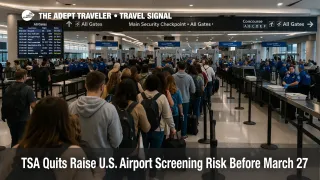
TSA shutdown airport risk is worsening across the United States before March 27, 2026, because checkpoint staffing is eroding faster than the system is recovering. Reuters reported on March 24 that more than 460 Transportation Security Administration officers have quit during the partial Department of Homeland Security shutdown, while almost 11 percent of officers, more than 3,200 people, were absent nationally. For travelers, the issue is no longer only whether lines are long. It is whether airports with less staffing depth begin consolidating checkpoints, cutting throughput, or moving closer to partial screening failure as the next missed paycheck approaches.
TSA Shutdown Airport Risk: What Changed
What changed on March 24 is that the staffing problem became more clearly structural. Reuters said TSA is now down more than 460 officers from quits alone, spring travel volume is running above last year, and some airports have already seen waits exceed 4.5 hours. DHS has also deployed paid Immigration and Customs Enforcement, and Homeland Security Investigations personnel to 14 airports, which shows the government is trying to preserve checkpoint flow with substitute support rather than solving the unpaid workforce problem at its source.
That distinction matters operationally. The extra federal personnel are being used to support tasks such as line management, crowd control, and some non screening checkpoint functions, not to replace certified TSA screening officers. The practical result is that a few airports may hold together a little longer at the front of the queue, while the core bottleneck, too few trained officers available for actual screening, remains in place.
The strain is landing during a heavy passenger window. TSA's own throughput page shows 2,573,056 travelers cleared on March 18, 2026, which helps explain why even a roughly 11 percent national absence rate can produce outsized screening failures when the network is already full.
Which Travelers and Airports Are Most Exposed
The most visible pain is still showing up at large hubs, especially spring break airports where passenger banks arrive in surges and missed departures create immediate rebooking stress. Reuters and other reporting have tied the worst current line risk to places such as Hartsfield, Jackson Atlanta International Airport (ATL) and George Bush Intercontinental Airport (IAH), where absenteeism and wait times have been especially severe. These airports usually stay open, but travelers there can still lose flights, hotel nights, tours, and same day onward connections long before an airport reaches any closure threshold.
The more fragile airports are often smaller commercial fields with one main checkpoint, fewer screening officers on shift, and limited later departures if the morning bank breaks. Reuters reported on March 19 that Transportation Secretary Sean Duffy warned some small airports could soon shut down if staffing worsens, because they do not have the same ability to spread pressure across multiple checkpoints, terminals, or later flight waves. In an earlier Adept Traveler article, U.S. Shutdown Airport Closure Risk Hits Small Fields outlined why that part of the network can fail faster than the biggest hubs.
The travelers with the least slack are the ones who should treat this as a real itinerary problem now. That includes families flying peak morning departures, passengers checking bags, travelers connecting to cruises or long haul flights, and anyone leaving from a smaller airport with only one or two realistic backup departures later in the day. In an earlier Adept Traveler article, ICE at U.S. Airports Starts, Raising TSA Travel Risk the main point was that extra federal support can change queue handling, but it does not restore normal screening resilience.
What Travelers Should Do Before March 27
Travelers flying before or just after March 27 should build more buffer than they would for a normal busy travel week. At large hubs already reporting severe delays, that means treating published departure time as the end of your airport process, not the start of it. At smaller airports, it means respecting even modest airport warnings because one thinly staffed checkpoint can become the whole trip's failure point.
Rebook sooner rather than later if your trip depends on a short connection, a cruise embarkation, a wedding, a tour departure, or any other fixed time event that cannot absorb a multi hour checkpoint failure. Waiting may still work for flexible domestic trips with multiple later flights, but the tradeoff gets worse as the next missed paycheck gets closer and attrition risk rises again.
Watch for three signals in the next 24 to 72 hours. The first is airport specific advice telling travelers to arrive unusually early, which usually means local staffing is already strained. The second is any notice of checkpoint consolidation, temporary closures, or reduced screening hours. The third is a fresh rise in national absenteeism after March 27, because that would push TSA shutdown airport risk beyond delays and more directly toward continuity problems at weaker airports.
Why the System Is Getting More Fragile Now
The mechanism is straightforward. When unpaid staff quit or call out, throughput falls at the exact point where every departing passenger must pass. Large hubs can sometimes absorb that through longer lines and uneven lane allocation. Smaller airports often cannot, because they depend on a narrower staffing margin and have fewer later departures to recover missed passengers. As a result, the first order effect is screening delay, while the second order effects hit parking, curb traffic, misconnects, hotel overnights, and same day reaccommodation.
What happens next depends less on one bad airport morning than on whether the shutdown persists through another payroll miss. Reuters reported that March 27 is the next full missed paycheck for TSA staff, and Duffy said current disruption could look minor by comparison if no deal is reached. That does not guarantee airport closures, but it does make the system less resilient at the checkpoint just as heavy spring demand keeps pressure high. That is why TSA shutdown airport risk now belongs in departure planning, not just in general travel news awareness.
Sources
- TSA says 460 airport officers quit as standoff poses major security risks, Reuters
- US official warns small airports could soon shut down over TSA absences, Reuters
- US says airport delays will worsen as shutdown continues, Reuters
- ICE agents deployed to more than a dozen US airports amid staffing gaps, Reuters
- The Latest: Over 450 TSA officers have quit since the partial shutdown began, AP News
- Here's what travelers need to know about ICE officers in airports, The Washington Post
- TSA checkpoint travel numbers, TSA