

Greece Taxi Strike And Farmer Roadblocks Extend Disruption
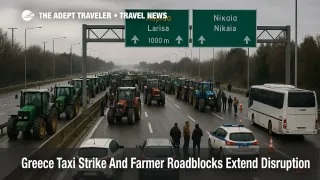
Greece taxi strike roadblocks are now combining to remove almost all taxi capacity nationwide through 6:00 a.m. on December 4, 2025, while farmer tractor convoys solidify long term blockades on key highways in Thessaly and northern corridors. Travelers who rely on cabs for airport, port, or late night city transfers, or who plan to drive the Athens Thessaloniki route, should assume very limited flexibility and longer travel times. Most visitors will need to shift to airport buses, metro and rail links, and prebooked car services where available, and add buffer time or adjust dates, especially for connections through Athens and Thessaloniki.
This update to earlier coverage of the Greece taxi strike and farmer roadblocks reflects two key shifts, the formal confirmation that no taxis will operate anywhere in the country until early on December 4, and the rapid growth of farmer tractor blockades into more static, long duration positions along major corridors that connect hotels, resorts, and border crossings.
How Long Taxis Will Be Unavailable
Taxi drivers represented by the Panhellenic Federation of Taxi Drivers have called a forty eight hour nationwide warning strike from 600 a.m. on December 2 to 600 a.m. on December 4, 2025. Greek outlets now state clearly that there will be no taxi service in Athens, Thessaloniki, or any other city during this period, turning what might have been patchy disruption into a full stop of licensed cab services.
The strike is a protest over new tax rules, a faster timetable for mandatory fleet electrification, and competition from ride hailing platforms and private hire vehicles. Taxi unions argue that current policies threaten drivers livelihoods and create what they consider unfair competition from app based operators. In Athens, drivers have staged motorcades and set up tents outside the Ministry of Transport, and union leaders are openly warning that if talks with officials do not materialize, they may escalate to an open ended strike later in December.
For travelers, the headline is simple. You should not expect to be able to walk out of a terminal and hail a taxi in any Greek city until the morning of December 4, and even then there may be a slow ramp up as drivers return from strike actions.
Airport And Port Transfers Without Taxis
Athens International Airport Eleftherios Venizelos (ATH) is operating, but with no taxis at the rank travelers need to lean heavily on public transport and prearranged transfers. The Athens Metro Line 3 and the suburban rail line connect the airport to central stations such as Syntagma and Monastiraki, while express buses like the X95 between the airport and Syntagma, and the X96 between the airport and Piraeus, continue to run. These services can absorb many travelers but will be crowded around morning and evening peaks and after banked flight arrivals.
Thessaloniki Airport Makedonia (SKG) remains linked to the city by OASTH bus routes, including airport express services that substitute for taxis on the thirty to forty minute run into central hotels and the ferry pier. At both airports, hotel shuttles and private car services that are licensed as transfers rather than taxis are expected to keep operating, although capacity is finite and last minute requests may be difficult to accommodate.
At the main ferry gateways such as Piraeus and Rafina near Athens, and the port of Thessaloniki, metro, suburban rail, local buses, and prebooked transfers will be the primary ways to move between ships and hotels. Travelers who had planned tight same day sequences, such as a morning flight into Athens followed by an afternoon ferry departure in Piraeus, should now assume slower surface legs and consider moving either the flight or the sailing to reduce missed connection risk.
Where Farmer Roadblocks Are Tightening
In parallel with the taxi strike, farmer protests over delayed European Union agricultural subsidies and pricing have shifted from short rolling actions to more entrenched blockades. At the Nikaia interchange near Larissa on the Athens Thessaloniki motorway, roughly 1,500 tractors have been parked directly on the highway, blocking both directions and forcing long diversions.
Over the last twenty four hours, additional convoys from Farsala, Tyrnavos, Elassona, Platykambos, and other parts of Thessaly have reinforced the Nikaia blockade and a parallel camp along the E65 corridor, with Greek reporting now speaking of more than 3,500 tractors spread across these points. New blockades are being established near Trikala at the Megalochori junction and at Malgara closer to Thessaloniki, and farmers are preparing to close the Promachonas border crossing to Bulgaria, which is an important route for coach traffic, trucks, and some overland tourists.
For travelers, that translates into intermittent full closures or heavily managed single lane flows on sections of the Athens Thessaloniki highway through Thessaly, with the traffic police diverting cars and buses onto secondary roads that wind around the tractor lines. Journeys that would normally take four to five hours between Athens and Thessaloniki can easily stretch by one to three hours, especially if diversions pass through small towns or if convoys reposition.
How Long The Blockades Could Last
Farmer unions say they are reacting to an estimated 600 million euro shortfall in EU subsidies and other payments, linked to an ongoing investigation into misuse of agricultural aid and alleged fraud involving falsified land and livestock claims. The government acknowledges delays in the first subsidy installment and has promised additional funds, but farmers argue that many households are facing acute cash flow problems heading into winter.
According to organizers quoted in local reporting, the current escalation is only the first phase. The plan is to fully establish and reinforce all blockades across the country by the end of the week, then hold a nationwide assembly in Nikaia to decide next steps. Some leaders are openly stating that they are prepared to maintain at least a skeleton presence at the roadblocks through Christmas if they do not see concrete progress.
Travelers visiting Greece in mid to late December should therefore consider tractor blockades a medium term risk rather than a one day event that will clear quickly.
Practical Routing Advice For Travelers
If you are flying into Athens or Thessaloniki on December 2 or 3, or on early morning services on December 4, plan as if no taxi will be available and choose flights that arrive during hours when metro, suburban rail, and airport buses run at full frequency. Avoid itineraries that require you to make a tight connection from a flight to a ferry or long distance coach, and consider building an overnight stop in Athens or Thessaloniki between legs instead of stacking them on the same day.
For self drive travelers, especially those picking up rental cars at Athens, Thessaloniki, or regional airports and heading toward Thessaly, Meteora, Volos, or the northern border, assume that sections of the main highway may be blocked or heavily delayed. Check routing apps for closure alerts but remember that smaller rural alternatives may not be fully mapped, and allow extra daylight time in case you are diverted through villages and local roads with low speed limits. A conservative plan is to add one to three hours to any drive that crosses central Greece and to carry snacks, water, and a charged phone in case you are caught in slow moving traffic near a protest line.
Coach passengers should expect some services to reroute or adjust schedules around the blockades. When possible, choose departures earlier in the day, since evening services have less margin if they are held near a blockade and may arrive very late at hotels or connecting ports. Keep in close contact with your operator by app or text, and confirm pick up points, since some stops on main highways could be moved to safer or more accessible locations during the protests.
Background On The Disputes
Both the taxi strike and the farmer blockades are rooted in economic and regulatory strain. Taxi drivers are pushing back against a package of tax measures and electrification deadlines that they say will increase costs without enough support for fleet renewal, while also demanding tighter enforcement on ride hailing competitors and private hire cars that they argue undercut regulated fares.
Farmers in Thessaly and other regions, meanwhile, are responding to delayed EU subsidy payments that have been complicated by fraud investigations into how agricultural funds were distributed in previous years. Many of the tractors now parked on Greek highways belong to small holders who say that without timely support they cannot cover fuel, feed, and loan payments. That context helps explain why both groups are signaling that they are prepared for sustained action unless they see policy changes or firm timelines from the government.
What Travelers Should Do Now
In the short term, the safest choices for December 2 and 3 are to avoid any itinerary that depends on taxis or on fast, predictable drives through Thessaly. Book airport buses, metro tickets, and suburban rail in advance when possible, arrange hotel or private transfers where capacity exists, and widen connection buffers between flights, ferries, and long distance buses. If you have flexible dates, consider shifting travel that involves crossing central Greece by road to later in December, after the first phase of farmer mobilizations is scheduled to be reviewed.
Sources
- No taxis in the country until Thursday morning
- Taxi strike today, drivers across Greece pull the handbrake
- Greek Taxi Drivers Announce 48 Hour Strike for December 2-3
- Greek taxi drivers to stage a forty eight hour strike
- Greek farmers clash with police in protests over delayed EU farm subsidies
- Greek farmers clash with police amid protests over delayed EU subsidies
- Greek farmers block Athens motorway as fallout from illegal subsidies fraud continues
- Protesting farmers boost their presence in new roadblocks
- Farmers close the customs office of Promachonas today and consider hardening their stance