

Strike Averted, Air Transat Canada Flights Stabilize
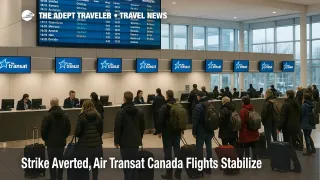
The Air Transat strike averted outcome is now the base case for Canada leisure and transatlantic travelers after the airline and the union representing its pilots announced a tentative agreement on December 9, 2025. Travelers headed to winter sun routes and Europe should see schedules stabilize, but anyone traveling in the immediate recovery window should still watch for leftover cancellations, retimes, and aircraft positioning changes tied to the earlier wind down plan. The practical move is simple, verify your booking status, keep alerts on through the ratification vote, and add buffer for tight connections until the network is fully back on pattern.
The Air Transat strike averted shift moves the story from strike notice and preemptive suspensions to a ratification window, with operations returning toward normal while pilots vote in the coming days.
What Changed, And Why It Matters
Air Transat confirmed on December 9, 2025, that it reached a tentative agreement with the union representing its pilots, and that the deal will be submitted to members for ratification in the coming days, with operations returning to normal. The Air Line Pilots Association, Int'l (ALPA), said Air Transat pilot leaders approved the tentative agreement for a pilot ratification vote, also framing the next step as a member vote in the coming days.
This matters because the strike threat had already moved beyond theory. Reuters reported that ALPA issued a 72 hour strike notice, Air Transat began suspending flights as part of a wind down, and a strike could have started as early as 3:00 a.m. ET on December 10, 2025. Reuters later reported the tentative deal averted the strike, and that Air Transat was resuming normal operations.
What Happens To Previously Canceled Or Changed Flights
A tentative agreement does not automatically rewind operational decisions made during a wind down. If your flight was canceled or significantly retimed during the period when suspensions were being phased in, you should assume one of three scenarios until you see it in writing from the airline: you are rebooked onto a different flight, your flight operates but at a different time, or the cancellation holds and you must choose between a new routing and money back.
Air Transat's public notice emphasizes restoration of operations and apologizes for disruption in recent days, but it also makes clear that the agreement still goes to ratification. In practice, that means travelers should focus on what is in the booking record right now, not what was planned last week. The fastest way to reduce surprises is to recheck your booking multiple times, once right after you receive any airline email, and again within 24 hours of departure, because recovery schedules can change as crews, aircraft, and duty limits are rebuilt.
If you are traveling as part of a package, the right first move is often through the party that controls the package record, whether that is Air Transat Vacations, a tour operator, or a travel advisor. That is because flight changes can cascade into hotel check in dates, transfers, and protected connections, and those are usually managed in the package system rather than as standalone flight segments.
How Rebooking And Refunds Work Under Canada's APPR
Background Canada's Air Passenger Protection Regulations, often shortened to APPR, set minimum obligations for airlines on flights to, from, or within Canada. The most important traveler distinction is not whether the disruption is annoying, it is how the disruption is classified, because compensation for inconvenience has specific eligibility rules.
For rebooking, the APPR guidance for large airlines is blunt: the airline must rebook you on its next available flight, or on a flight with a commercial partner, departing within 9 hours of your original departure time, taking a reasonable route from the same airport. If that is not possible within 9 hours, the airline must rebook you as soon as possible on any airline, and the new flight must depart within 48 hours of your original departure time. If the airline cannot rebook you within 48 hours, the guidance says it must rebook you on any airline from a nearby airport, and transport you to that airport free of charge.
If the disruption strands you away from your point of origin and the trip no longer serves its purpose, APPR guidance also addresses the scenario where the airline must return you to your origin and refund the entire ticket as if no part of the trip had been made.
On compensation, APPR guidance states that cash compensation for delays and cancellations hinges on the disruption being fully within the airline's control, and it excludes situations that are outside the airline's control from that specific compensation pathway. That does not mean you have no remedies, it means you should prioritize rebooking, refund eligibility, and documented expenses, rather than assuming there will be a fixed cash payout for inconvenience.
For Europe Bound Travelers, EU Coverage Can Still Matter
Many Air Transat itineraries are Canada to Europe and Europe to Canada. The European Union's passenger rights framework can apply based on where the flight departs and arrives. EU guidance states that EU air passenger rights apply to flights departing the EU to a non EU country, whether operated by an EU or a non EU airline, which can capture Europe to Canada segments on Air Transat.
This does not automatically mean you will receive compensation in every case, because compensation often depends on the cause and timing of the disruption. What it does mean is that travelers with EU departing segments should check which regime applies to that segment, and keep records, because rerouting and assistance obligations can be different than a purely domestic Canadian flight.
What To Watch During The Ratification Window
The ratification vote is the last major gate before the tentative agreement becomes a fully implemented contract. Air Transat and ALPA both describe the next step as a member vote in the coming days. Until that vote is complete, the risk profile is lower than it was under an active strike notice, but it is not zero, especially for travelers on tight, expensive, or time sensitive itineraries.
The smart traveler posture for the next week is defensive planning without panic. Keep push alerts on, avoid self connecting on separate tickets, preserve receipts for incremental costs, and consider moving critical trips to earlier flights in the day so you have more same day recovery options if the schedule shifts again.
For readers tracking the earlier escalation, Adept Traveler's prior coverage of the strike risk window and the wind down plan provides the timeline context: Canada Pilot Strike Risk For December Air Transat Flights and Air Transat Pilot Strike To Disrupt Canada Flights. For broader rebooking and refund scenarios across carriers, the site's Passenger Rights topic hub is the best starting point.
In the final view, the Air Transat strike averted development is real progress, but travelers should treat the next few days as a normalization phase, not an instant reset. If you are flying soon, verifying your booking and understanding your rebooking and refund lanes under APPR is still the highest value move.
Sources
- End of Strike Threat, Tentative Agreement Reached | Air Transat
- Air Transat Pilot Leaders Approve Tentative Agreement For Pilot Ratification Vote | ALPA
- Canada's Air Transat, pilots' union reach tentative deal to avert strike | Reuters
- Canada's Air Transat to suspend flights following strike notice from pilots union | Reuters
- Flight Delays and Cancellations | Air Passenger Protection (CTA)
- EU Air Passenger Rights | Your Europe