

Italy Airport Strikes January 2026, Milan Flights at Risk
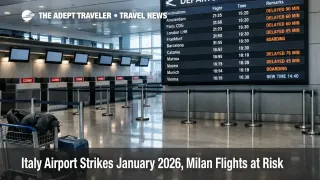
A cluster of aviation strike actions is queued for Italy in January, with ground handling stoppages that can slow check in, baggage, and aircraft turns at major airports. Travelers routing through Rome Fiumicino Leonardo da Vinci Airport (FCO), Milan Linate Airport (LIN), and Milan Malpensa Airport (MXP) are most exposed on Friday, January 9, 2026, with an additional air traffic control risk flagged at Verona Villafranca Airport (VRN) on Saturday, January 31, 2026. Move flexible trips off the peak windows, aim departures inside the protected time bands, and add buffer time for connections, rail, and hotels.
Italy airport strikes January 2026 concentrate disruption risk into specific time bands, which means timing choices and connection design matter as much as the headline date.
For January 9, the operational problem is stacked handling pressure rather than a single, clean shutdown. A four hour national stoppage is listed for handling companies associated with Assohandlers from 1300 to 1700, and there are also 24 hour actions listed for Swissport Italia at Milan Linate and for Airport Handling at both Milan Linate and Milan Malpensa. Separate airline group actions are also flagged the same day, including easyJet cabin crews for 24 hours and Vueling flight attendants for an eight hour window, which can thin capacity even if the airport itself is still functioning.
Who Is Affected
Travelers who touch Italy on January 9 are the obvious first tier, especially anyone who must check a bag, relies on curbside or counter processing, or is connecting with less than comfortable slack. Milan is a particular pain point because Linate is slot constrained and turnaround dependent, and Malpensa carries a large volume of long haul banks where late inbound aircraft and delayed baggage rooms can quickly spill into missed connections and crew duty problems.
The second tier is anyone who is not even flying within Italy, but is connected to Italy through aircraft rotations. When a morning arrival into Milan or Rome is delayed, that same aircraft often leaves later for another European hub, and that pushes disruption outward into onward connections, reaccommodation seat scarcity, and late day hotel demand near multiple airports. Winter schedules amplify this effect because there are fewer "extra" frequencies to absorb a missed rotation.
The third tier is ground transport dependent itineraries. Even if your flight operates, longer processing and late baggage can break timed rail and car transfer plans, and Lombardy and Milan have additional public transport strike risk later in the month that can complicate airport access and last mile plans if you are trying to reach Malpensa Express or city connections on a tight clock.
For additional Italy strike timing context and how these stacks behave at Milan airports, see Italy Airport Strike Disrupts Flights January 9, 2026 and Italy Air Transport Strike, September 26: Timetable and Plan.
What Travelers Should Do
If you have flexibility, the simplest risk reduction is to move nonessential Italy flying off Friday, January 9, 2026, or to redesign your day so you are not depending on bag drop, tight terminal changes, or a last train connection. If you must travel that day, aim for flights scheduled inside the protected bands, travel carry on only if realistic, and treat transfers and hotel check ins as separate legs that need additional slack.
A practical decision threshold is whether a miss would force an overnight anyway. If a broken connection would cost you a hotel night, a prepaid tour, or a cruise or ski transfer, rebook proactively now into a morning protected window itinerary, or to Thursday, January 8, 2026, or Saturday, January 10, 2026, rather than betting on day of reaccommodation when airport queues and call centers are at their worst. If your itinerary is on separate tickets, assume you will bear more risk, and bias toward rebooking earlier.
In the 24 to 72 hours before travel, monitor three signals in parallel: your airline app for pre cancellations and automatic rebooking offers, airport and handler advisories for processing constraints, and ENAC updates for minimum service and any published guaranteed flight information. For Verona travelers on Saturday, January 31, 2026, also watch for flow restrictions or reduced arrival rates, because those can appear as "ordinary" delays while still breaking car pickup slots and same day train plans.
How It Works
Italy treats air transport as an essential public service, so strikes operate under a minimum service regime. ENAC notes two daily protected time bands, 0700 to 1000 and 1800 to 2100, when flights are intended to operate, and outside those bands airports must still preserve minimum service levels that can include a limited share of scheduled flights.
That legal framework shapes airline behavior, but it does not eliminate traveler facing disruption. When handling labor is constrained, carriers often cancel lower priority frequencies first, then retime remaining departures into the protected bands, which creates crowding and longer lines at the exact times you would otherwise prefer to travel. Meanwhile, baggage systems and ramp flows can become the bottleneck, so a flight can be "operating" while still departing late, arriving with delayed bags, or missing its next rotation.
The knock on effects then propagate through at least two other layers of the travel system. First, connections and crew flow: late inbound aircraft miss departure slots, crews approach duty limits, and reaccommodation demand spikes onto already limited winter seat maps, which can strand passengers into overnight stays. Second, surface transport and lodging: missed trains, sold out transfer options, and last minute hotel demand near Milan and Rome rise quickly when passengers are displaced, even if the original strike window was only a few hours.
Passenger rights are broadly consistent even when compensation is not. If a flight is canceled, EU rules generally provide a choice between reimbursement or rerouting, and you may be entitled to assistance depending on circumstances, while cash compensation often turns on whether the cause is deemed within the airline's control.
Sources
- Voli garantiti in caso di sciopero (ENAC)
- Prestazioni minime garantite (ENAC)
- Tutti gli scioperi dei trasporti di gennaio 2026 (Moveo Telepass)
- Scioperi settore Aereo (Aeroporto.net)
- Scioperi dei trasporti a gennaio 2026: il calendario completo (Qualitytravel.it)
- Air passenger rights (Your Europe, European Union)
- ENAV Verona Airport: 4 hour ATC strike on Jan 31 (Strike Tracker)