

Handling Strike Madrid Barajas Airport, Dec 30 Jan 7
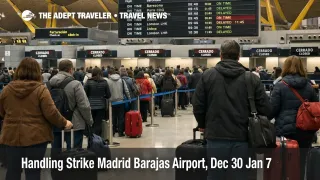
Ground handling staff at Adolfo Suárez Madrid Barajas Airport (MAD) are set to stage partial walkouts that can slow check in, baggage handling, and aircraft turnaround for flights served by the handling company South Europe Ground Services. Passengers are most exposed on December 30, 2025, plus January 2 and January 7, 2026, because the action hits peak holiday return flows and tight hub connections. Travelers should plan for longer airport processing times, build connection buffers, and be ready to switch to carry on only strategies or alternate routings if queues and turnaround delays start stacking.
The Madrid Barajas handling strike means you can see real delays even when flights are not canceled, because a late baggage offload, a slow refuel and pushback sequence, or delayed baggage transfer can break connections across the afternoon and evening departure banks. The published walkout windows are 800 a.m. to 1200 p.m. and 600 p.m. to 1000 p.m., Madrid time (CET), on each of the announced strike dates.
Who Is Affected
Aena says the handling company involved provides services to multiple airlines at Madrid Barajas, so the practical exposure depends on which airline is contracted for check in, baggage, and ramp services on your specific flight. If you are connecting through Madrid on separate tickets, your risk is higher because even a modest departure delay can erase your buffer and leave you unprotected if the onward segment closes.
Iberia Group travelers are a clear watch group during these windows because Madrid is the carrier's primary hub, and Iberia says its Madrid operations are located in Terminal 4, including flows between Terminal 4 and the Terminal 4 satellite for many long haul connections. If you have a same day long haul departure after an inbound short haul arrival, assume that baggage transfer time and gate changes can become the failure point.
Travelers who need special assistance should also plan conservatively. The Ministry resolution treats ground assistance, handling, and related airport services as essential for mobility, and it sets minimum service protections to keep part of the operation moving, but minimum services do not eliminate long lines or slower service rates at the counters and on the ramp.
What Travelers Should Do
Arrive earlier than you normally would for Madrid, and treat the morning and evening walkout windows as high friction periods for check in and baggage drop. If you can travel carry on only, do it, because baggage acceptance and delivery are the easiest places for small slowdowns to become big delays during handling disruptions.
Use a simple threshold for whether to wait or rebook. If your itinerary includes a tight Madrid connection, or a last flight of the day to your destination, shifting to a flight well outside the walkout windows, or moving travel to a non strike day, is often the safer play than hoping operations normalize in time. Iberia says some customers traveling on the affected dates may be offered changes, depending on booking channel and fare rules, so check your airline's advisory page before airport lines build.
Over the next 24 to 72 hours, monitor three things, your airline's flight status, your terminal level crowding when you arrive, and whether earlier departures are already running late, because those inbound delays are what typically poison later banks. If delays are accumulating, protect your onward plan by extending layovers, avoiding separate ticket chains through Madrid, and holding a backup ground option for short domestic legs where rail or coach is feasible.
How It Works
Ground handling is the set of airport services that makes a flight physically runnable, passenger check in and boarding support, baggage acceptance and sorting, baggage transfer for connections, ramp loading and unloading, and turnaround coordination that affects departure readiness. When a handling provider runs partial stoppages, the system impact often shows up as throughput collapse rather than a clean cancellation wave, counters move slower, baggage belts backlog, and aircraft sit waiting for steps, bags, and paperwork.
Minimum service rules are designed to keep essential mobility running, but they also imply uneven performance across flight types. For Madrid Barajas during this action, the Ministry resolution sets protections that, in effect, prioritize a larger share of flights for non peninsular domestic services, and a smaller protected share for international and many mainland domestic flights, which can translate into more aggressive retiming, reassignment, or consolidation decisions by airlines as they try to operate within constrained staffing. The knock on effects spread beyond the terminal, because late arrivals disrupt crew duty clocks and aircraft rotations, which then increases misconnects onto long haul departures, compresses hotel availability for stranded passengers, and pushes some travelers into rail and bus alternatives at the same time seats are tight for the holidays.
If you want a quick read on similar holiday week disruption dynamics tied to airport handling, see Spain Azul Handling Strikes Delay Baggage at Airports and Portugal Ground Handling Strike Called Off for New Year.