

Verona ATC Strike Risk To Disrupt Flights Jan 31, 2026
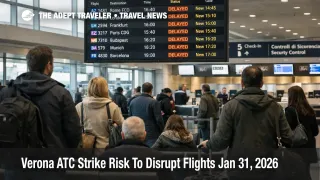
A potential air traffic control, ATC, disruption is now on the radar for Verona, Italy, after Italian strike listings flagged an ENAV action tied to Verona Villafranca Airport (VRN) on Saturday, January 31, 2026. Travelers flying into or out of Verona, plus anyone chaining VRN flights into separate ticket connections, rail, or timed ski and lake transfers, is most exposed. The practical move is to avoid tight mid afternoon plans, target earlier flying when possible, and line up a reroute path via nearby northern hubs in case delays build.
The Verona ATC strike risk could slow arrivals and departures at Verona Villafranca Airport (VRN) during a time boxed window, raising the odds of delays and late day itinerary breaks.
Strike calendars describe the action as a 4 hour stoppage involving ENAV personnel at Verona, listed for 100 p.m. to 500 p.m. Central European Time. Even when flights still operate, ATC staffing constraints can reduce arrival rates, force longer spacing, and create departure slot queues that push flights off their planned times. That matters at a leisure heavy airport like Verona because many itineraries are built around fixed check in times, shared transfers, and last train connections.
Who Is Affected
The first tier is anyone scheduled to depart or arrive at Verona Villafranca during the listed 100 p.m. to 500 p.m. CET window on January 31, 2026, especially travelers with checked bags, car rentals, and group transfers that do not wait. The second tier is anyone with a same day onward plan that assumes Verona will run on time, for example a late afternoon arrival that is supposed to connect to a timed shuttle into the Dolomites, a hotel check in window around Lake Garda, or an evening rail leg that becomes painful to replace once it is missed.
The third tier is network spillover. ATC delays do not stay neatly inside one airport's perimeter, because the aircraft that arrives late to Verona often leaves late to its next station, and that propagates through crew duty limits, turnaround sequencing, and downstream rotations. If an inbound aircraft is late from a hub, the easiest operational choice for an airline is sometimes to protect the next hub bound departure and sacrifice a thinner, point to point frequency later, which can strand leisure travelers when rebooking inventory is already tight on weekend patterns.
Finally, travelers who plan to pivot to nearby airports should expect friction on the ground layer. When passengers divert from Verona to Milan or Venice at short notice, it increases demand for rail seats, private transfers, and one way car rentals. That is the second order ripple that tends to get missed, flights can be rebooked, but last mile capacity can become the real constraint.
For related Italy disruption timing, see Italy Airport Strike Disrupts Flights January 9, 2026 and Italy Airport Strikes January 2026, Milan Flights at Risk.
What Travelers Should Do
If you are booked through Verona on January 31, 2026, start by stress testing your itinerary against a mid afternoon delay. If a 90 minute slip would cause you to miss a last train, lose a prepaid transfer, or arrive after a non flexible hotel check in cutoff, you should treat that as a rebooking trigger now, while seat inventory is still visible. In practice, earlier flights, and morning arrivals, are the cleanest risk reducer because they give the system time to recover before evening.
If you cannot move the flight, build buffers where the travel system actually breaks. That means padding the handoff between the flight and ground transport, choosing refundable transfers, and planning a backup night near Verona or near your alternate airport. For travelers headed to ski areas or lake towns, the expensive failures are usually the transfer and the first night, not the airfare itself, so protect those pieces with flexibility.
Over the final 24 to 72 hours before January 31, monitor three signals in parallel. First, airline app alerts for schedule retimes, pre cancellations, and waiver rules. Second, any airport or regulator notes that indicate reduced capacity, because ATC constraints can appear as air traffic flow restrictions even when the terminal looks normal. Third, recheck your alternate routing plan via Milan or Venice so you know exactly which airport and ground path you will switch to if your Verona flight starts sliding into the mid afternoon congestion.
How It Works
ENAV is the provider responsible for air navigation services in Italy, including the tower and approach functions that manage spacing, sequencing, and runway flow around an airport. When an ATC work action is listed, the practical effect for travelers is often capacity reduction rather than a total stop, meaning flights may still operate but with longer gaps, more holding, and departure slots that back up.
Italy's aviation strike framework also includes minimum service concepts administered through ENAC, including protected time bands of 700 a.m. to 1000 a.m. and 600 p.m. to 900 p.m. local time. Those protections help preserve baseline mobility, but they do not prevent the cascade effects that matter most to itineraries, because a delay created at 4:30 p.m. can still push an aircraft late into the evening, trigger crew legality issues, and break the last workable onward connection.
For northern Italy in winter, the disruption cost is amplified by geography and timing. When Verona slips, some passengers will reroute via Milan Malpensa Airport (MXP), Milan Linate Airport (LIN), Venice Marco Polo Airport (VCE), Il Caravaggio International Airport (BGY), or Bologna Guglielmo Marconi Airport (BLQ). That mode shift concentrates demand into a smaller set of airport rail links and highway corridors, which is why the second order impacts often show up as sold out trains, scarce last mile transfers, and unplanned hotel nights, even for travelers whose flights eventually operate.
Sources
- Dettaglio sciopero | Commissione di Garanzia (31/01/2026, ENAV Verona)
- Voli garantiti in caso di sciopero (ENAC)
- Scioperi aerei gennaio 2026: scioperano i controllori Enav (Missionline)
- Scioperi dei trasporti a gennaio 2026: il calendario completo (QualityTravel)
- Travel And Tour World coverage of Verona ENAV strike risk