

Spain Rail Strike To Disrupt Trains Feb 9 to 11
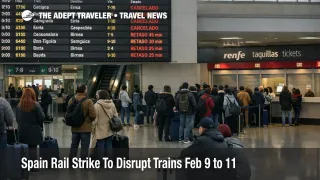
Spain's rail system is facing stacked reliability risk after another incident added pressure during a week of serious rail safety scrutiny. Travelers are most affected on intercity and commuter rail because disruptions tend to compound through inspections, precautionary speed limits, and crew availability issues. The practical move now is to treat February 9 to 11, 2026, as low confidence travel days on rail, build backups for city pairs, and avoid tight same day connections that depend on one specific train running on time.
The Spain rail strike Feb 9 increases the odds that long distance trains and regional feeders run on reduced timetables, pushing travelers to reroute, rebook, or add buffer nights to protect the rest of the trip.
This is an escalation beyond the earlier risk phase covered in Spain Rail Strike Risk After Adamuz, Barcelona Crashes, because there are now confirmed strike dates and an additional incident that can keep operations conservative even before the walkout.
Who Is Affected
Intercity travelers are the most exposed group because Spain's core corridors are built around timed, high demand banks that do not degrade gracefully when capacity drops. If you are traveling on Renfe long distance services, including AVE, Alvia, and Avant, or on private operators that rely on the same network paths, a reduction in staffed crews or operating slots can translate into outright cancellations, retimed departures, and hard to predict platform changes that break carefully planned itineraries.
Regional and commuter riders face a different failure mode that still hits tourists directly. City travelers often rely on Cercanías and Rodalies as the feeder layer to reach major stations, hotels, and airports on schedule. When those feeders thin out, the risk shifts from a late arrival to a missed departure, especially on mornings when station access, security checks, and boarding windows are tight. That is why travelers stitching together day trips, timed entries, and same day hotel check ins are just as vulnerable as long distance riders.
Air travelers also get pulled into the blast radius when rail reliability drops. When rail is not dependable, travelers substitute into short haul flights, taxis, and rideshares, which can increase curbside congestion and raise misconnect risk at Adolfo Suárez Madrid Barajas Airport (MAD) and Josep Tarradellas Barcelona El Prat Airport (BCN). Even if flights operate normally, airport access and rebooking competition can deteriorate quickly when rail passengers flood alternatives. This dynamic fits the broader winter pattern tracked in Europe Transport Strike Dates 2026 for Flights and Trains, where multi day disruption calendars reduce your same day escape options.
What Travelers Should Do
If your trip touches Spain rail on February 9 to 11, 2026, take action before operators and sellers get swamped. Move high stakes travel off those dates when you can, and when you cannot, add schedule slack by traveling earlier, booking a changeable backup, or placing a buffer hotel night near your departure station so a cancellation does not cascade into missed check ins, tours, or onward legs.
Use a clear decision threshold for rebooking versus waiting. If losing two to three hours would make you miss the last practical connection of the day, a cruise or tour start, a nonrefundable timed entry, or an international flight, treat that as a reroute trigger and switch modes or dates as soon as your operator confirms the strike handling plan. If your itinerary can absorb an overnight without major cost, you can wait longer, but only if you are not chaining multiple rail segments where one gap collapses the whole sequence.
Over the next 24 to 72 hours before you travel, monitor three channels in parallel: the operator notices for your specific route, your ticket specific alerts from your seller, and any publication of minimum service obligations and protected departures. Watch for the release of "servicios mínimos," the trains that remain protected, and any corridor level restrictions tied to inspections, because those details determine whether your specific plan has enough slack to survive day of changes.
Background
Rail disruption spreads through the travel system in overlapping waves, capacity loss at the source and recovery loss downstream. A strike reduces the available crew pool, dispatch capacity, and operating flexibility, which shows up as cancellations and retimed departures. When that happens on busy corridors, demand compresses into fewer remaining trains, and rebooking becomes a queueing problem rather than a simple timetable swap. The traveler experience then worsens even for trains that still run, because platforms crowd, boarding takes longer, and station services bottleneck.
The safety and incident layer makes this worse by lowering the network's appetite for risk. After serious incidents, operators and infrastructure managers often add inspections, apply precautionary speed restrictions, and enforce more conservative operating rules on affected segments. That can reduce throughput per hour even on non strike days, and it can create uneven knock on delays that break the predictability tourists rely on for timed entries and same day hotel moves. In practice, this is why a fresh incident in the same week matters to travelers, even if it is not on the exact city pair they plan to ride.
Second order ripples hit at least two other layers quickly. First, airports see mode shift pressure as travelers move from rail to short haul flights, adding crowding to check in, security, and rebooking lines, and raising transfer and curbside risk in Madrid and Barcelona. Second, roads and coaches take demand that normally rides rail, which can spike prices and sell out inventory on the Madrid to Barcelona, Madrid to Valencia, and Madrid to Andalusia corridors, while pushing up last minute hotel demand near major stations when people get stranded. The decision for travelers is less about whether some trains run, and more about whether the entire chain, station access, departures, and onward connections, still has enough slack to survive a late breaking cancellation.
Sources
- Spanish train drivers call three-day strike after deadly derailments
- Train collides with crane in Spain's fourth rail crash in a week, four injured
- Los maquinistas convocan huelga los días 9, 10 y 11 de febrero para exigir mayor seguridad ferroviaria
- Los maquinistas convocan huelga el 9, 10 y 11 de febrero para exigir medidas de seguridad ferroviaria
- Una grúa rompe el cristal del FEVE y deja seis heridos leves
- Los maquinistas convocan una huelga de tres días entre el 9 y el 11 de febrero tras los accidentes
- Spain's train drivers call nationwide strike after back-to-back fatal rail accidents