

Italy Airport Strike Feb 26, Flights Disruption Risk
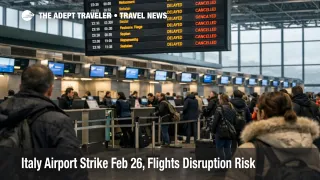
Italy's planned nationwide air transport strike was blocked for February 16, 2026, and reporting indicates the action has been moved to February 26, 2026. The travelers most affected are anyone flying within Italy, transiting Italy, or starting a long haul trip through Italy's hubs later this month. The practical move now is to stop treating February 16 as the nationwide failure day, then shift your risk planning to February 26, especially if your itinerary has tight connections, separate tickets, or a fixed arrival commitment.
The change matters because a blocked strike does not erase the underlying dispute, it relocates the disruption window into a date that many travelers will not be checking anymore. The earlier risk framing and airport list still help for planning, but the date is now different, and the late shift can concentrate rebooking pressure into fewer remaining February departures. Travelers who relied on the February 16 warning should treat February 26 as the new decision point, not as a footnote to the earlier plan.
For continuity on what was previously expected, and why Olympic period demand makes recovery harder, see Italy Feb 16 Air Strike, Flights Still at Risk.
Who Is Affected
Travelers touching northern hubs are exposed because Milan Malpensa International Airport (MXP) and Milan Linate Airport (LIN) sit in the Olympic corridor, and they absorb both event traffic and normal business demand. Long haul travelers are exposed because Leonardo da Vinci Fiumicino International Airport (FCO) concentrates widebody connectivity, and disruptions there tend to cascade into missed onward banks and limited same day reaccommodation. Northeast leisure and cruise adjacent travelers are exposed because Venice Marco Polo Airport (VCE) often acts as a gateway where even modest cancellations can break timed ground transfers.
Carrier exposure depends on which labor groups participate and which flights get protected, but reporting around the original February action cited ITA Airways, easyJet, and Vueling among impacted brands. Even when your airline is not the direct party, airport and handling slowdowns can still delay turnarounds, baggage delivery, and gate operations, which is why "my airline is not striking" is not a safe planning assumption for a nationwide air transport action.
Second order ripples are where travelers lose time and money. The first order hit starts at staffing and throughput, fewer open counters, slower ramp and turnaround services, longer queues, and a higher probability your aircraft or crew is out of position for the next leg. The second order effects show up in at least two other layers quickly, missed rail links and car transfers when flights arrive late into Milan or Rome, and hotel night shifts near hubs when cancellations force overnights and rooms get scarce. If you are also moving around northern Italy by rail for Olympic period itineraries, disruption stacking is a real risk, and Italy Olympic Rail Sabotage Risk on Lake Como Line is a reminder that reliability problems can compound across modes.
What Travelers Should Do
If you are booked on February 26, 2026, reduce fragility first. Move anything time fixed, such as cruise embarkation, weddings, ticketed events, or first night non refundable hotel stays, off February 26 if your fare rules allow it, and prioritize itineraries with fewer legs. If you cannot move the date, bias toward nonstop flights, earlier departures, and itineraries that do not require a same day onward transfer you cannot miss.
Set a hard decision threshold for waiting versus rebooking. If your itinerary includes a separate ticket connection, a last flight of the night, a tight long haul bank at Rome Fiumicino, or a must arrive by time commitment, waiting for "final clarity" is usually the losing bet, because the seats you will need disappear first when waivers open. If your trip is flexible, you can tolerate arriving later the same day or the next morning, and your airline lets you change without punitive costs, waiting can be rational, but only if you have a backup routing ready.
Over the next 24 to 72 hours, monitor the signals that change outcomes. Watch for airline specific waivers and fee free change windows, because those often matter more than the headline about a strike date shift. Check ENAC minimum service guidance and the protected time windows, which are typically 700 a.m. to 1000 a.m. and 600 p.m. to 900 p.m. local time, then look for airport specific passenger notices that clarify staffing expectations and recommended arrival buffers. Recheck your flight status the day before departure and again on the morning of travel, because late schedule adjustments are common when disruption risk is elevated.
Background
Italy's aviation strikes operate inside an essential services framework that tries to balance the right to strike with the public's right to mobility. In practice, that means minimum service rules and protected time windows during which flights should still operate, plus published guidance for passengers on how to confirm flight status with carriers and airports. ENAC, Italy's civil aviation authority, publishes strike related information including the protected windows, and sometimes lists guaranteed flights for specific strike days.
When a nationwide strike is blocked or shifted, travelers can misread it as cancellation of risk, but operationally it often becomes a rescheduling problem. Airlines and airports that had planned contingencies for one day must replan staffing, aircraft rotations, and reaccommodation for another day, and that can create turbulence even outside the exact strike hours. The knock on effects then propagate through connection banks, crew legality, and capacity limits, and they spill into hotels and ground transport because disrupted passengers tend to cluster near hubs. During Olympic period demand, the system has less spare capacity to absorb these shocks, which is why a moved date can still be a high impact date for travelers.