

Middle East Airspace Closures Ground Flights Feb 28
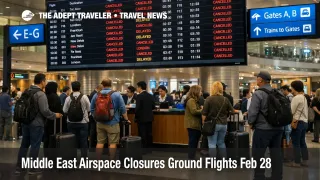
Middle East airspace closures on February 28, 2026, triggered a rapid pullback of commercial flying after U.S. and Israeli strikes on Iran, and Iranian retaliation, pushed multiple states to close or restrict airspace. The traveler facing consequence is immediate, large numbers of canceled departures, and broken connections through the region's busiest hubs, plus longer routings that may no longer be legal on crew duty time or practical on tight itineraries. For most travelers, the next best move is not waiting for normal schedules to return, it is deciding whether to rebook around the region now or pause travel until airlines publish stable operating plans.
Middle East Airspace Closures: What Changed
The Middle East airspace closures were visible in real time on February 28, 2026, as flight tracking showed aircraft avoiding Iran, Iraq, Israel, Kuwait, Bahrain, and nearby air corridors that normally carry Europe to Asia traffic. Several countries announced closures or partial closures, which effectively removed the shortest paths that airlines use to keep long haul banks on time and to protect hub connections. Airlines then responded the way they usually do in a fast moving conflict zone, they suspended services, canceled rotations, and rerouted remaining flights onto longer tracks that consume fuel and time, and can still be revised again with little notice.
Which Travelers Are Most Exposed Right Now
Travelers connecting through Gulf hubs are the most exposed, because a hub pause does not just cancel one flight, it breaks the entire connection bank that follows it, and then strands aircraft and crews away from their next day rotations. That first order failure is the canceled departure, and the second order failure is the inventory collapse that makes rebooking much harder for several days, even after partial reopening.
Israel bound and Israel connecting travelers face an additional constraint, many carriers cut service to Tel Aviv early, and the market often tightens quickly when a large share of flights is canceled. If a traveler is ticketed on separate tickets, the risk multiplies, because a missed long haul connection can become an uncovered loss on the onward airline, even when the original disruption was outside the traveler's control. This is why travelers should treat "protected on one ticket" as a core decision variable, not a small booking detail.
What Travelers Should Do Now
Start with a hard test, if your itinerary uses a Gulf hub connection, or transits near affected airspace, assume same day connections are fragile for the next 72 hours, and check for a carrier travel waiver before you travel to the airport. If your trip cannot tolerate an overnight, or missing a cruise embarkation, a timed tour, or a meeting start, the tradeoff usually favors rebooking earlier, even if it is less elegant, because the price and seat availability curve worsens as stranded passengers stack into fewer options.
Use airline announced suspension windows as your decision threshold. If your carrier has paused a route through a specific date, do not wait for day of operations to "see what happens," push for a protected reroute that avoids tight minimum connections, or take a refund and rebuild the itinerary around a different path. If you are on separate tickets, strongly favor refunds and a self reroute that restores slack, because you are the one holding the risk when connection protection is missing.
Over the next 24 to 72 hours, monitor three items, airspace reopening notices, your operating carrier's waiver terms, and your aircraft's inbound leg early in the day. If your reroute creates an unexpected transit or overnight in Israel after reopenings, keep documentation readiness aligned with the new path, and use a current entry guide rather than assumptions. Relevant internal references include Middle East Airspace Closures Halt Dubai, Doha Flights, Flight Delays and Airport Impacts: Feb 28, and Israel Entry Requirements For Tourists In 2026.
Why This Is Happening, and Why It Spreads Fast
This disruption spreads quickly because airspace is a hard constraint. When multiple adjacent countries close or restrict airspace, the remaining corridors concentrate traffic, flight times rise, fuel plans change, and the schedule becomes brittle enough that airlines often cancel rather than operate a chain of late arrivals that will still strand passengers downstream. Longer routings also increase exposure to crew duty time limits, which can turn a flight that technically can depart into a cancellation because it cannot be completed legally with the assigned crew.
Regulatory signaling matters, too. EASA published a conflict zone information bulletin for the Middle East and Persian Gulf after the February 28, 2026 strikes, which is a strong indicator that European operators, and many partners, will keep conservative routing, and service suspensions, in place until the risk picture stabilizes. Even after airports resume partial operations, recovery often lags because fleets and crews are scattered across alternates, and one day of hub stoppages can take several days to unwind across global rotations.