

Etihad Pauses Abu Dhabi Departures March 1, 2026
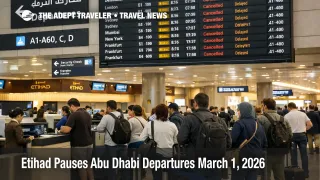
Etihad temporarily halted departures from Zayed International Airport (AUH) on March 1, 2026, creating an immediate connection and misconnect problem for travelers using Abu Dhabi as a hub. Etihad's operational update also stated that flights scheduled to arrive into Abu Dhabi before 2:00 p.m. local time were canceled, with later arrivals expected to operate only if conditions allowed. In practical terms, this turns normal connection planning into an irregular operations day where you should assume tighter banks will fail first, even when some flights still show as operating.
The key decision for travelers is whether you are trying to protect a same day onward connection, or whether you can tolerate an overnight and a reissued itinerary. If you are connecting onward through the Gulf region, this disruption layers on top of broader Middle East airspace constraints that have already forced hub pauses at Dubai International Airport (DXB) and Hamad International Airport (DOH), and those conditions can compress rerouting options quickly. For related context, see Middle East Airspace Closures Halt Dubai, Doha Flights and Doha, Dubai Hub Pauses Break Connections Feb 28.
Which Travelers Face The Most Disruption
Travelers with tight onward connections through Abu Dhabi are the highest risk group because a departure pause breaks the timed arrival and departure banks that make the hub work. When the bank breaks, the first order effect is missed connections and canceled departures. The second order effect is that aircraft and crews end up out of position, which can degrade schedules into March 2 even after operations partially resume.
Separate ticket itineraries are the most fragile. If your inbound flight is on one reservation and your onward flight is on another, the onward carrier can treat the missed flight as a no show, even if the disruption was outside your control. That can force you into a last minute replacement fare at exactly the moment inventory is tightening from mass reaccommodation demand across the region.
What Travelers Should Do Now
If you are due to depart AUH on March 1, 2026, treat the published pause window as a minimum, not a promise. The operationally safer move is to check your booking directly with Etihad, confirm whether your specific flight is still intended to operate, and avoid going to the airport until you have a current status update in hand. If you are still at home, update your contact details on your booking so you actually receive rebooking messages when schedules move.
Rebook now if you have a hard arrival deadline within 48 hours, if your itinerary depends on a tight connection, or if you are on separate tickets. Waiting can make sense only if your flight is still showing as operating, you can tolerate an overnight, and you can see multiple later options that still meet your real arrival requirement, not just your preferred arrival time. If you do rebook, prioritize fewer connections and routings that avoid the most constrained airspace corridors, because detours can create additional missed connections later in the trip.
For the next 24 to 72 hours, monitor three checkpoints, your booking in manage my trip, the airport operations advisories, and live flight movement for your route. A flight that boards can still divert or return to origin if airspace constraints tighten again, and that is the pattern that most often turns a normal connection into a forced overnight with baggage separation risk.
Why This Pause Spreads Into Missed Connections
Hub connections work because arrival and departure waves are timed, gates are assigned for flow, and minimum connection times assume predictable inbound arrival streams. When departures pause, the first layer of disruption is obvious, departures cancel, and inbound flights may be canceled or held, which immediately breaks the connection bank.
The second layer is recovery math. Even after a restart, the hub has to process a backlog with fewer usable gates, crews with duty time limits, and aircraft that may not be where the schedule expected them to be. That is why a time boxed pause can still create next day knock ons, especially on long haul rotations that require specific aircraft and rested crews.
The third layer is passenger reaccommodation pressure. When thousands of travelers are displaced at once, the remaining seats on competing carriers and alternate routings are consumed quickly, and the traveler with a flexible plan wins over the traveler who waits for the perfect itinerary. That is also why separate ticket travelers tend to pay the most, they are shopping in the worst part of the demand spike, without automatic protection.
Sources
- Regional Airspace Disruption, Operational Update (Etihad flight status page)
- Etihad suspends, cancels flights until 2pm tomorrow
- UAE temporarily, partially closes airspace as exceptional precautionary measure
- Abu Dhabi complex housing embassies damaged as retaliatory strikes widen in Gulf
- UAE airlines extend flight suspensions until Monday amid waves of Iranian missile strikes