

Middle East Airspace Closures Extend Into March 1
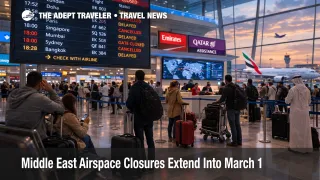
Middle East airspace closures rolled into a second day on March 1, 2026, with key Gulf transit airports still shut or heavily constrained, which keeps global itineraries routed through the region materially unreliable. Reuters reported that major hubs including Dubai and Doha remained shut or severely restricted for a second consecutive day, extending cancellations, diversions, and knock on disruptions into airline networks well beyond the region. Qatar Airways said flight operations to Doha remained temporarily suspended due to the closure of Qatari airspace, signaling that the restart hinges on government airspace reopening, not airline preference.
This is an update from the February 28 shock because it confirms the disruption is not a single day pause. The second day is where stranded passenger loads, scattered aircraft, and crew legality constraints start to harden into multi day schedule damage, even for travelers whose later flights never enter Middle East airspace.
Which Itineraries Are Most at Risk Right Now
The highest exposure group is travelers mid journey who are relying on same day connections through Dubai International Airport (DXB) or Hamad International Airport (DOH), especially those with short scheduled transits that normally work because these hubs run tightly banked connections. When hub operations pause, the first failure is straightforward, canceled departures and missed connections. The second failure is capacity, once a bank is missed, the next viable seat may not be the same day, particularly on long haul segments.
Travelers on separate tickets are still the most financially exposed. Even if the first disruption is outside your control, the onward carrier can treat you as a no show, which turns the problem into walk up fares, hotel nights, and sunk costs for tours, cruises, and timed entry bookings. If you are deciding whether to protect the itinerary or protect the fare, start by assuming that short connections through Gulf hubs are fragile until official reopening notices are in place and your operating carrier confirms a restart schedule.
For background on the initial shock and why hub pauses break tight connections, see Doha, Dubai Hub Pauses Break Connections Feb 28 and Middle East Airspace Closures Halt Dubai, Doha Flights.
What Travelers Should Do Now
Before you go to the airport, treat official airport and airline channels as the gating signal, not your original itinerary. Qatar Airways has tied its resumption to Qatar Civil Aviation Authority reopening decisions, so you want confirmation that airspace is open, plus confirmation that your specific flight is operating, not merely "scheduled." For Dubai, Dubai Airports issued an operational update during the disruption, and travelers should use that style of official airport guidance to avoid arriving into a closed or severely constrained terminal.
Decision thresholds matter because waiting can cost you the itinerary. If you have a cruise embarkation, a wedding, a timed tour, or a meeting you cannot miss, the practical move is to pivot away from Gulf hub connections while closure conditions persist, even if that means a longer routing. If your trip is flexible, waiting for waivers can be rational, but only if you set a deadline, for example, if you do not have a confirmed rebooking by the end of March 1, 2026, start actively rerouting rather than letting the queue decide.
Over the next 24 to 72 hours, watch three signals: which airspaces remain closed or constrained, whether hub airports are reopening fully or in limited waves, and whether your airline is restoring long haul flying in banks or only running recovery flights. Flight tracking summaries can help you understand what is open versus "technically open but not flowing," and they can also show whether detours are forcing fuel stops or pushing arrivals outside connection windows.
If your plan includes Israel entry or onward land crossings, keep your document plan ready because reroutes and diversions can change where you clear immigration or where you attempt to enter. The most practical baseline reference is Israel Entry Requirements For Tourists In 2026.
Why the Disruption Spreads Beyond the Middle East
Gulf hubs function as routing machines that compress long haul travel into banked connections. When multiple neighboring airspaces close at once, airlines either cancel, or they detour around the closure, and those detours add time, consume spare aircraft time, and push crews toward duty time limits. That is why a disruption that starts as a regional airspace problem can become a global schedule problem by day two, aircraft and crews end up out of position, recovery flights consume slots and gates, and the next day schedule loses slack.
The first order effect is continued cancellations and missed connections at the hubs. The second order effect is that reaccommodation capacity collapses because the same widebody aircraft that normally feed the banks are either grounded, rerouted, or stuck away from planned maintenance and crew rotations. Reuters described the compounding logistics challenge as crews and aircraft scattered, and airlines worked through an evolving closure picture.
Sources
- US-Iran conflict disrupts thousands flights as travel chaos deepens
- Dubai Airports issues operational updates following temporary airspace measure
- Update: Temporary Suspension of Qatar Airways Flights due to Qatari Airspace Closure
- Airspace closures following Israeli and US strikes on Iran
- Airspace closed, airlines halt flights as US, Israel attack Iran and Iran responds