

Worldwide Security Alert Flags Airspace, Hotel Risk
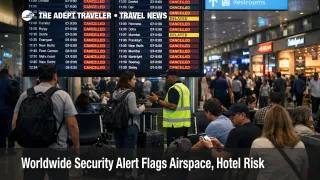
The U.S. State Department issued a worldwide security alert on February 28, 2026, advising Americans to exercise increased caution after U.S. combat operations in Iran. The alert explicitly warns that travelers may face disruptions from periodic airspace closures, and it directs Americans, especially in the Middle East, to follow the latest security messages from the nearest U.S. embassy or consulate. By March 1, 2026, some U.S. missions in the region were publishing shelter in place guidance, a signal that movement, transfers, and even routine hotel stays can become less predictable on short notice.
Worldwide Security Alert: What Changed
The key operational change for travelers is that this is no longer only an airline schedule story. It is a government level warning that elevated security conditions can travel with you across borders, and it is paired with a practical trigger that matters immediately, airspace can close, reopen, then close again as the situation evolves. That pattern is exactly what breaks tight connections, because even flights that operate can arrive late enough to miss onward banks, baggage may not follow, and reaccommodation inventory collapses quickly when multiple carriers reroute around the same corridors.
Separate reporting also indicates the escalation is reaching civilian infrastructure in ways that can touch traveler lodging choices. In Dubai, United Arab Emirates, Reuters reported debris from intercepted threats led to a small exterior fire at the Burj Al Arab, and it also reported an incident involving a hotel on Palm Jumeirah, alongside broader disruption at Dubai International Airport (DXB).
Which Travelers And Trips Are Most Exposed
The highest risk segment is anyone whose itinerary transits Gulf hubs or relies on short same day connections, including Europe to Asia routings that normally "thread the needle" through the region. If your trip is built on one protected connection you are still exposed to misconnect and overnight risk, but if you stitched together separate tickets you are exposed to losing protection entirely, because the second carrier can treat you as a no show even when the first disruption is outside your control.
Travelers staying in prominent hotels in the affected cities should treat lodging as part of the risk surface, not just flights. The Associated Press reported damage at the Crowne Plaza in Manama, Bahrain, with local authorities saying there were no casualties. Even if you are not in the immediate blast radius of any incident, the practical travel impact can be sudden road closures, slowed transfers, and intermittent service interruptions that turn a normal airport run into a missed departure.
For readers who were already tracking the aviation side of this escalation, the earlier breakdown in Middle East Airspace Closures Halt Dubai, Doha Flights remains the right starting point for understanding why hub itineraries fail so quickly once regional airspace starts to empty.
What Travelers Should Do Now
Treat the next 72 hours as a volatility window, even if your specific flight still shows "on time." If your routing touches the region, push your decision earlier than check in, because waivers, reroutes, and hotel availability are all meaningfully better before the next wave of cancellations strands more passengers. If your trip cannot tolerate an overnight, a missed cruise embarkation, or a fixed event start, the safer tradeoff is to rebook onto routings that avoid the region entirely, even if the path is longer or costs more.
Use a simple threshold. Rebook now if your itinerary depends on a tight hub connection, if you are on separate tickets, or if your airline is offering a free change, and you can move to a routing that avoids the highest risk airspace. Wait only if you have genuine date flexibility, and you can absorb a forced overnight without breaking the purpose of the trip. If you are currently in the region, follow the most recent embassy messaging for your location, and assume normal movement can change fast.
If you are accepting any reroute that changes entry timing or forces an unplanned overnight, make sure your document and entry plan matches the new path. For Israel related routings, Israel Entry Requirements For Tourists In 2026 is the fastest way to sanity check what a last minute itinerary change can do to your border and documentation assumptions.
Why Disruption Spreads Beyond Flights
Airspace is a hard dependency in the travel system. When carriers cannot use the shortest safe corridors, block times rise, crews time out, fuel planning changes, and aircraft end up parked in the wrong places. That means the second order effect is not just "today's cancellation," it is that tomorrow's schedule inherits missing aircraft and missing crews, so the recovery can lag even after partial reopenings.
The security alert layer matters because it changes how embassies, airports, hotels, and tour operators behave under uncertainty. Shelter in place guidance reduces routine movement, which can slow staffing, limit services, and increase friction at exactly the moments travelers need flexibility. Meanwhile, reports of hotel impacts in Dubai and Manama are a reminder that high profile properties can become part of the operational picture, whether through direct incidents, precautionary access controls, or sudden demand shifts as travelers relocate.