

Middle East Tours, Cruises Suspended Through March 5
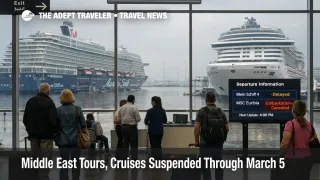
Middle East tours suspended is no longer just an airline schedule problem, it is a supplier shutdown problem. Major tour operators and cruise brands have paused or canceled Middle East programs into at least Thursday, March 5, 2026, which turns many trips into hard cancellations, extended hotel stays, or in port holds even if some flights resume unevenly. Reuters reported Germany's Dertour canceled trips to multiple Middle East countries through March 5, and TUI Cruises canceled several Arabian Gulf cruises scheduled between February 28 and March 5.
This matters now because the traveler decision set changes once a tour operator or cruise line suspends operations. When the supplier cancels, the next move becomes documentation, refunds, protected reaccommodation, and timing choices, rather than trying to salvage the original routing through a disrupted hub network. For the aviation backdrop that pushed this shift, see Middle East Airspace Closures Halt Dubai, Doha Flights and Worldwide Security Alert Flags Airspace, Hotel Risk.
Middle East Tours Suspended: What Changed For Travelers
The new development is the downstream response. Reuters reported Dertour canceled trips to destinations including the United Arab Emirates, Saudi Arabia, and Israel through March 5, citing urgent travel warnings, and said a low four digit number of customers were stranded with crisis teams supporting extended accommodations. In the cruise lane, Reuters reported TUI Cruises canceled several cruises scheduled between February 28 and March 5, with about 5,000 guests aboard Mein Schiff 4 and Mein Schiff 5 described as safe. Cruise Industry News separately reported TUI Cruises cancellations for departures from Dubai and Doha on February 28, March 1, and March 2.
For travelers, the operational consequence is a "do not depart" reality that can override your flight status. If your package tour departure is canceled, you may be placed into an extended hotel stay while the operator sources lift out, or you may be rerouted away from the region entirely. If you are on a Gulf cruise, the failure mode is often a canceled sailing, a shortened itinerary, or a ship held alongside while guidance and airspace access evolve. Seatrade Cruise News reported MSC Cruises canceled a scheduled regional cruise on MSC Euribia and that the ship remained alongside in Dubai.
Which Travelers Are Most Exposed Right Now
Package travelers departing in the window through March 5, 2026, are the most exposed because the operator controls the bundle, and a single weak link, airspace access, port access, or local movement guidance, can force the entire package to be canceled. This is especially true for trips that were built around Gulf hubs and short connections, because even partial reopenings can behave like irregular operations with rolling delays and misconnect risk. That is why the supplier decision to suspend programs is so material, it is effectively a forecast that the operator does not believe it can deliver the itinerary with acceptable duty of care in the near term.
Cruise guests in the Arabian Gulf face a different kind of exposure. When ships are held in port, the first order effect is that embarkation timing, port sequencing, and shore excursion delivery can break even if the ship itself is safe. The second order effect is repatriation and inventory pressure, passengers suddenly need hotel rooms, new flights out of alternates, and sometimes new passports, visas, or entry documentation if routing changes. That can ripple into higher walk up fares, scarce seats, and inconsistent baggage recovery, particularly for travelers who booked separate tickets to reach the ship.
Travelers with time fixed obligations, weddings, events, cruise embarkations, nonrefundable tours, are the group that should be least patient. If your trip cannot slide by a day or two, the main risk is not whether the situation improves, it is that the rebooking queue and seat inventory will make the decision for you, late, and expensively.
What Travelers Should Do Now
Start by treating this as a documentation and money protection workflow, not a social media monitoring exercise. Save the cancellation notice, the revised itinerary, and any written statement about refunds, free rebooking, hotel coverage, meals, and transfers. Screenshot flight statuses and cruise account pages that show the original plan and the change, and keep receipts for out of pocket hotels, transport, and meals, because reimbursement usually depends on proving both the cost and the reason it was unavoidable.
Next, pick a decision threshold, and write it down. If you are scheduled to depart by March 5 and your operator or cruise line has canceled, push immediately for the two concrete options that preserve leverage, a full refund route and a protected rebooking route, and ask for deadlines in writing. If you are being offered rebooking, ask what is actually covered, including airfare difference, hotel nights, transfers, and visa or document costs if the new routing crosses borders you did not plan. If you paid with a credit card and the supplier is not delivering what was sold, ask the supplier for a written confirmation of nonperformance, because that is useful if a dispute or chargeback becomes necessary. Do not chargeback as a first move if the supplier is actively offering a refund, but do not let weeks pass without a documented plan.
Finally, assume the exit routing may be messy, and plan for buffer. If you are stranded, prioritize leaving the region via whatever lift the operator can protect, rather than chasing the "perfect" itinerary on separate tickets. If you are repatriating independently, be conservative about tight connections, baggage transfer assumptions, and same day cruise or tour joins. If your reroute involves Israel, review Israel Entry Requirements For Tourists In 2026 before accepting a new path that could change where, and when, you clear immigration.
Why Supplier Suspensions Change The Whole Equation
Flights can restart while trips remain undeliverable because tour operators and cruise brands are not only moving people, they are also guaranteeing ground transport, hotels, excursions, staffing, and duty of care. When governments issue urgent warnings or guidance, suppliers often choose a conservative suspension because the operational risk is not a single flight cancelation, it is the inability to keep groups moving safely and predictably across multiple touchpoints.
The mechanism is compounding constraints. Airspace closures and rolling airport recovery reduce seat supply, which slows repatriation. When repatriation slows, hotels fill with forced extensions, and local transport and staffing plans break. On cruises, a port hold is a safety and guidance response, but it also freezes the itinerary, which breaks embarkation windows, shore excursions, and onward flights booked around the original disembarkation day. That is why "through March 5" is not just a date, it is a planning boundary that affects whether you should attempt to travel at all this week, or take the refund and rebuild later.
Germany's travel warning expansion, reported by Anadolu Agency, underscores why suppliers are pulling back broadly across the region rather than trying to operate around isolated hot spots. Reuters' reporting that the German travel association DRV cited around 30,000 holidaymakers from German tour companies as impacted helps quantify how quickly this has become a mass package travel problem, not a niche disruption.