

Jalisco Violence: Puerto Vallarta Travel Status
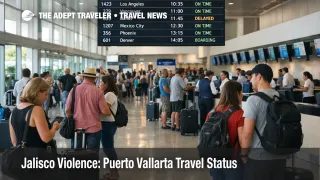
Travelers looking for a clean "open or closed" answer in Jalisco, Mexico are going to be disappointed. Puerto Vallarta is operating as a functioning resort and airport destination again, and airlines have been restoring schedules after the late February disruption, but the practical risk that remains is not runway access, it is road access and the speed at which conditions can tighten again if new incidents flare. The most decision useful framing on March 3, 2026 is that Puerto Vallarta is not broadly shut down, yet the state's security backdrop still changes how travelers should plan transfers, excursions, and any itinerary built on tight same day timing.
The U.S. Department of State's Mexico travel advisory continues to rate the State of Jalisco as "Reconsider travel" due to terrorism, crime, and kidnapping, while also stating there are no restrictions on travel for U.S. government employees in the Guadalajara metropolitan area and Puerto Vallarta, including neighboring Riviera Nayarit. That combination is exactly why headlines and lived experience can feel contradictory. Puerto Vallarta can be "permitted," and still not be "predictable," if the risk you actually care about is a highway disruption that breaks your airport ride, your tour pickup, or your ability to move between zones on a fixed clock.
Puerto Vallarta Travel Status: What Is Operating Now
Air travel is the clearest sign of normalization, because airlines tend to come back quickly once access routes and staffing stabilize, and once aircraft and crews are repositioned. Air Canada, for example, said it would resume full flight operations to Puerto Vallarta starting Tuesday, February 24, 2026, after suspending service during the immediate unrest window, and that kind of carrier level restart typically signals that the airport side is workable for routine passenger flows again.
For travelers, the more important nuance is that "the airport is open" is not the same as "your transfer is safe and reliable at any hour." During the disruption cycle that followed the February 22, 2026 security operation in Jalisco, the failure mode repeatedly described in credible reporting was roadblocks, vehicle fires, and sudden mobility constraints, not a long duration closure of terminals. In practical terms, that means you can have a confirmed flight and still lose the day if the ride to Licenciado Gustavo Díaz Ordaz International Airport (PVR) becomes the bottleneck.
In Puerto Vallarta itself, travelers should expect the core resort zone, hotel operations, and major visitor services to keep running, because that is the economic center of gravity. What changes is the margin for error. A trip that is mostly pool, beach, and walkable dining can feel normal again quickly. A trip that depends on long drives, multiple handoffs, or rigid appointment times is the one that still breaks first when security conditions wobble.
Which Jalisco Trips Still Carry The Most Risk
The most exposed itineraries are the ones that force you onto highways at specific times, or that depend on being able to move through greater Jalisco with no friction. The late February violence following the operation against cartel leadership included roadblocks and arson events across Jalisco and beyond, and Reuters' timeline coverage describes a retaliation pattern designed to disrupt mobility and project control. That style of disruption does not need to be constant to be trip breaking. It only needs to happen at the wrong hour on your route.
Cruise passengers and day trippers are a special risk category because they are time boxed. Port calls are discretionary for cruise lines, and even when a destination is not "closed," ships may substitute ports, add sea days, or limit the call if local movement feels uncertain. If Puerto Vallarta is a single port day on your loop, the real question is not whether you personally feel comfortable, it is whether your operator chooses to de risk the stop. Travelers planning around that should also read Puerto Vallarta Fallout, Cruise Calls Shift, Flights Normalize for the cruise and flight mechanics already observed this week.
Two more segments deserve blunt labeling. First, anyone planning inland drives, including mountain towns, daylong tours, or multi stop overland itineraries, because that increases exposure to the exact mobility disruptions used in retaliation cycles. Second, travelers connecting their Puerto Vallarta stay to Guadalajara, Mexico, for events, family visits, or onward flights, because Miguel Hidalgo y Costilla Guadalajara International Airport (GDL) being functional does not protect you from a bad road hour between zones.
What Travelers Should Do Before They Commit
Start by treating transfers as the gating item. If you are flying into Licenciado Gustavo Díaz Ordaz International Airport (PVR), plan arrival day as a buffer day, not a precision schedule day. Do not stack a long excursion, a pre paid activity with a hard start time, or a same day wedding style commitment immediately after arrival. The tradeoff is simple, you might "waste" a few hours of flexibility, but you greatly reduce the chance you lose the entire day to one disrupted road segment.
Use daytime movement as a default. Even when the destination feels normal, volatility is harder to manage at night because reroutes, detours, and communications get worse. If you must travel between zones, do it in daylight, keep your fuel and phone power conservative, and keep the plan simple with fewer handoffs.
Set a decision threshold for rebooking versus going. If your trip is a resort stay where you can stay mostly in a well traveled zone and you have flexibility, it can be rational to proceed while monitoring official advisories. If your trip depends on inland movement, tight same day timing, or a chain of prepaid components, the smarter move is often to rebook, or to redesign the itinerary so the high dependency pieces are refundable. If you need a broader framework for "risk without panic" trip triage across security stories this week, Worldwide Caution, Spring Break Travel, Advisors Urge Calm is the best internal reference.
Why Jalisco Can Feel Normal And Still Be High Friction
Jalisco's current traveler reality is best explained as a system problem, not a vibes problem. When major security operations hit cartel leadership, retaliation frequently targets movement and public perception, because those levers create immediate disruption without requiring a sustained battle for territory in tourist zones. Reuters describes a retaliation pattern after the February 22 operation that included roadblocks and vehicles set ablaze across multiple areas, and that is exactly the kind of disruption that breaks travel logistics faster than it breaks resort operations.
A second mechanism is information distortion. Associated Press reporting on disinformation after the killing describes how misleading, decontextualized, and sometimes manipulated content can inflate fear and confusion, which then changes traveler behavior and supplier decisions even when the on the ground footprint of an incident is limited. This matters because it can trigger airline and tour operator conservatism, and it can also cause travelers to make bad last minute moves, like rushing onto roads to "beat" rumored closures. The operational takeaway is to anchor decisions to official advisories and carrier notices, not viral clips.
Finally, advisories can look contradictory because they separate "permitted travel" from "recommended travel." The State Department's Mexico travel advisory explicitly rates the State of Jalisco at a higher caution level, while also stating there are no travel restrictions for U.S. government employees in Puerto Vallarta and the Guadalajara metropolitan area. That does not mean risk is absent. It means the specific restriction set is not triggered for those areas, while the broader risk assessment remains elevated at the state level. Travelers should read that as a planning instruction: keep your itinerary inside the most predictable corridors, reduce road dependence, and avoid building a trip that collapses if one transfer fails.
Sources
- Mexico Travel Advisory (U.S. Department of State)
- Air Canada to resume flights to Mexico's Puerto Vallarta from Tuesday (Reuters, February 24, 2026)
- Key events in Mexican operation to capture cartel leader 'El Mencho' (Reuters, February 23, 2026)
- Mexican drug lord killing sparks revenge attacks; cars and businesses set ablaze (Reuters, February 23, 2026)
- Online disinformation fueled panic after the killing of Mexico's most powerful drug lord (Associated Press)
- Shell shocked and tense: inside the Mexican tourist town where 'El Mencho' made his last stand (The Guardian, February 27, 2026)
- Guadalajara (Grupo Aeroportuario del Pacífico)
- Puerto Vallarta (Grupo Aeroportuario del Pacífico)