

Arabian Gulf Cruises Canceled, MSC and Celestyal
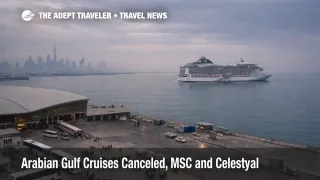
Arabian Gulf cruise cancellations have now extended to the rest of the winter season for both MSC Cruises and Celestyal Cruises, as the Iran, U.S. conflict keeps regional airspace, and port operations unstable. The immediate traveler problem is no longer just a missed sailing, it is the downstream logistics of getting off ships that are being held alongside, and then finding usable flight capacity out of the Gulf while airlines work through a backlog and prioritize departures by original travel date.
MSC says MSC Euribia remains in port in Dubai, United Arab Emirates, under guidance from regional authorities, and that the remaining three scheduled winter cruises have been officially canceled. Celestyal has also ended its remaining Arabian Gulf season sailings, with affected March departures from Doha, Qatar, and Dubai no longer operating.
For the broader operating picture driving these cruise disruptions, see Middle East Airspace Reopens, Closures Stay Fluid.
Who Faces the Biggest Disruption
The highest risk group is anyone currently onboard ships being held in port, or anyone scheduled to embark in the Gulf in the next two weeks. When ships cannot turn on schedule, the failure cascades fast, the next sailing cycle disappears, hotel nights and onward flights misalign, and rebooking inventory tightens because the same airspace constraints impacting cruise operations also thin flight schedules.
A second high exposure group is travelers with separate bookings, meaning cruise only fares, separately ticketed flights, and nonrefundable hotels. In that setup, the cruise line can refund the cruise, but your airline and hotel deadlines may not move with it, and misalignment can turn into no show penalties, missed connections, or expensive last minute one way tickets.
Finally, travelers whose itineraries rely on specific Gulf departure banks should assume timing risk even after a disembarkation plan is announced. MSC's own update emphasizes that airlines operating flights are prioritizing passengers by original flight date, which means travelers can be competing in a queue that is not based on who is standing at the counter first.
What Travelers Should Do Now
If you are currently onboard, treat this as an exit logistics problem first. Ask the cruise line for a written update that covers your disembarkation window, whether transfers and accommodation are provided, and how flight seats will be assigned, including whether you must take action to be manifested. Save screenshots of every message and change notice, because documentation is what determines whether you can escalate with airlines, insurers, or card issuers.
If you are booked on a canceled sailing, anchor your decision on a simple threshold: rebook now if you have a hard deadline (work, school, medical care), or if your trip is built on separate tickets and nonrefundable components. Waiting for more clarity can be rational only if you can absorb schedule drift, and if you have confirmed, in writing, what the operator is refunding and when. Celestyal's current guidance indicates support for onward arrangements and potential accommodation or transfers where required, but travelers still need to align that with their own airline obligations and deadlines.
Over the next 24 to 72 hours, monitor three signals, not social chatter. First, ship specific updates from your cruise line, because that is where disembarkation permission and transfer timing appear first. Second, airline advisories for the airports being discussed as exit nodes, especially Dubai International Airport (DXB), Abu Dhabi Zayed International Airport (AUH), and Muscat International Airport (MCT). Third, airspace status updates, because renewed restrictions can invalidate routings after you have already repositioned to an airport.
For a deeper explainer on the flight bottleneck that is now driving cruise outcomes, see Gulf Cruise Repatriation: MSC Eyes Charter Flights.
Why This Turns Into a Flight Seat Bottleneck
Cruise disruption in the Gulf spreads differently than a typical itinerary change because ships can be safe while passenger movement depends on authority permissions and aviation throughput. First order, ships remain alongside, and turnarounds fail, which cancels upcoming departures and strands future guests before they ever reach the region. Second order, the entire problem becomes seat allocation and corridor reliability, not simply rebooking, because limited flight resumptions prioritize clearing backlogs and operating within narrow, changeable airspace windows.
That is why MSC's focus on airline coordination, and the explicit exploration of charter flights from Dubai, Abu Dhabi, or Muscat, matters operationally. Charters can bypass thin commercial inventory, but they still depend on airport processing capacity, crew availability, and permissions that can change quickly. On the Celestyal side, the key constraint is similar, even with disembarkation plans expected within a defined window, travelers still need viable onward lift, and the lift is the scarce resource right now.