

Cyprus Travel Advisory Upgraded to Level 3
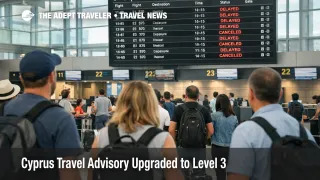
The U.S. State Department raised Cyprus to Level 3, "Reconsider Travel," dated March 3, 2026, even while noting there were no changes to the underlying risk indicators. The practical change is what the update signals for near term trip reliability, Cyprus is now being treated as exposed to spillover risk from the U.S. Iran conflict, and the State Department has also authorized non emergency U.S. government personnel and family members to depart the island due to safety risks.
For travelers, the advisory language matters because it pairs a higher caution level with an explicit warning about "armed conflict" risk and the reality that U.S. embassy assistance is limited in the area administered by Turkish Cypriot authorities. In the same advisory, the State Department points to significant disruption to commercial flights following the onset of hostilities on February 28, 2026, which is the mechanism that can turn a normal leisure trip into a rebooking problem fast, even if you are not planning to visit any conflict zone.
This also lands inside a broader Worldwide Caution issued February 28, 2026, which warns Americans about travel disruptions tied to periodic airspace closures. That is why Cyprus can move up the advisory ladder without a neat, Cyprus only trigger, the risk here is the travel system around Cyprus becoming less predictable, not necessarily a new day to day threat profile in resort areas.
Which Cyprus Trips Are Most Exposed Right Now
Trips with tight flight timing are the most exposed, especially itineraries that rely on same day connections, cruise embarkations, wedding schedules, or non refundable tour departures. When regional airspace constraints ripple, the first order pain is canceled or delayed flights and sudden schedule changes, and the second order pain is missed onward plans and expensive last minute lodging.
Travelers planning to move between the Republic of Cyprus controlled south and the northern area administered by Turkish Cypriots have an additional constraint, the State Department explicitly flags limited U.S. Embassy ability to assist in that area, and it also warns that entry or exit via Ercan Airport can create future complications with the Republic of Cyprus. That is not a theoretical issue, it is the kind of border and documentation friction that becomes acute if you need to reposition quickly during a transport disruption window.
Finally, the island's proximity to regional military assets is part of why the advisory is being framed as spillover risk. On March 2, 2026, Reuters reported a drone strike hit the UK's RAF Akrotiri base area in Cyprus, which underscores why authorities are treating the Eastern Mediterranean as operationally connected to the wider conflict.
What Travelers Should Do Before Departure
Start by deciding what you are optimizing for, cost, convenience, or itinerary certainty. If your trip has a hard start date, or you cannot tolerate a multi day slip, the decision threshold is simple, rebook to routings with more slack, consider shifting dates, or postpone until the advisory environment stabilizes and airline schedules are less fragile. If you are flexible and can absorb changes, you can keep the trip, but you should plan it like a disruption prone itinerary, not a normal Mediterranean week.
Enroll in the Smart Traveler Enrollment Program (STEP) before you depart, and keep your contact details current. STEP is the channel the State Department repeatedly uses to push security updates and reach travelers during fast moving situations, and it becomes more valuable when conditions change faster than airlines can reliably publish schedules.
Build a transport buffer that matches how disruptions actually show up. Avoid the last flight of the day into Cyprus, because a late cancellation is more likely to force an overnight. Keep your first 24 hours on the island light on prepaid, timed commitments, because that is the window where rebookings, delays, or diversions tend to compress plans. If you are already in the region and you need a broader view of assisted departure planning, this earlier coverage explains how U.S. evacuation logistics are evolving under rolling airspace closures: State Dept Plans Charter Flights for Americans in Mideast.
Why Cyprus Can Change Even Without New Local Risk Indicators
The State Department's own wording explains the core logic, Cyprus was raised to Level 3 with "no changes to the risk indicators," but with an updated summary to reflect changes to U.S. embassy operations and a regional risk frame tied to armed conflict and flight disruption. In other words, the lever is not only local crime, unrest, or infrastructure damage, it is the ability to move reliably, to get consular help where you are, and to leave if conditions deteriorate.
This is how the disruption spreads. First order, airspace restrictions and military activity can reduce flight options or force reroutes, which raises the odds of delays and cancellations. Second order, those schedule breaks stack into missed connections, seat scarcity, and higher rebooking costs, and they can also shift demand toward alternate hubs and longer routings. That propagation effect is why a leisure destination can be reclassified quickly, even if beaches and hotels are operating normally.
If you want the day by day operational picture of how corridor reopenings can still behave like stop start operations, this related read is the best baseline: Middle East Airspace Reopens, Closures Stay Fluid. The key takeaway for Cyprus bound travelers is that "open" in a nearby corridor does not automatically mean "stable" for your specific flight or connection.