

State Dept Plans Charter Flights for Americans in Mideast
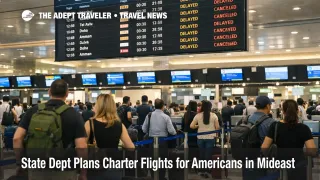
Americans stranded across the Middle East after U.S. and Israeli strikes on Iran are being told to expect a more organized assisted departure effort, but not a clean, predictable evacuation. Secretary of State Marco Rubio said Tuesday the State Department is "actively" implementing plans that include charter flights, potential military flight options, and expanded commercial capacity, while airspace closures continue to force aircraft to divert or turn back mid mission. Rubio said about 9,000 Americans had already departed, and about 1,500 were requesting help, as the department urged citizens to leave 14 countries including Israel, the United Arab Emirates, and Egypt.
State Department Charter Flights: What Changed for Travelers
The practical change is that the State Department is now publicly describing an "identified" set of charter and military options, plus "expanded commercial" options, rather than relying mainly on travelers to find scarce seats during rolling shutdowns. Rubio also described multiple attempts disrupted by sudden airspace closures, including cases where aircraft had to reverse course, which is a signal travelers should treat departure windows as conditional, even after they have a routing in hand.
This update also clarifies why the department is emphasizing alternatives beyond flying directly from the most stressed hubs. Rubio pointed to land routes into neighboring countries with operating airports as a potential release valve, because if an airport is attacked or the airspace is closed, flights can be "lined up" but still unable to land.
Which Travelers Are Most Likely to Need Assisted Departure
Travelers inside countries facing intermittent airport shutdowns, or fast moving airspace restrictions, are the most likely to end up in the "requesting help" category, even if their original tickets were valid. The highest risk group is anyone whose plan depends on a single constrained exit node, such as Tel Aviv Ben Gurion Airport (TLV), Dubai International Airport (DXB), or Kuwait International Airport (KWI), because short notice closures can erase same day rebooking inventory and strand passengers landside.
Cruise and tour travelers can be exposed in a different way, because an itinerary can become "operationally impossible" without being formally canceled far in advance. If your ship, tour operator, or airline has shifted to special movements and repatriation priority, your best option may be to align with the operator's managed process rather than trying to freelance a seat in a tightening market.
There is also a communications risk layer. Travelers have criticized early phone and embassy messaging that warned callers not to rely on the U.S. government for assisted departure "at this time," and reporting indicates that message later changed. That matters because it pushes travelers toward a simple operating assumption, official options can evolve quickly, but only if the department can actually reach you when a seat becomes real.
What Americans in the Region Should Do Now
Register in the Smart Traveler Enrollment Program (STEP) immediately, even if you think you can self book. STEP is the mechanism the State Department keeps pointing to for rapid outreach, and Rubio explicitly framed the problem as being able to contact people when options open. If you are already stuck, use official consular channels for your location and keep your phone reachable, because the operational failure mode Rubio described is not a lack of intent, it is that flights cannot legally land or safely operate when airspace status flips.
Use decision thresholds instead of waiting for perfect clarity. Rebook or reposition now if you have a hard deadline, you are on separate tickets, you are running low on lodging flexibility, or your departure airport has a recent pattern of closures. Waiting can make sense only if you have confirmed shelter, you can tolerate additional nights, and you have a verified path to be contacted and manifested if a charter seat becomes available.
If you are considering an overland move to catch flights from a neighboring country, treat the border as a real constraint, not a formality. You need to confirm entry rules, passport validity, and whether your nationality requires a visa, because a border refusal can leave you worse off than staying put with a stable hotel plan. For travelers weighing Jordan as an exit corridor, use this reference before moving: Jordan Entry Requirements For Tourists In 2026. If Oman becomes your best practical hinge point for onward flying, anchor on verified special flight eligibility first, not rumors at the terminal, and consider this operational context: Muscat Evacuation Flights Become Gulf Exit Hub.
Why Airspace Closures Keep Breaking Evacuation Plans
This is a corridor problem, not only a ticketing problem. When airspace closes, carriers and governments lose the ability to route aircraft safely and legally into the airports that would otherwise serve as evacuation nodes, which is why Rubio described planes turning back in flight and why "having airplanes ready" does not equal an evacuation pipeline.
The second order effect is that even partial reopenings can fail travelers. Limited operations typically prioritize repatriation flights, aircraft repositioning, and clearing stranded backlogs, which means normal commercial schedules can look like they are restarting while the system still cannot support large scale departures. That is also why land exits and "bigger airplanes with more seats" matter, they are attempts to move volume through fewer workable nodes when the network cannot rely on its normal hub structure.
Sources
- Secretary of State Marco Rubio Remarks to Press
- STEP, Smart Traveler Enrollment Program
- Crisis Response and Evacuations, Travel.State.gov
- State Department scrambles to help Americans stranded in Middle East war
- State Dept. scrambles to aid stranded Americans amid attacks, airport closures
- Middle East Airspace Closures Ground Gulf Hubs
- Muscat Evacuation Flights Become Gulf Exit Hub
- Jordan Entry Requirements For Tourists In 2026