

Israel Tourist Exit Help Adds Taba Shuttles, Virtual Desk
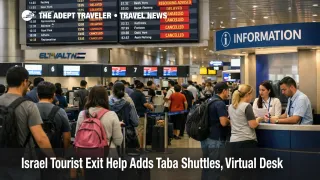
Israel's Ministry of Tourism says it has activated emergency procedures aimed at helping tourists currently in Israel reach home, as airlines rebuild schedules after the Israel Iran war disrupted regional flying. The practical change for travelers is that the ministry is pushing two "pressure valve" options at the same time: always on information support through its Virtual Tourist Office, and assistance identifying workable departure routes, including land borders when flying is constrained. The ministry's move matters because flight capacity and airport operating windows can lag far behind traveler demand after a security shock, which leaves many people needing a plan that does not depend on one specific flight operating.
Israel tourist evacuation help is now less about finding the perfect itinerary and more about reducing uncertainty and friction. If you are trying to depart in the next 24 to 72 hours, the immediate decision is whether you still have confirmed air uplift from Tel Aviv Ben Gurion Airport (TLV), or whether you should pivot to a land exit and build a new onward flight plan from a neighboring country. Reuters reporting in the past two days has described a limited restart environment, with airlines prioritizing displaced passengers and large numbers of travelers still stranded, which is exactly when overland exits become a mainstream option rather than a niche workaround.
Israel Tourist Evacuation Help: What Changed
The Israel Ministry of Tourism says it is operating its Virtual Tourist Office 24 hours a day, seven days a week, to provide official information and respond to tourist inquiries by digital channels. The government's service listing for the Virtual Tourist Office provides an email address, virtual@goisrael.gov.il, and a WhatsApp contact, +972-53-5835808, as well as a Facebook channel for the same office.
On the movement side, the ministry says it is helping tourists identify departure options, including land border crossings, and is operating shuttle services from central pick up points in Jerusalem, Israel, and Tel Aviv, Israel, to the Taba border crossing into Egypt. It has also described coordinated efforts to facilitate hotel accommodation for displaced individuals, working with industry partners and authorities, which signals that authorities expect irregular movement patterns to persist, not resolve in a single day.
Who Benefits Most From These Options
Independent travelers are the main beneficiaries of the Virtual Tourist Office, because it gives you a single official channel to confirm what is operating before you commit to a long transfer, a border crossing, or an expensive last minute flight. It is especially relevant if you are weighing a tradeoff between waiting for a flight from Tel Aviv Ben Gurion, versus repositioning south for a land exit, and then buying onward flying from Egypt.
Travelers who can physically reach Jerusalem or Tel Aviv pickup points benefit most from the ministry's shuttle concept, because the hardest part of an overland plan is often not the border itself. It is the ground layer, meaning reliable transport, predictable pickup logistics, and knowing what documents and timing constraints you face once you arrive. A shuttle does not remove border formalities, but it can compress the most failure prone part of the trip, getting to the crossing on time, with fewer "unknowns."
Tour group travelers are a separate category. The ministry's guidance, as described in travel trade reporting, is that tourist groups operate under the full responsibility of their Destination Management Company (DMC), which is expected to make the operational calls during wartime conditions, including which border crossing to use for onward movement to Jordan or Egypt, and how handoffs are coordinated with partners on the far side of the border. If you are in a group, this effectively changes your decision tree, your first call is usually your group leader or DMC point of contact, not a new booking site.
What Travelers Should Do Now
Start with confirmation, not hope. If you plan to fly out of Tel Aviv Ben Gurion Airport (TLV), your threshold should be direct confirmation from your airline that your specific flight is operating and that passenger processing is normal enough for your departure to be realistic. In the current environment described by Reuters, airlines have been prioritizing displaced passengers and using limited operating windows, which means published schedules can be a poor predictor of what actually moves.
If you need to leave within 24 to 72 hours and you do not have confirmed air uplift, treat the land exit as a serious option rather than a last resort. The ministry's shuttle to Taba is best understood as a friction reducer, it can make the overland plan simpler and more predictable, but you still need to plan the second half of the trip, onward flying from Egypt, potential overnight lodging, and extra buffer for document checks and congestion at the crossing.
If you are traveling with a tour group, align on one operating plan. The key risk in group situations is fragmented decision making, where some people rebook flights, others try a border exit, and the whole group loses its coordination. The ministry and DMC framing implies that continuity of services depends on the DMC coordinating both sides of the border, so your best move is usually to stay inside that plan unless you are separating from the group entirely.
Why Overland Exits Matter When Flights Are Limited
This situation is a classic recovery pipeline problem. First order effects show up as canceled or delayed departures and limited seat supply out of the main airport, because carriers must reposition aircraft, manage crew legality, and prioritize stranded passengers before selling freely to new demand. Second order effects then spread into the ground layer, with longer hotel stays, tighter room availability in key cities, and transfer bottlenecks as more travelers compete for the same vehicles and border processing capacity.
The Virtual Tourist Office and the shuttle plan are designed to address both layers. The office reduces information gaps, which is critical when operational changes happen faster than third party sites refresh. The shuttle reduces transfer uncertainty, which is often the part of the trip that breaks first when thousands of travelers pivot to the same exit. For travelers, the practical takeaway is that a "working" plan is usually the one with fewer handoffs and fewer assumptions, even if it is not the cheapest option.