

MSC Euribia Dubai: 5 Charter Flights for Guests
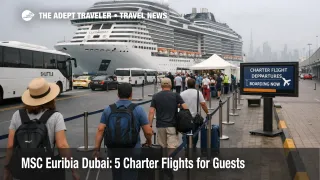
MSC Euribia charter flights are now a live repatriation pathway in Dubai, United Arab Emirates, and that is the meaningful change for stranded cruise passengers. On March 5, 2026, MSC Cruises said it launched a dedicated operation of five charter flights, with the first departure planned for March 5, and with close to 1,000 guests expected to leave the region by Saturday, March 7, 2026. This shifts the problem from vague reassurance to a controlled, seat managed exit plan, but it also confirms the hard reality, capacity is narrow, assignment is centralized, and not everyone moves at once.
This is also happening in the context of cruise season pullbacks across the Arabian Gulf. MSC has said it canceled its three remaining Gulf cruises for the season, and Celestyal has also ended its remaining sailings while its ships remain in the region. The operational question for travelers is no longer whether the sailing runs. It is whether you can get off the ship, get to an airport that is actually moving passengers, and secure a seat on a flight that will operate through shifting airspace constraints.
MSC Euribia Charter Flights: What Changed For Dubai Guests
MSC's update is unusually specific for an active disruption, five charter flights are now scheduled as a dedicated repatriation operation, and the timeline is short, through March 7, 2026. That specificity matters because it sets expectations about how movement will happen, in batches, and according to a managed process rather than open commercial booking.
It also clarifies what MSC is still doing in parallel. The cruise line said it is pursuing other pathways for remaining guests, including commercial flights, additional charters, and coordinated government assisted solutions. For travelers, that means you should not assume the five flights are the full solution. You should assume they are the first tranche, and that your outcome depends on how quickly additional lift becomes available, and how quickly airport operations normalize.
If you are trying to understand how this escalated from cancellations into extended port holds and repatriation logistics, Adept's prior coverage provides the setup and the earlier decision logic in Gulf Cruise Repatriation: MSC Eyes Charter Flights. For the broader season level cancellation context, see Arabian Gulf Cruises Canceled, MSC and Celestyal.
Which Travelers Are Most Exposed Right Now
The highest exposure group is passengers currently onboard MSC Euribia in Dubai, because even with charter flights announced, the constraint is throughput, not intent. A five flight operation can move meaningful numbers, but it still leaves a large population waiting for either later charters or workable commercial seats, and that waiting period is when travelers make expensive mistakes, missed deadlines, lost documentation, and poorly coordinated ground transfers.
The next exposure group is anyone booked on the now canceled MSC Gulf sailings, and anyone booked on Celestyal's remaining Gulf departures that are no longer operating. The core risk here is misalignment between what the cruise line refunds and what your separately booked flights, hotels, and tours will allow. Even when the cruise fare is refundable, your air ticket rules may not follow, and your hotel can still treat you as a no show.
A third exposure group is travelers planning to fly out of the region in the next several days, even if they are not on a cruise, because repatriation movements and irregular operations compete for the same scarce resources, airport staffing, processing capacity, and seat inventory. When airlines and authorities prioritize clearing backlogs, availability often becomes uneven by carrier and by departure corridor, and the practical effect is fewer reliable same day options.
What Travelers Should Do Now
If you are onboard MSC Euribia, treat this as an exit logistics problem first. Ask MSC for a written update that confirms whether you are assigned to a charter, what documentation is required at the handoff, where and when you will be transferred, and what happens to checked baggage. Do not rely on verbal updates alone. Save screenshots of every message, boarding instruction, and booking change, because documentation is what you will need for insurance, charge disputes, and airline follow up later.
Use a simple timing threshold to decide how hard to push for alternatives. Rebook aggressively if you have a fixed deadline, work, school, medical care, or a time locked family obligation, and accept that a less convenient routing can be the safer choice if it gets you onto an operating corridor sooner. If you can tolerate delay, waiting can be rational when the ship remains a stable accommodation, but only if you keep checking for hidden deadlines, passport validity, visa status, overstay rules, and any onward bookings that will penalize you as the calendar moves.
If you are affected by the Celestyal cancellations, assume that disembarkation sequencing, not onboard conditions, is the limiting factor. Celestyal has said guests will be advised of disembarkation plans within 24 to 48 hours, and that onboard teams will support onward arrangements, including transfers or accommodation where required. Your job is to align your own airline obligations with that window, contact your carrier about ticket flexibility, and avoid committing to tight onward connections until you have a confirmed departure time and a realistic airport processing plan.
Why Cruise Repatriation Turns Into A Flight Seat Bottleneck
Cruise disruptions in the Gulf spread differently than a typical itinerary change because ships can be safe while passenger movement depends on permissions, corridor reliability, and aviation capacity. First order, the ship remains alongside, and upcoming voyages get canceled or shortened because the turnaround cannot happen. Second order, the traveler problem becomes seat allocation, airport processing, and ground transfer reliability, especially when airports and airlines are already working through backlogs and operating under changing airspace constraints.
That is why the charter detail matters. Charters can bypass thin commercial inventory, but they still run into the same physical constraints, airport staffing, security processing, baggage handling, and the availability of aircraft and crew positioned to operate the route. The result is a managed queue, not an open market. Some travelers move quickly, others wait, and the difference is often driven by how the operator sequences guests, and by what departure corridors are actually open at the moment the flight is scheduled.
The practical takeaway is that travelers should plan around a moving window. Build buffer time, avoid tight onward connections, and do not treat a rumored flight as real until you have a written confirmation with a departure time and a clear handoff plan. In this kind of disruption, the traveler who stays organized, keeps documents ready, and aligns decisions to confirmed operating windows usually gets home faster than the traveler who chases every new rumor.
Sources
- Update on the Situation in the Middle East, MSC Euribia (MSC Cruises)
- German tour operators Dertour and TUI Cruises suspend Middle East trips (Reuters)
- MSC confirms charter flights to repatriate guests in the Middle East (PAX News)
- Your rights as Middle East cruises disrupted by US Iran war (The Independent)
- Over 150 Russian tourists stuck on cruise ship in Qatar as Middle East war rages (The Moscow Times)