

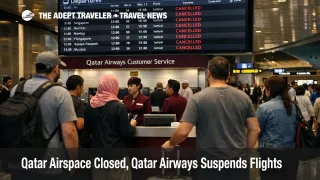
Qatar Airspace Closed, Qatar Airways Suspends Flights
Air France Paris New York flights are expanding for summer 2026, with the headline change being a stronger Paris Charles de Gaulle Airport (CDG) to Newark Liberty International Airport (EWR) schedule starting June 1, 2026, when Air France plans to operate up to two daily flights on the route. At the same time, Air France says it is rolling out complimentary high speed Wi Fi powered by Starlink across aircraft operating New York service, a tech upgrade that matters most on overnight returns and for travelers trying to work in transit. For travelers, the practical decision is simple, if you want more departure time choices than the typical midday pattern to Paris, France, Newark gets a second daily option, and it can reduce the odds that a single cancellation or misconnect collapses your day.
The wider New York schedule is also getting heavier. Air France says it will offer up to 11 daily flights between Paris Charles de Gaulle and the New York area in summer 2026, split between John F. Kennedy International Airport (JFK) and Newark. On the JFK side, Air France says it will run up to six daily flights, including Boeing 777 300ER flights equipped with the carrier's La Première cabin, and it highlights Delta Air Lines' additional flights within the transatlantic joint venture.
Air France Paris New York Flights: What Is New in Summer 2026
The most traveler relevant change is the Newark frequency increase. Air France says the Paris Charles de Gaulle to Newark route will be strengthened from June 1, 2026, with up to two daily flights, compared with one previously. For schedule planning, that is meaningful because it creates two separate departure banks, a midday departure from Paris and an evening departure from Paris, plus corresponding late afternoon and late night departures from Newark.
Air France also says the additional Newark frequency will be operated by Airbus A350 900 aircraft featuring the airline's latest cabins, including a Business class seat with a sliding door. That detail matters for travelers who care about consistency, because Air France is implicitly signaling that Newark is not just "extra capacity," it is positioned as a product forward option when the new cabin is available on the day you are flying.
For the New York region overall, Air France says summer 2026 service will reach up to 11 daily flights split across JFK and Newark. If you are trying to protect an itinerary with a meeting on arrival, or you are building a same day onward connection, more frequencies generally means more recovery options, but it does not eliminate irregular operations risk, it just gives you a bigger menu to rebook into.
Who Benefits Most From the Added Newark Frequency
The clearest winner is the traveler who values departure time flexibility more than airport preference. If you live in New Jersey, Manhattan's west side, or you are connecting to Amtrak at Newark, the second daily Newark flight can be the difference between "make it work" and "add a hotel night," especially on tight business schedules.
Business travelers also benefit because two daily departures allow a more realistic choice between a daytime or evening departure from Paris, France, and a late afternoon or late night return from Newark. Air France itself frames the second daily frequency as "flexibility" for both business and leisure customers, and that reads as an attempt to make Newark a viable default, not a niche alternative.
Leisure travelers benefit in a different way. When you are traveling with checked bags, kids, or fixed hotel check in windows, the cost of a schedule change is often not the flight itself, it is the knock on cost, the lost day, the extra night, the missed timed ticket. More daily frequencies can reduce the chance that you get stranded until the next morning, but only if you book a fare that preserves change and rebooking flexibility, and only if seats exist when disruptions happen.
There is also a small but real benefit for travelers who are sensitive to "single point of failure" routing. If you are trying to avoid a tight connection through another U.S. hub, a stronger nonstop menu from the New York area can reduce the need to stitch together fragile domestic connections before crossing the Atlantic.
How To Plan Around It and What To Do Next
If you are booking for summer 2026, the immediate action is to treat June 1, 2026, as the key date for the second Newark daily, then search for flight numbers and departure times that align with your risk tolerance. Air France published local time schedules for the Newark flights as AF0062 departing Paris at 1230 p.m. and arriving Newark at 245 p.m., with AF0063 returning at 505 p.m. and arriving Paris at 610 a.m. the next day. The second pair is AF0064 departing Paris at 745 p.m. and arriving Newark at 1000 p.m., with AF0065 returning at 1155 p.m. and arriving Paris at 110 p.m. the next day.
Your decision threshold should be based on what you are protecting. If you are protecting a same day onward connection in Europe, or a morning commitment in Paris, picking the return that arrives at 610 a.m. versus 110 p.m. can be the difference between "safe" and "too tight." If you are protecting sleep and want the latest possible departure from Newark, the 11:55 p.m. departure can be useful, but it also concentrates your risk into a late night window when rebooking alternatives may be thinner if something goes wrong.
For connectivity, Air France says its aircraft operating flights to and from New York are gradually being equipped with complimentary high speed Wi Fi powered by Starlink, and it has separately said the high speed Wi Fi rollout is planned across its fleet by the end of 2026. The practical move is to treat Wi Fi as a "nice to have," not a guarantee, then check your exact aircraft type close to departure, because the service is being installed progressively across the fleet, not flipped on everywhere overnight.
Finally, if you are traveling around the Cannes Lions Festival window, Air France says it will again operate special JFK to Nice Côte d'Azur Airport (NCE) flights in June 2026, and it ties those flights to the Cannes Lions event dates. That is a high demand period on the French Riviera, so the earlier you lock lodging and ground transport, the less you pay in last minute pricing.
Why This Expansion Matters and How the Upside Spreads
The mechanism here is capacity plus schedule shape. Adding a second daily frequency to Newark is not just "more seats," it is a second timing option, and timing is what breaks itineraries when something slips. First order, the added frequency gives travelers more choices for departure and arrival windows on both ends. Second order, it can reduce pressure on rebooking inventory after a cancellation, because there are simply more same day flights to funnel passengers into, even if not everyone gets their preferred cabin.
The Starlink Wi Fi piece matters because it changes how travelers value long haul time. When Wi Fi is reliably fast and free, the flight becomes usable work time for many travelers, which can influence whether they choose an earlier departure that protects a meeting, or a later departure that protects a day on the ground. It also changes disruption recovery behavior, because travelers can more easily rebook, message hotels, and manage connections while airborne, rather than waiting for the gate.
The Cannes Lions specials are a smaller but telling signal. Air France is effectively acknowledging that certain event weeks produce predictable demand spikes between the U.S. and Nice, France, and it is adding targeted lift rather than relying only on connections through Paris. The second order effect is that these flights can pull some demand off already crowded connecting paths, which can indirectly improve availability for travelers who still need to route through Paris.
For travelers, the best way to use this news is to be precise. Book around the June 1, 2026, Newark change if schedule flexibility is the point, confirm your aircraft type if the new Business class seat matters, and treat event week specials as a cue to lock plans early because the French Riviera will be expensive and full regardless.
Sources
Qatar Airways says its scheduled operations remain temporarily suspended because Qatari airspace is closed, which effectively takes Doha off the table for normal transits right now. What changed since prior coverage is the airline extended the suspension messaging on March 4, 2026, and set the next formal update for March 6 at 9:00 a.m. Doha time, a signal that this is still an airspace driven stop, not a short, local delay wave.
For travelers, the practical takeaway is simple. If your itinerary relies on Hamad International Airport (DOH) to connect onward in the next several days, treat it as non viable unless and until the Qatar Civil Aviation Authority announces a safe reopening and Qatar Airways restores published schedules.
Which Itineraries Are Most Exposed To Doha Disruption
The highest risk group is anyone ticketed to connect through Doha within the next 48 to 72 hours, especially on long haul routings where missing one bank of connections can push you into a next day departure because seat inventory is thin during irregular operations. The next tier is travelers on separate tickets, for example a Doha connection booked independently from an onward leg, because protections can break at the handoff and baggage may not follow cleanly when the operating carrier cancels the first coupon.
There is also a non obvious exposure group, passengers whose trips were not supposed to touch Qatar at all. When a major hub stops flowing, demand spills into other Gulf routings and into north and south detours, which can raise fares, compress connection times, and increase misconnect risk across the region. That spillover pattern is already being reflected in broader reporting about widespread Gulf airspace impacts and contingency movements.
What Travelers Should Do Now
First, stop waiting for social posts or third party chatter to validate your plan. Use primary sources, your operating carrier's status, and any rebooking waiver language, because those are the levers that determine whether you can move without penalty. Qatar Airways' travel alert says customers with confirmed bookings between February 28 and March 10, 2026, can change dates up to 14 days from the original travel date or request a refund of the unused value of the ticket, and it also notes long call waits, pushing most travelers toward self service where possible.
Second, reroute around Doha if your arrival time actually matters. The clean decision threshold is whether you can tolerate an overnight slip. If you have a hard start, for example a cruise embarkation, a tour departure, a family event, or a fixed work commitment, rebook now onto a routing that avoids Qatar entirely, even if it is longer, because reliability beats speed while airspace status is unresolved. If you have flexibility and multiple later options, waiting can be rational, but only if you can accept a multi day schedule change. The related guidance in State Dept Depart Now Alert Hits Gulf Hub Connections is a useful framework for making that call under uncertainty.
Third, treat baggage and airport logistics as part of the decision, not an afterthought. If you are already mid trip and a Doha connection has broken, prioritize confirming where your bag is physically located before you commit to a new routing, because bags can be held at an intermediate station, loaded onto a canceled onward plan, or require a landside claim depending on the airport and carrier handling decision. When you rebook, ask explicitly whether the new itinerary is protected as a through trip under one reservation, and whether your checked bag will be interlined or must be reclaimed and rechecked.
Why This Disruption Spreads Beyond Qatar
This is not just "one airline canceled flights." Doha works as a hub because it runs tightly banked connections, waves of arrivals, then waves of departures with short transfer windows. When the airspace closes, that banking stops instantly, and the network's aircraft and crews end up out of position for the next day's schedule. First order effects are cancellations and blocked connections through Doha. Second order effects are delays and cancellations far outside Qatar as aircraft rotations break and carriers squeeze into remaining corridors.
Independent tracking and operational reporting have also emphasized that Middle East airspace closures are commonly extended as NOTAM windows expire, which is why travelers should plan around the constraint rather than assuming a quick return to normal. For a broader view of how hub failures and corridor constraints ripple through airline networks, see Middle East Airspace Closures Ground Gulf Hubs, and for the deeper systems explanation of why capacity limits become binding during shock periods, see U.S. Air Traffic Control Privatization: Reality Check.
Sources
- Travel Alerts, Qatar Airways
- Qatar Airways Service Update: 03 March 2026, Qatar Airways Newsroom
- Airspace closures following Israeli and US strikes on Iran, Flightradar24 Blog
- UK will charter flights from Oman to evacuate Britons from region amid Iran strikes, The Guardian
- Airspace closed in six countries under U.S. departure advisory, The Washington Post
- Summer 2026: Air France strengthens its New York service
- Complimentary high-speed wifi now available on board Air France flights
- Air France launches free ultra-high-speed Wi-Fi on board all its aircraft
- Air France launches direct flights between Los Angeles, New York and the French Riviera
- Air France Boosts Paris-New York Routes for 2026