

State Dept Charter Flights Begin for Americans in Mideast
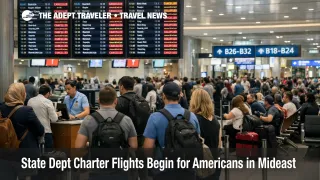
State Department charter flights Middle East: A U.S. government charter flight departed the region on March 4, 2026, as officials began moving from "find your own commercial seat" toward a more structured assisted departure effort for Americans caught in rolling airspace disruptions. This matters now because the commercial network is still uneven, with major hubs switching between closures, constrained reopenings, and heavy cancellation rates that can strand travelers even when an itinerary still shows "on time."
The confirmed change is that at least one charter flight is now operating, and more are being arranged. Reuters reported the State Department described facilitated charter flights from the United Arab Emirates, Saudi Arabia, and Jordan. ABC News reported the department also expected additional flights from the United Arab Emirates, Qatar, Saudi Arabia, and Israel. Travelers should treat those country lists as a sign of evolving routing rather than a promise that every listed departure point is reliably available at the moment they arrive at an airport.
The immediate travel reality is scarcity and volatility, not a clean "evacuation pipeline." A large share of scheduled flights to and from the region have been canceled since the conflict began, and even where airports resume partial operations, banks and connections do not behave normally. The practical traveler question is no longer only "Should I leave," it is "Which exit node can I reach, with documents, cash flow, and buffers, and which route still has a realistic seat."
What Changed for Travelers Seeking a Way Out
The charter flight departure on March 4, 2026, is a meaningful shift because it adds a second channel alongside commercial bookings. In normal disruption events, travelers can usually self rescue by buying a new ticket, switching airports, or rerouting through a nearby hub. In this event, airspace closures and intermittent airport access mean you can do everything "right," and still lose the flight at the last minute when routing becomes unsafe or prohibited.
This update also changes the timeline discipline travelers need. If you are trying to exit, the decision window is now tighter and more procedural. You need to be reachable through official channels, and you need to be prepared to move when a specific departure becomes real. If you wait for perfect clarity, you risk being overtaken by seat scarcity, or by a sudden closure that erases the inventory you were counting on.
Adept Traveler has been tracking how quickly official posture has been evolving in State Dept Plans Charter Flights for Americans in Mideast, and how the "which countries" list can change as the system tries to find workable corridors.
Which Travelers Are Most Exposed Right Now
The highest risk group is anyone whose itinerary depends on a single stressed hub, or on a tight connection through the Gulf or nearby corridors. If your trip uses separate tickets, you have a second layer of exposure, because a canceled inbound leg can strand you short of your departure point, and the onward airline may not protect you.
Travelers already in the region face the most immediate disruption because they are competing for a limited pool of seats, hotels, and ground transport at the same time as other governments run repatriation flights. If you are traveling for a hard deadline, for example a cruise embarkation, a tour start, a medical appointment, or a family event, your tolerance for "maybe tomorrow" should be close to zero.
Travelers not in the region, but connecting through it in the next 24 to 72 hours, are exposed in a different way. Even flights that operate can arrive outside their connection banks because routings are longer and gate capacity is strained, which raises missed connection rates and increases the odds of unplanned overnights. This is the scenario where early, proactive rerouting can save the itinerary.
For more context on the widening assisted departure concept and why some travelers benefit more than others, see Middle East Charter Flights Expand for U.S. Citizens.
What Travelers Should Do Now
If you are a U.S. citizen in the region and want to leave, treat this as a seat acquisition problem under uncertainty, not as a normal disruption where "show up early" solves it. Start with official registration and contact channels for your location, and keep your phone reachable. The failure mode in events like this is not just that seats are scarce, it is that the option can appear, then disappear, based on airspace status.
Rebook now if you have a hard deadline, if you are on separate tickets, if your lodging is fragile, or if your planned departure point has a recent pattern of closures or heavy cancellations. Waiting only makes sense if you have confirmed shelter, enough funds to absorb additional nights, and a realistic plan for being notified and moved when a departure opportunity becomes available.
If your best option is to reposition overland to a neighboring country with functioning flights, treat the border as a real constraint. You need to confirm entry rules, passport validity, visa requirements, and the practical ability to reach the crossing safely. If Jordan becomes part of your plan, use Jordan Entry Requirements For Tourists In 2026 as a starting point before you commit to ground movement, because a border refusal can turn a "smart reposition" into a worse stranding scenario.
For everyone, the buffer rule is simple. Assume multi hour variability on airport access, check in, and departures, and avoid tight same day connections. When you do buy a new routing, prioritize itineraries with fewer dependency points, and with longer legal connection times, even if they cost more.
Why Charters Help, but the Network Still Breaks
Charter flights can move blocks of passengers out of constrained areas, but they do not instantly normalize the system. The underlying mechanism is that airspace restrictions break the hub bank model that normally makes Middle East routings efficient. Gulf hubs typically work because inbound and outbound waves are tightly timed. When aircraft must detour around restricted corridors, arrival times drift, gate plans fail, crews time out, and connections collapse.
The first order effect is cancellations, diversions, and rolling airport closures. The second order effect is mispositioned aircraft and crews, swollen rebooking queues, and seat scarcity on alternate routes far outside the conflict zone. That is why travelers see global ripple delays even when their trip never touches the Middle East directly.
This is also why different sources can cite different "departure countries" for assisted flights at the same moment. As corridors open and close, the operation pivots to whatever node can safely move volume that day, which can include nearby countries that are functioning as transit points. Travelers should read the country list as a directional map of possible exit corridors, then verify the specific departure they are being offered before they start moving.
Sources
- US charter flight repatriating Americans from Middle East, State Department says (Reuters)
- Charter flights set to return stranded Americans as travelers scramble (ABC News)
- Governments scramble to bring citizens home during travel chaos caused by war in Middle East (AP via ABC)
- Travellers stranded, airlines under pressure as Iran war escalates (Al Jazeera)