

Middle East Charter Flights Expand for U.S. Citizens
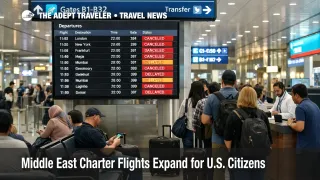
The U.S. State Department says it is facilitating charter flights from the United Arab Emirates, Saudi Arabia, and Jordan for U.S. citizens trying to leave the region after the Iran strikes and the resulting airspace disruptions. This matters right now because the commercial network is still operating unevenly, with major Gulf hubs running partial schedules and large cancellation rates that can strand travelers mid itinerary even if their original ticket still shows an active flight. If you are in the region, or you are connecting through it in the next 24 to 72 hours, the practical move is to plan around limited capacity, longer routings, and sudden airport or airspace status shifts, not around published timetables.
State Department Charter Flights: What Changed
This is a shift from "find any commercial option" to a hybrid model, where the State Department is both helping travelers book remaining commercial seats in countries where airlines are still flying and arranging charter capacity where commercial aviation is constrained. The department said it had handled calls from nearly 3,000 U.S. citizens in the Middle East, and it also pointed to efforts to move people overland to third countries when local airports do not have workable commercial options.
At the same time, airline operations in the Gulf are still not "normal," even when some flights resume. Travel reporting citing FlightAware data described exceptionally high cancellation shares at Dubai International Airport (DXB), including large portions of Emirates and flydubai schedules canceled, which is the operational reality travelers run into when they try to rebuild itineraries through Dubai on short notice.
Who Benefits Most From the New Exit Options
The travelers most likely to benefit are U.S. citizens who are already in the region, cannot find viable commercial seats at a reasonable price, or are stuck in a country where local departures are thin, unpredictable, or repeatedly interrupted. In practice, charter flights also matter for travelers who have already been displaced by diversions and missed connections, because a charter departure can be a faster way to reset back to a stable hub than waiting for your original airline's rebooking queue to unwind.
Jordan and the UAE are especially relevant decision points because they can function as practical gateways even when other corridors are constrained. If you are attempting to route out via Amman's Queen Alia International Airport (AMM) or Dubai, the key question is not whether there are "some flights," it is whether you can secure a confirmed seat on a specific departure that will actually operate, and whether you can reach that departure safely and legally given border, documentation, and ground transport constraints. Travelers with separate tickets are exposed twice, first to the risk of losing the inbound leg, and then to the risk that the onward leg will not protect them if schedules shift again.
For travelers not trying to exit the region, the main relevance is misconnect risk. When hubs operate on capped, irregular patterns, even flights that operate can arrive outside their bank windows, breaking onward connections across Europe, Asia, and Africa. That is why itineraries that look plausible on paper can still fail in the field, especially if they rely on one tight connection through Dubai, Abu Dhabi, or Amman.
What Travelers Should Do Now
If you are a U.S. citizen in the region and you want out, treat this as a seat acquisition problem under scarcity. Start with your nearest U.S. embassy or consulate guidance, and be ready to pivot between commercial seats and facilitated options depending on what is actually operating at your departure point. If you have not already enrolled in the Smart Traveler Enrollment Program (STEP), do that before you start moving, because the fastest operational updates tend to route through official channels when conditions change quickly.
Use a simple decision threshold for hubs that are still clearing backlogs. Rebook away from Gulf hub connections if your itinerary requires same day arrival for a cruise embarkation, a tour start, a wedding, medical care, or any hard appointment you cannot slip. Wait only if you can absorb a multi day delay and you have lodging, cash flow, and document flexibility to stay put while options reopen. For Dubai International, do not go to the terminal based on a screenshot or a stale schedule, go only when your airline has explicitly confirmed you are on an operating flight under current conditions.
For travelers routing through Jordan, review entry and transit requirements before you commit to a last minute reroute, because documentation and border procedures can be the hidden failure point when everyone is trying to reposition at once. Adept Traveler's guide, Jordan Entry Requirements For Tourists In 2026, is a useful starting reference for what documents and processes tend to matter at air and land crossings.
If you are not in the region yet but your ticket connects through it, act earlier than you normally would. The most reliable outcome right now is often a clean reroute that avoids a single point of failure. For context on how quickly this has been evolving in the Gulf hub system, travelers can review State Dept Depart Now Alert Hits Gulf Hub Connections and UAE Exceptional Flights Restart From Dubai and Abu Dhabi.
Why Airspace Disruption Keeps Stranding People
The mechanism is a combination of airspace constraints and hub banking. Gulf hubs normally work because inbound and outbound waves are tightly timed, which compresses long haul itineraries into short connections. When airspace closes, or when airports run under capped "exceptional" conditions, those banks break. The first order effect is cancellations and diversions. The second order effect is that aircraft and crews end up out of position, rebooking queues swell, and seats disappear on alternative routings, even for travelers far from the immediate conflict zone.
Charter flights help, but they do not magically normalize the system. They are a pressure release valve for people who cannot find commercial seats, and they can move blocks of passengers to safer, higher capacity nodes. The tradeoff is that charters tend to operate on evolving eligibility, timing, and coordination rules, and travelers still have to solve the "how do I reach the departure point" problem, which can include ground transportation, border formalities, and real time security conditions.
Sources
- State Department scrambles to help Americans stranded in Middle East war, ABC News
- Stranded travelers clamor for flights out of the Middle East, AP News
- US says it is facilitating Mideast charter flights for Americans amid criticism over Iran, Reuters
- State Department says it is arranging charter flights for stranded U.S. citizens, Travel Weekly