

Dubai Airport Flights Halted After March 7 Blast
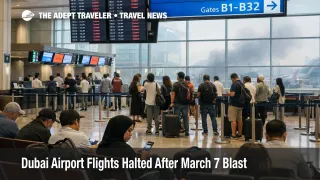
Dubai airport flight suspension became a traveler movement problem again on March 7, 2026, after flights were briefly halted and only a partial restart followed at Dubai International Airport (DXB) and Dubai World Central, Al Maktoum International Airport (DWC). Dubai Airports and Emirates both say operations are running only in a limited way, and travelers should not go to either airport unless their airline has confirmed the flight. For most stranded passengers, the practical rule is now tighter than a normal disruption day, move only if the booking chain is real, and shelter in place if local warnings sound.
This is an update story because the new fact is not simply that Dubai faced another security shock, it is that the hub briefly stopped, then reopened only selectively. Reports from the scene said passengers were moved into train tunnels after the alert, and video circulated showing smoke near the airport area, but officials have not publicly confirmed the exact blast point at the airport or detailed any direct terminal damage. That distinction matters for travelers, because the operational advice is firm even while some incident details remain unresolved.
Dubai Airport Flight Suspension: What Changed
What changed on March 7 is that Dubai moved from broad disruption into a controlled restart. Dubai Airports says some flights are operating from DXB and DWC, but schedules remain fluid and travelers should stay away unless their airline has confirmed the flight. Emirates says it is operating a reduced schedule after the partial reopening of regional airspace, and that transit passengers in Dubai will only be accepted if the onward flight is also operating.
That means travelers should not read resumed flying as a normal airport reopening. A partial restart is still a rationed system. The airport may be open enough to process some confirmed passengers, but not open enough to absorb hopeful standby attempts, split ticket improvisation, or same day airport runs without airline protection. In practice, the change is from blanket shutdown logic to selective clearance logic.
Which Travelers Face the Most Risk
The strongest fit for movement is the traveler with a confirmed March 7 departure from Dubai and, if connecting, a confirmed onward itinerary on an operating flight. That passenger now has a credible reason to move, especially if the airline has already contacted them. Travelers in that group should still recheck status before leaving for the airport, because both airport and airline messaging say schedules continue to change.
The weaker fit is everyone else, especially travelers on split tickets, those waiting on reissue requests, and those assuming airport staff can fix an incomplete trip chain at the terminal. The U.K. Foreign, Commonwealth & Development Office, or FCDO, is still advising against all but essential travel to the United Arab Emirates and says travelers should follow local instructions, avoid security and military areas, and shelter indoors when warned because the main immediate danger can come from falling debris after intercepts. That makes a speculative airport trip harder to justify than on a normal irregular operations day.
Travelers already using Adept's earlier coverage, Emirates Dubai Restart: Confirmed Flyers Only March 7 and UAE Shelter In Place Rules Reshape Exit Planning, should now combine those two ideas instead of treating them as separate stories. Dubai is usable for some passengers again, but the ground movement threshold inside the UAE is still higher than normal.
What Travelers Should Do Now
Start with proof, not optimism. Check the airline app, confirm the exact departure is operating, confirm every onward segment if you are connecting, and look for direct airline contact before leaving your hotel or residence. If any leg is still missing, canceled, or unconfirmed, the safer move is usually to stay put and wait for a protected solution rather than turning a booking problem into an airport access problem.
Build more buffer than you would for a standard departure. Even confirmed passengers should expect extra friction around access, re-screening, queue management, and connection handling while Dubai processes a reduced schedule. If authorities issue another warning while you are still landside, shelter guidance takes priority over itinerary ambition. The FCDO's current language is explicit that the safest place during an alert is inside a secure structure, preferably in an interior stairwell or a room with fewer external walls or windows.
Over the next 24 to 72 hours, the three useful signals are simple. Watch whether Emirates expands beyond the current reduced schedule, whether Dubai Airports broadens public access beyond airline-confirmed travelers, and whether official guidance in the UAE shifts again. Until those signals improve, the right decision threshold is strict: move for a confirmed departure chain, wait if the trip still depends on airport improvisation, and keep the Dubai airport flight suspension in mind as an operating condition even after flights begin moving again.
Why the Disruption Still Spreads Through Travel
The mechanism is straightforward. When a major hub restarts before the wider security environment is stable, the airport stops behaving like an open marketplace and starts behaving like a gated recovery point. Some aircraft can depart, but every weak link still matters more than usual, airport access, check in throughput, baggage acceptance, connection timing, and the status of onward sectors. That is why Emirates is focusing so heavily on confirmed bookings and confirmed onward flights.
First order, the March 7 disruption paused departures and forced travelers at DXB into a sheltering posture during the alert window, according to scene reporting. Second order, the selective restart raises the cost of bad timing. Travelers can burn hotel nights, miss protected connections, or get stranded landside if they move before the itinerary is fully rebuilt. In other words, the issue is no longer whether any plane can leave Dubai, it is whether your specific trip can survive the Dubai airport flight suspension without breaking at the next step.