

Dubai MSC Euribia Repatriation Tops 1,500 Guests
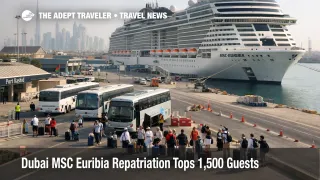
MSC Euribia repatriation in Dubai, United Arab Emirates, is now a measurable airlift rather than a vague promise. MSC Cruises said on March 6, 2026, that it had organized flights for more than 1,500 guests who were aboard MSC Euribia, and that seven flights carrying its guests had already departed the region. For stranded cruise passengers, this changes the practical question from whether MSC can move people at all to how quickly remaining guests can be assigned seats, moved off the ship, and routed home through a still constrained Gulf air network. Travelers still waiting should treat this as a managed, priority based exit process, not as a sign that normal Dubai air capacity has returned.
This is a meaningful update from Adept Traveler's March 5 coverage, when MSC said it had launched a five charter flight operation with close to 1,000 guests expected to leave by Saturday, March 7, 2026. The new figures show that throughput has expanded beyond that first tranche, and that MSC is now using a mix of dedicated charters, seats secured with Emirates and flydubai, and some government organized flights.
MSC Euribia Repatriation: What Changed In Dubai
The main confirmed change is volume. MSC Cruises now says more than 1,500 guests have had flights organized, with seven flights already departed as of the company's March 6 update at 2:00 p.m. CET. The line also said guests have been repatriated to the United Kingdom, Italy, Germany, Spain, the United States, and Brazil, which gives travelers and advisors a much clearer picture of where the operation is actually sending people.
That matters because cruise disruptions become more expensive the longer they stay abstract. Once repatriation moves from "we are exploring options" to named channels and visible throughput, passengers can better judge whether to keep waiting within the cruise line's process or start planning around a longer hold. It also shows that Dubai is functioning as a constrained extraction point, not a fully restored cruise and air gateway. Reuters has separately reported that reduced regional air capacity and repatriation flying across the Gulf are still competing for scarce seats.
For readers catching up, Adept Traveler previously tracked the first flight phase in MSC Euribia Dubai: 5 Charter Flights for Guests, and the wider Gulf cruise shutdown in Arabian Gulf Cruises Canceled, MSC and Celestyal.
Which Travelers Still Face The Most Pressure
The guests in the hardest spot are the ones still aboard or still awaiting confirmed onward passage. MSC's latest statement says some guests remain on the ship, even after the seven departures, which means the bottleneck has shifted from intent to remaining capacity, assignment order, airport transfer timing, and the ability to match passengers to workable destinations.
There is also a second exposure group, travelers not connected to the ship at all. Every charter seat, every block of scheduled seats taken by cruise recovery, and every government organized departure absorbs capacity that might otherwise have gone to other stranded passengers in Dubai or nearby Gulf markets. In a normal system, that competition would be manageable. In a stressed system, it can raise fares, delay rebooking, and leave non cruise travelers chasing thinner same day inventory.
For advisors, the practical lesson is that "Dubai is open" is the wrong frame. The better frame is that Dubai is moving people selectively, through mixed channels, with different priority rules and uneven visibility. That is why cruise guests may get home faster than an unrelated stranded traveler trying to buy a fresh ticket on the open market.
What Travelers Should Do Now
If you are an MSC Euribia guest still waiting, stay inside MSC's contact chain and do not assume you can improve your outcome by self dispatching to the airport without a confirmed seat. The repatriation system is now clearly functioning, but it is functioning as a controlled movement pipeline. Passengers who leave that process too early risk losing coordinated transfers, duplicating costs, or getting stuck in a terminal without a usable departure.
Rebook independently only if you have a hard deadline, a confirmed alternative seat, and clarity on baggage, transfers, and reimbursement rules. Waiting makes more sense if MSC has you in an active assistance flow and your destination aligns with one of the markets already being served. The decision threshold is simple, if your independent option is firm and materially sooner, it may be worth taking. If it depends on speculative inventory in a still distorted Dubai market, it may not actually beat the cruise line's managed exit plan.
Over the next 24 to 72 hours, watch for three things, whether MSC reports additional flight batches, whether Dubai based carriers keep adding workable seats, and whether broader Gulf corridor stability improves or worsens. Those three variables will decide whether remaining guests clear steadily or whether the last group onboard faces a slower tail of hotel, transfer, and onward connection problems.
Why The Dubai Cruise Exit Is Still A Capacity Story
The mechanism here is straightforward. A cruise line can solve part of a stranding event by buying or organizing lift in blocks, but that does not repair the underlying air network. MSC's use of charters, scheduled Emirates and flydubai seats, and government organized flights shows that it is patching together every viable channel, because no single channel has enough slack to clear everyone quickly on its own.
The first order effect is positive, more passengers are leaving the region. The second order effect is pressure, because those departures compete with broader repatriation demand, distort commercial seat availability, and keep airport and transfer logistics tense even when flights are technically operating. That matters for Dubai hotels, cruise terminal transfers, airport processing times, and onward connections at destination airports receiving late, unevenly timed arrivals.
This is also why the MSC update matters beyond one ship. It is evidence that cruise recovery in the Gulf is moving from ad hoc reassurance toward measurable throughput, but it is still doing so inside a stressed regional transport system. For travelers, the takeaway is not that the crisis is over. It is that one of the more visible stranded groups now has a clearer exit channel, while everyone else in the same Dubai airspace ecosystem still feels the squeeze.
Sources
- Update on the Situation in the Middle East, March 6, 2026, MSC Cruises
- More repatriation flights as Middle East airspace closure strands thousands, Reuters
- Everyone cheered, stranded Gulf travellers gamble on their route home, Reuters
- Airline, travel industries scramble with fallout from Middle Eastern conflict, Reuters